
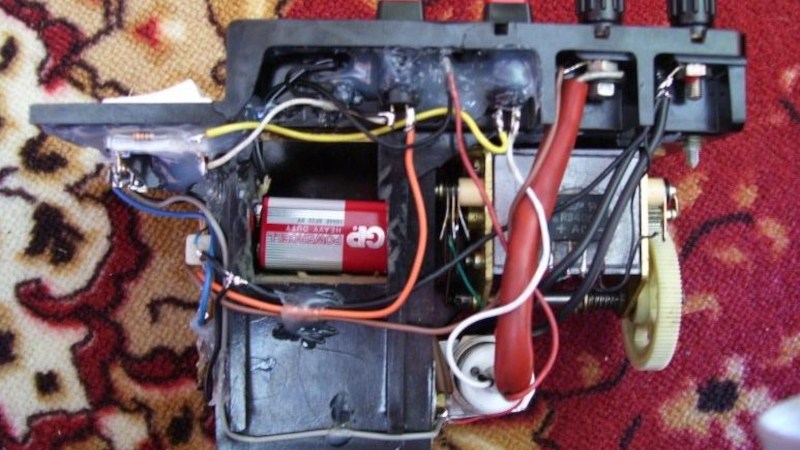
A pyrotechnic charge is set off by passing a high voltage through a filament within it, melting the filament and igniting the charge. We could think of a variety of circuits that could do this, but perhaps we wouldn’t have come up with [Michał Słomkowski]’s solution. He’s used the ringer crank generator from an old military field telephone. It’s an old project he’s shared with us due to its recent republishing on his website.
The basic principle is simple enough, winding the generator charges a capacitor bank through a bridge rectifier. Then a thyristor is used as the trigger device, dumping the contents of the capacitor into the filament. But the full circuit has a couple of refinements. There’s a charge indicator circuit using a couple of Zener diodes and an LED, and a filament tester which passes a non-triggering current through the filament from a 9 volt battery. We like the use of an over-the-top high-current thyristor, no doubt what he had in his junk box.
Perhaps it’s a symbol of how far technology has moved, that today it’s surprisingly rare to find a bridge rectifier or a thyristor, and building this device today would involve a microcontroller and probably an AliExpress inverter module as a matter of course.
Meanwhile, should field telephones interest you, we’ve been there before.











Thyristors are not rare – and you can use triacs which are used in all kinds of light dimmer/motor controller circuits. But… be aware of all the modes of dv/dt ignition with thyristors, in application like this it could get someone hurt!
Bridge rectifiers are also not rare. I see them all the time. Big standard if anything.
I’ve had to replace bridge rectifiers in cheap Black and Decker corded lawn mowers, until I finally gave up on the really low-quality of them and switched to a bettery-powered mower by a reputable company.
You got that far before giving up?
The first line…. The first line….
That’s why you don’t use semiconductors. Use two relays in series with the contact moving direction 90 degrees apart, so dropping the box may not trigger the explosion by contact inertia.
Well hold on now, I really think those pyros ought to buy me dinner first at least
How is this different from igniting an Estes model rocket with a store-bought battery as a kid?
The Estes launch systems just use the current from a PP3. This appears to change a capacitor bank for a bigger current pulse. Depending on what he’s setting off, that’s probably important.
In my day it was just a battery, I used the big 6v flashlight battery, similar in size to a Coke can hooked up directly to the little nichrome wire with some blue flammable stuff on it.
I really like those TNT detonators with the T handles that you see in old cartoons. What do they use? Some sort of piezo?
A piezo would not produce enough current i suppose. The old detonators work via a rack and pinion mechanism that spins a magneto, there were also versions that had a rotary handle instead of the T-handle.
https://en.wikipedia.org/wiki/Blasting_machine
Acme produced a lot of these for their favorite customer, Wile E. Coyote.
I’ve seen them with both a plunger and a crank. It seems the crank is used to ring a bell, while the plunger does the actual voltageproducing.
The T handle is the rack on a rack-and-pinion, which spun up a generator via a clutch pawl when you push it down. The generator spins up into an open circuit, storing kinetic energy. When the handle bottoms out, the pawl/clutch lets the generator armature keeps spinning, and producing voltage. When the handle bottoms out, it closes the contactor at the bottom, connecting said generator to the output terminals and off to the blasting caps. The stored kinetic energy from the spinning armature gets converted into electrical power (voltage * current) at that moment.
Obviously archaic, not used any more.
Hogan’s Heroes did it first…
Got older version, probably torn out from railway phone like one below:
https://telesfor.org/wp-content/uploads/photo-gallery/MB-56-BS_004.jpg
In my early career (40+ years ago) I repaired blasting machines for ICL. These ran around 300 volts to push up to several hundred amps down a string, to absolutely, positively ensure the cap got the charge it needed.
Despite the newer models having electronic systems for continuity testing and high voltage generation, NONE used an electronic switch (thyristor or otherwise) as the final switch to send current out. It was always TWO mechanical contactors, in series. Safety First. Or healthy paranoia, at least.
BTW: These blasting machines could drive and set off dozens to hundreds of caps simultaneously rather than sequentially. The idea being you wanted to make sure a blast didn’t disrupt your wire and cause a failure of a later intended blast. It’s a different world now: different initiators, sequenced triggers, non-electronic initiators, etc.
How do you think almost every blasting machine worked, and many still do? The plunger spun a generator on the downstroke. Modern battery powered ones have continuity detection that is nice if you have a lot of devices. An old blasting machine is one of the few things I have always wanted and do not have ab example of. I have a new digital system, but that is a lot less fun.
I can’t help but think we’re all on a watchlist now.