
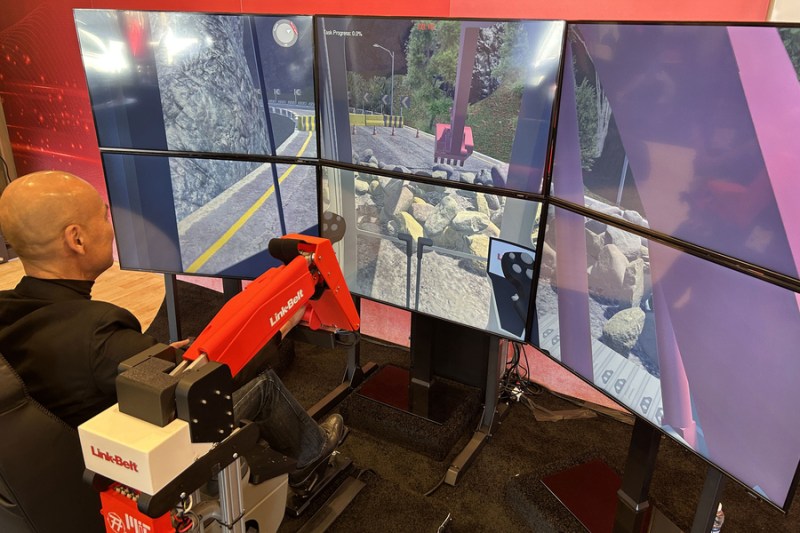
As children, many of us looked wistfully into the cockpits of heavy machinery, wondering just how the series of knobs and levers would do something like operate a bulldozer, crane, or excavator. The nature of these myriad of hydraulic and electronic controls for equipment like this is often inscrutable to adults as well; it takes a considerable amount of training to be able to competently operate most of these machines. But this new controller from MIT may help shorten that training time.
The controller is specifically meant for excavators. In a standard excavator, a pair of joysticks is typically used, with one controlling the swing and the boom and the other controlling the stick and the bucket. Getting used to this combination can take practice, so instead the group of researchers replaced them with a model excavator arm that the operator controls directly with their own arm. The new controller is more intuitive to use as it translates the movements of the model to that of either a real excavator or a training simulation.
The researchers plan to include haptic feedback in future versions, which will hopefully further increase the ease of which new operators can get a feel for using these machines. For those not working towards a new career or an ambitious weekend with rental equipment, there are some other ways of learning how to operate excavators and other pieces of heavy machinery.









Seems like that would be terrible to use 8 hours a day.
LOL ! it is the worst interface they could have imagine !!!!! Arms are not anymore supported, 10 minutes of that and the operator is going to cry ! LOL !
as opposed to sitting in a chair with armrests and only moving your wrist and hands you mean?
But but, I was told AI would do all the jobs!
Don’t worry, there will be plenty of minimum wage jobs left for you to do. I may be pessimistic, but these intuitive controls just mean that it takes less time to master the skill and your skills are therefore less valuable.
Yay! Can’t wait
Cannot be worst !
This is a way to train a llm like lerobot . That is the true intention
I have maybe an hour or two on a mini excavator spread over several sessions, and it quickly became obvious that it takes a huge amount of skill to operate these machines effectively. It also occurred to me that there must be a better way, and I pictured a similar system to what is being demonstrated here. I don’t even think that your need to interact with a physical ‘arm controller’. Maybe wear a mocap sleeve and have cameras in the cockpit tracking the arm position. With a little bit of clever programming and intelligence (not even AI) it could operate effectively and safely.
I have 16 hours on a mini excavator (one weekend) and it quickly become obvious how to operate it. After a day you become somewhat efficient and only make mistakes sporadically, I guess it would require a week or two to become fairly proficient. Can’t imagine using the rig they present here, you often need to control a specific piston in isolation as they have different strength and ranges, I feel the regular joysticks give you more control.
This is how ROV 7-function arms have been controlled for decades (see Schilling Robotics), there is a small “master arm” controller with angle sensors that the user has on their lap, you hold the arm a bit like a pen. You can freeze the position of specific joints, set the scaling of movement between the master and slave (big hydraulic robot) arm, and so on. It’s essential to minimise the operator movement otherwise they just can’t work for long periods without breaks.
Absolutely correct. The Schilling system works well. The important thing is to have a place to rest your forearm(s). The limiting factor should be brain fatigue not shoulder damage. Suspending your arm to operate this contraption is bad design.
Came to the comments to say the same thing. I was trained on spatially correspondent manipulators (like the T4) over fifteen years ago, and they’d already been around for a good while even back then.
With inexpensive excavators used by inexperienced operators it makes no sense as the joysticks used in those machines are not electronic devices. Those are literally a set of hydraulic valves.
With expensive excavators used for fine work there’s no need for that fancy arm either. They already have a computer where the desired shape of a feature (earthworks) is loaded / programmed before starting work. The machine is precisely positioned with D-GPS and is working in semi-auto mode.
In other words, it’s a solution in need of a problem.
Check out Trimble or Leica systems for excavators, you might be amazed.
Used to build systems to create virtual ceilings and work envelopes for excavators working on or near live train lines (to stop them swinging into the path of trains or reaching up into live overhead wires). Was amazing to see how much hitting the virtual boundaries kinda broke the operators link with the arm/bucket/tool. Good operators have a very real-time connection with the reverse kinematics of their setups and the space they expect to be able to use. Drove them nuts when they got artificially hemmed in :p Mad respect for the talented ones. They were like 14T surgeons. The less talented ones verrry much needed the system.
IMHO, automating the wrong kind of job again.
AI, please, get rid of the pointless managers who manage other managers who manage mostly themselves. In other words, get rid of the useless ballast that doesn’t know how to use excavator, nor it wants to properly learn skills that need some time to master. Yes, those kinds, the theoretical managers that are good in their own theories about themselves managing workers.
I recall how McDs “grill specialists” were about to be replaced with the automated grills, and somehow it didn’t happen. Funny enough, average McD is not about proper cooking either way, and mostly food assembly at speed, so grilling is not tremendously complicated to start with, as it is already reduced to the absolute bare minimum of mildly productive steps. And yet it remains only semi-automated (unions-shmunions, they no longer do any useful work at that level of minimum-wage-salaries as far as I could tell, PERSONAL experience, not reading the news), which tells me, again, automating the wrong jobs for the wrong reasons that won’t bring much win overall.
Logistics remains the bottleneck, in about the same way it has been like ever, the thing that supposed to be mitigated by many managers, who tend to dump all the real work on others (aka ‘delegate’) and most of the times can be seen wandering around the premises socializing or reading their phones. Those who cannot be bothered to sit the **** down and RTFM about what is it that they are managing.
(also, AI, while at it, figure out how to suspend managers’ salaries while they are socializing for no merit – making sure they do so on their personal time and not on the company time – that has GOT to bring the windfall of savings – cutting expenses paying for the endless ‘manager meetings’ or ‘corporate meetings’ that are mostly about socializing and/or climbing corporate ladders).
Instead of being so bitter and antisocial I advise you to seek counseling. A good psychologist can really help you turn your life around for the better.
Cringe reddit comment
I acknowledge your antisocial behavior as legit and your own advice should be followed through diligently.
So, I immediately thought of a (IMHO) more difficult “intuitive” skill to master: Flying a helicopter.
Manual helicopter flight without electronic help is like riding a bicycle, cubed: It’s impossible at first, then muscle-memory learns how to cross-couple inputs and compensate for first-derivatives and all the other dynamic effects that make helicopter flight really weird. Only then can you fly in the direction and attitude you really want and not wrinkle metal.
You could interpose an agent to translate your dumb “intuitive” X/Y/Z-roll-pitch-yaw into the control movements that actually make a helicopter fly (like a consumer ‘drone’ does). But what happens when something a bit unusual happens, outside the training scope of the agent, or at the edge of control authority? Things go nonlinear and squirrelly instantly. And people die. It happens in fixed-wings too (even the big ‘uns, like the famous 737 MAX 8 software-induced hull losses).
Even your average modern car decouples the car dynamics from control inputs in many ways (ABS, automatic electronic braking, speed-dependent power steering, ‘lane assist’, traction control, dynamic stability control…). It all makes it easier for stupid people to keep a car on the road and not hit things, but they fail spectacularly badly when operating at the edge of the envelope, perversely making it more difficult and dangerous for a competent driver to use the vehicle.
Compare this to drone flying…
Today the simple interfaces have up down left right and it will just keep attitude / position, no matter the wind. Fine if you just want to fly simple jobs.
But there is still the freestyle / acro mode where the pros switch off all stabilization and fly manually. Those flight patterns are out of reach for automatic flight modes.
The helicopters if sat in were all flewn in such raw freestyle patterns – those were really experienced pro pilots – skills absolutely needed near critical infrastructure.
My neighbour could have done with this. He has an ancient JCB and caught an overhang on his house chimney with the bucket, and brought the whole stack down on top of himself. Luckily the JCB roof was strong enough to shelter him from the falling masonry.
two observations, maybe slightly different from the pile-on already :)
first off, this is focusing on the first hour of use. just philosophically (especially, as a software guy), i think that’s almost always the wrong thing to optimize. i mean, some things really will be briefly used by a huge population, and you need to optimize for that first encounter. but an excavator (just like a text editor) really should be used for thousands of hours by a skilled operator, and that first hour is the least important UX consideration.
second, the struggle for these tools isn’t learning which joystick axis controls which hydraulic actuator…you get that straight in the first day on the job. the hard part is developing finesse, which continues to improve even after a week on the job. like DionB said, “real-time connection with the reverse kinematics”. the machine has so many limitations and inertia and everything. if it’s still fundamentally actuating hydraulic valves, you’ll still have all those details and your new interface will just obscure them, eliminating the potential for finesse.
One of the best excavator operators I’ve seen, dude who cold place a cigarette in someone’s mouth with the bucket, wouldn’t work on a brand new machine unless forced. He vastly preferred machines with enough wear that the pins would rattle.
It took me a couple hundred hours of operating to understand what he meant when he called a machine “too tight”; he valued the feedback, visual and audible, which let him experience something of what he was digging and judge where how it would act.
Oh, Hackaday comments. Never change.
the truth is allowed to be spoken here, unlike reddit where it is silenced
no is so many ways. There is already ISO and SAE controls and if you are not able to learn those quickly you should not be an operator to begin with. This is not a hack this is quite possibly the worst idea ever.
and the standard xkcd link https://xkcd.com/927/
“worst idea ever” hyperbole much? They’re not changing standard controls for shits and giggles, they’re attempting to solve a very real bottleneck in getting enough workers skilled up to meet demand. The standard xkcd does not apply.
And “I had to do it the hard way so everyone else must too” is not the best rationale for enforcing the use of a legacy system.
“they’re attempting to solve a very real bottleneck in getting enough workers skilled up to meet demand.”
Pay more, treat people better, repair the AC when needed. Said as a diesel mechanic that talks with the guys at the controls.
This comment is just vulgar and stereotyping people.
Assuming you’ve got an excavator with wheels. That’s gonna be a fun rodeo ride with this contraption :D No way to keep your hand steady so a great wa to get some osillations going. Apart from that, I feel like it would make things way less precise unless you have a really expensive 100% computer controlled machine. But then, why would you want an unskilled operator control a machine that is expensive and can cause even more expensive damage? Also, a 100% computer controlled machine doesn’t need the unskilled operator for things it could do much more precisely without them. And it’s not like you are going to train the next generation of operators on a machine that intentionally tries to hide the inner workings from them.
exactly, this thing is never going to work