
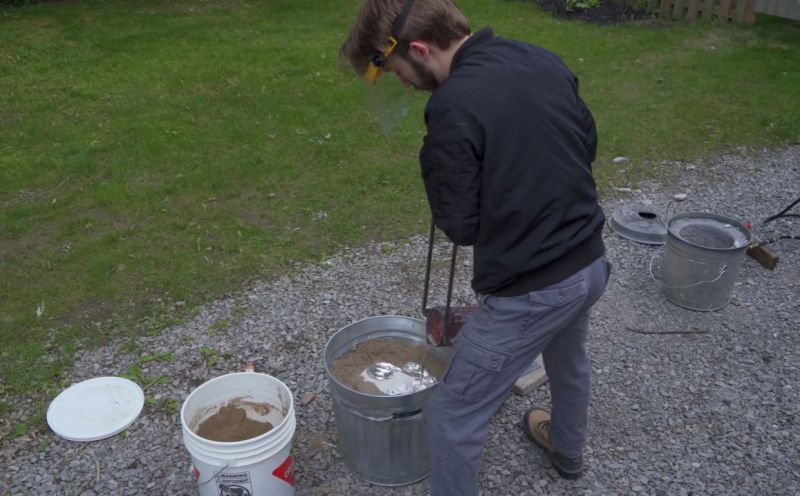
After building a couple of internal combustion engines by milling billet aluminium stock and cringing at the absolute waste of material this created, [Camden Bowen] figured he’d give casting metal parts a shot. Of course, the key here is to create the molds for said casting, which is where you got a few options available.
Since DIY is really his thing, he also made his own kiln using cement and perlite, plus a propane burner. For the aluminium material to melt, he bought a stack of aluminium alloy wheels, as these are made of an alloy that’s actually suitable for casting. These were turned into ingots as a first step towards casting the engine parts, which among other things helps to purify the metal.
For the actual casting method he picked lost PLA, meaning the intended shape is 3D printed in PLA, then put into plaster before it’s melted out of the newly minted mold in an oven and subsequently burned out in the kiln. For the plaster [Camden] used regular Plaster of Paris, mixed with sand to give it suitable heat-resistant properties.
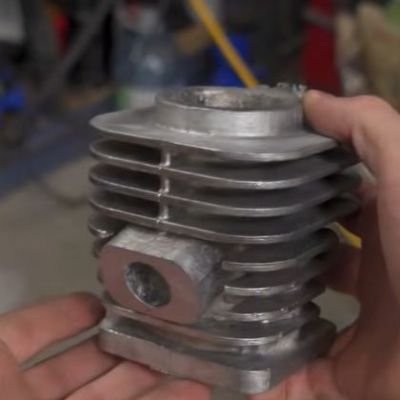
After some trial and error, as well as a lot of trouble burning out all the PLA, he got a usable mold and managed to eventually cast an engine cylinder with only a few imperfections. Considering just how convoluted it would have been to mill that part out of billet aluminium, it’s easy to see why commercial manufacturers are casting such parts as well.












Nice, but is it really a waste when it gets melted back down?
If he only used milling as a process and not casting then when would the mill-scrap get melted back down?
He addresses in the video that the alloy he was using for his initial machining was not suitable for recycling via casting. So while it could be recycled he wasn’t viably able to do that and would probably get pennies on the dollar for recycling.
https://youtu.be/F59uIEqeOzE?t=240
yeah the question becomes what kind of waste you’re trying to minimize…if you send the scrap to an outside service, it does get re-used, it isn’t being ‘wasted’ in some sense. but you sure are out the money!
If it’s valuable enough to recycle, they pay you money for it. If not, they make you pay money to get rid of it – directly or by extra fees at purchase etc.
That’s the simple rule to determine whether the recycling actually matters.
2STROKESTUFFING on youtube has done both lost PLA casting and direct print in aluminium cylinders
I really, really like this project. Maybe lost wax would work better?
Make a negative SLA mould -> make a wax part out of it -> use lost wax moulding to cast the metal part
Also makes me think, if a single individual can cast engines and make them work, why do defence companies want a hundred thousand for a fixed wing military UAV drone? I get that reliability costs money, but if a prototype can be made for under 1k$, why would a mass produced version cost wildly more?
Certified parts and very long parts availability for low quantities. Once you’re an approved manufacturer, you get to set your own prices. No one else wants to go through the trouble of certification. $1000 for a switch is ridiculous, but it’s pre-approved and the approval process costs way more. It’s all a big scam in my opinion, but this is the claimed reasoning.
little reason to have rigid certification for part for a military UAV drone, it’s disposable
The certification is for the supply chain as much as the reliability of the part. Can’t have our drones suddenly not be “our” drones anymore. I have bought and messed with a usb c cable with a wifi chip in it that connected and provided terminal access to the phone it was plugged into plus all kinds of automated scripts that can be remotely executed. Supply chain matters.
there are very few parts where that is even a theoretical risk, and in war you pick good enough over too late or too expensive
Because like all ordinance you want it to go boom when and where you want it to go boom, not 20 feet from where you launched it
If you were making them for a living, you would have to account for your own salary, the cost of the land, facilities, utilities, services, tools, materials and taxes. Suppose the person wants to make about 30 bucks an hour, they need to triple that to 90-100 bucks per hour to run the business. If it takes three working days to cast that single engine cylinder with all the prep work, finishing, failures and restarts, that one engine cylinder would cost you around $2000. The completed engine, probably $10k as a one-off thing. If you were to start manufacturing them in larger quantities, you’d have to start investing in the production facilities and logistics, which then rolls over to the price of the product.
It’s not actually cheap, it just looks cheap when someone is doing it for a hobby on their own dollar and time.
Has anyone here done this type of thing? I’ve been doing some aluminum casting, dabble in small engine design, and would love to venture into something as complicated as casting a cylinder head. I’ve been avoiding lost PLA for the reasons Camden ran into: when I tried it, I could never get all of the PLA (and residue) out. I have a petrobond setup, and I’ve done a bit of lost foam casting successfully (best results when painting the foam with plaster before dunking into a fluidized sand bed).
Has anyone used one of the wax 3D printing filaments made for burnout. How well does this work? Is there a better way?
55 years ago, a friend and I cast a new head for his moped. We made a male mold from styrofoam that we hand carved with a bread knife. We surrounded the foam core with sand and poured aluminum made from scrap melted in a cast iron kettle on his mother’s stove. (Yikes — looking back at this process…) Looked like it was built by Fred Flintstone, but did the job.
I’ve been looking into some of this myself; and I’ve wanted to try out Polymaker’s Polycast. I know that’s not an answer, but it might lead you down an interesting research rabbit hole.
IME petrobond is really not great for anything where you are not able to physically remove the pattern buck.
Using a refractory, even simple plaster gets far better results. But its still not perfect as PLA leaves a residue. PVB works better as it completely pyrolizes. Unfortunately it requires final temperature incredibly close to the one plaster breaks down at. Unless you have very fine and accurate control of your burnout kiln youre better off going with Ransom & Randolph Ultra-Vest or R&R SC-20 for burning out PVB and casting aluminum.
Have cast iron from artisanal blast furnace, and worked in past for a jeweler that did custom casting.
Petrobond works, but you don’t get nearly the detail you do from resin bond sand. If you can do the design, there are companies that do made to order 3D printed resin bond sand molds if you didn’t know this. ExOne does this near me just outside Pittsburgh down the street from where I grew up.
If you must do it yourself, best option is SLA resin printing using 99% ash out dental resins. they are expensive, but you can print a positive and have it burn out completely per the name.
If you only have standard 3D filiment printers, here they use lost pla but if you design a mold that can come apart, you can pour wax into a mold and then take it out, trim or smooth any layer lines off, and then put that in your sand, but if it’s in Petro Bond that’s just the loose stuff and the wax will bubble out and possibly not cast well. lost wax works best though in investment casting-
The very best method for detail is actually investment casting, which really isn’t that much harder. look up the formula or buy some, it’s basically just a special kind of plaster of Paris you dip the part into many many times building up like a traditional candle, it dries in between and creates a perfect shell. if you do this you could try the special wax fdm filament, and add some pour spouts and vents to the part in the orientation you’re going to cast, and then dip it in the investment and build up a really thick shell. Watched iron done this way, and before they pour the iron they bake out the wax after the shell has hardened in a special oven for like 24 hours. you got to make sure the wax is all gone. Then pour, and you’ll get a perfect copy of whatever you had.
This is all totally doable at home in Aluminum, brass, and bronze.
stucco shell building is a PITA. Unless you absolutely have to, Its easier to use a pourable investment and fill a flask around your sprued part. 44# of r&r ultravest (Quartz & Cristobalite bound with gypsum) is only $55.
If it works every time, sure- but moldmaking is time consuming. If I’m going to do something, I’m going to do it once, with the method that is most likely to give good results. I’m the opposite of most people, I’m not looking for the fastest way to do something- I’m looking for the most bulletproof way to do something, because my time is worth something and I don’t have time to screw things up repeatedly. When you’re pouring with a team of 20 people, you get one shot. If your mold fails, that’s it till next year.
Ive seen the investment shell done and poured, its more work but if you have high detail it works fantastically.
Yes, Siraya Tech makes casting resin that you can 3D print from a resin printer. It burns clean. It is commonly used for designing jewelry for casting. The precision of UV-cure resin printers is greater than FDM printers and you don’t get layer lines.
Resin printing, though common in desktop units, is a whole different enterprise than FDM printing, however. It’s messy as heck and the toxicity of the fumes and eye and skin contact with the resin requires PPE and much more cautious handling — but is no more dangerous than managing metal casting from a furnace.
Maybe resin would be a better choice as there are formulations specific for burning and casting, not sure if this would be too big. Pretty cool project though.
Ambitious. It would probably be more productive to 3D print a multipart negative mold, use expanding foam to cast a positive, then use that foam positive to cast the aluminum positive.
Styrofoam was used for making castings before PLA. There was no need to melt out as the molten metal would burn out the Styrofoam. The immense advantage of PLA is the ability to design first and then create the form perfectly. .
I wonder how well a 3d printer would cope with printing wax, lowering the hot end temperature, perhaps adding a cooler.
I’m curious why using a chemical such as lacquer thinner, acetone, toluene, etc. to dissolve the remaining PLA is not used? I think that the solvent could be used a few times before it’s sufficiently contaminated to dispose of by burning.
I feel like if they sprayed the PLA with a mold release agent like ZipSlip, it might have burned off cleaner.
I don’t print PLA anymore as it has too low of a temperature deflection to build anything useful with for machine parts. However, if so recall correctly, acetone, paint thinner and organic solvents roll of it like water from a duck’s back.
Why burn out anything make a pattern and use that.