
The average hot water is a relatively simple appliance to understand. It uses gas or electricity to dump energy into water in the form of heat, keeping it at a pleasant temperature for uses like bathing and cleaning. Basic mechanisms are in place to ensure the water stays at a relatively constant temperature, neither too hot where it could cause burns, nor too cold such that it wouldn’t be fit for purpose.
One of the problems, though, is that sometimes storing water at the desired temperature can create the perfect breeding ground for bacteria. However, a neat little trick developed by NIST could solve that problem rather elegantly.
You’re Hot And You’re Cold

One of the interesting problems of our modern era is that changing our water usage has changed the risk profile for pathogens growing in hot water. NIST has noted for some time that while the pipes in our walls haven’t changed size, things like our shower heads have changed their flow rate to save water. Less flow rate in the same sized pipes means that water stays in the pipes for longer, increasing the time in which harmful pathogens have to grow in that environment.
Chief amongst these pathogens? The one most commonly feared is legionella pneumophila, the bacterium responsible for causing Legionnaires’ disease. The severe form of pneumonia comes with a fatality rate of 10%, and infection typically comes from inhaling aerosolized droplets containing the bacteria.
Of course, a great way to create aerosolized droplets filled with bacteria is to spray not-quite-hot water through a shower head. This is why hot water systems, particularly in large multi-occupancy buildings, are a risk for such infections. Legionnaires’ disease is rare, but it’s always out there, with 6000 confirmed cases showing up in the US each year. It’s possible that the true number is up to 10 times higher because the disease isn’t routinely tested for. The disease’s rarity is in part because engineers and tradespeople put in plenty of work to minimize the ability for the bacterium to breed in hot water systems. As NIST’s work demonstrates, though, there is possibly even more that could be done to tackle this problem.
Ideally, your hot water pipes in your house would not host any nasty bacteria. But often, hot water systems sit around 49 °C (120 °F), a temperature that’s hot enough to be useful and pleasant without a major scalding risk. Legionella pneumophila won’t easily grow at that temperature; the bacteria thrives between 20 °C to 45 °C (68 °F – 113 °F). Unfortunately, though, it’s not hot enough to kill the bacteria completely. Furthermore, water cools as it travels through pipes to an outlet, and thus pipes can be a perfect environment to spur further growth.
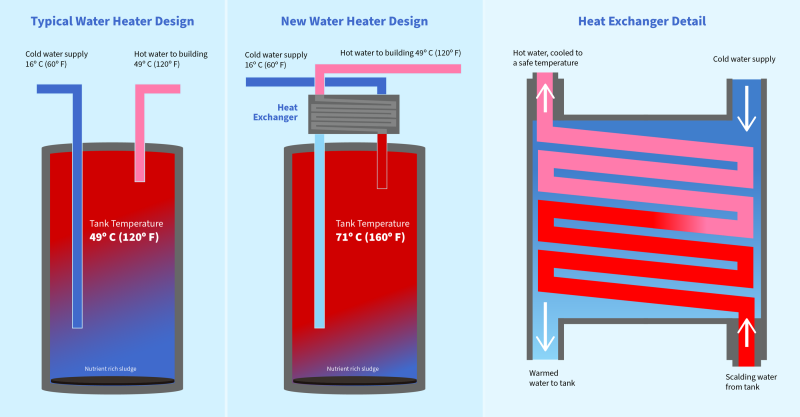
The simple solution would be to simply jack up the hot water system to store water at a much higher temperature, say around 70 °C (160 °F). This could be undesirable in many contexts, though, as water that hot can more easily cause burns. It would be ideal to store the water at a higher temperature, while making sure it was delivered at a slightly lower temperature so it didn’t hurt anybody when it left the tap or shower head.
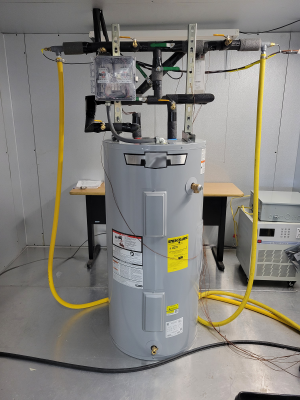
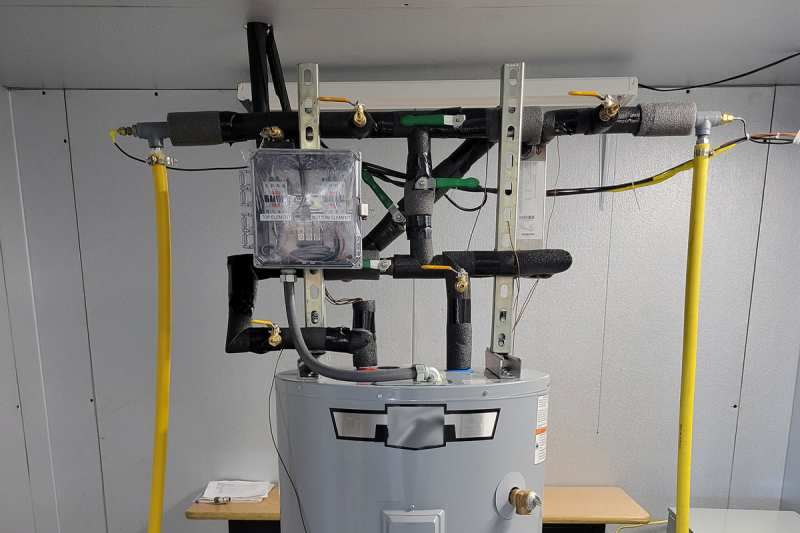
It turns out that there is a remarkably simple way to achieve this. NIST developed a simple heat exchanger which can be mounted atop any old hot water system. It’s designed such that the hot water leaving the tank passes through a heat exchanger where it’s surrounded by cold water which is running to the water heater’s intake pipe. This has dual benefits. The hot water inside the tank can be stored in the tank at 70 °C, which kills almost all legionella peumophila almost instantly. That water, though, is then cooled to a slightly safer temperature as it passes through the heat exchanger and out to the tap or shower. The hot water remains at a safe temperature for the user, and contains far less harmful bacteria, and cooling it doesn’t introduce any pathogens from another source. In turn, the cold water coming into the tank is pre-warmed slightly by the hot water, so the energy isn’t simply wasted.
This trick isn’t just simple, it’s also cheap. NIST engineers were able to fabricate a prototype unit to fit to a residential water heater using just $100 of components. It could be a useful addition for homeowners looking to make their hot water service a little cleaner. However, the real benefits are likely to be for larger operators of multiple-occupancy facilities, like nursing homes and hotels. These facilities often have to take great care to avoid the build up of harmful bacteria in building-wide hot water systems. Having the ability to increase the tank temperature to the point that legionella pneumophila bacteria simply die off would be a huge boon to this effort.
Sometimes, it’s possible to make great gains with a simple hack. Using the cold water service to cool hotter outgoing water is a smart trick that uses only minimal additional equipment to offer a safer hot water supply. It could yet become a common install for hot water systems in order to fight the good fight against a harmful disease that likes to lurk in our pipes. If you happen to see a heat exchanger atop a hot water heater in future, you can smile that someone has done the work to try and make that hot water supply just a little safer going forward.












To the one-time heat-exchanger cost must be added the continuous higher cost to keep the water at the higher temperature. This can be mitigated somewhat with another one-time cost: thicker insulation on everything.
Perhaps using solar energy to sterilize the incoming cold water, with a similar heat-exchanger to cool it down before it enters the water tank, would be just as effective but cheaper to operate (where such solar energy is available) by actually reducing the heating cost.
Higher temperature but same stored energy means you can use a smaller storage tank, less surface area. Turns out it’s about an even trade for losses. Smaller tank plus additional insulation means same overall volume AND higher efficiency.
Not really? The heat exchanger isn’t adding any water to get the outgoing water down to safe, just recycling some of the heat into the water that replaces it. It should be roughly the same amount of hot water flowing to shower or sink, unless the pipe temperature changes, and the point is for it not to rise. So the tank capacity to handle X showers before running cold should be pretty much the same.
Exactly. The higher temp=less volume argument works if you’re delivering that hot water all the way to the mixing valve and cutting the temp by ADDING cold water to it. For this system that argument doesn’t hold.
Thank that one through a bit more, boys… Higher temperature, more total stored energy, more volume of warm water.
Exactly – if your reservoir volume is at 160F, your net volume of 120F water that can be delivered will be larger than if you hold your reservoir at 120F.
Of course most literature available to the public denies that you’ll get more “hot” water by turning up the thermostat in order to reduce the scald risk. It’s a scientific lie intended to guard against injury, but easily disproved on paper.
Where this may run into more serious thermal/energy concerns is with heat pump based water heaters, which I presume are far less efficient – or possibly require a resistance heating step – to heat the storage volume to 160F. Those are still fairly rare due to their expense (And, for some models, poor longevity).
That’s rather important, it’s not a “just” thing.
In the system as a whole, the heat exchanger provides the exact same function as downstream mixing valves. Of course the heat exchanger is slightly less efficient, but it is still functionally “mixing in” cold water, just before the tank rather than at the tap.
The thing you are overlooking is that mixing valves introduce unsterilized cold water. The heat exchanger keeps the unsterilized and 160F sterilized hot water separate.
Not really. If your cold water is contaminated with enough bacteria to be dangerous as-is, neither of these systems will do anything.
The assumption is that cold water in this system comes from a municipal water supply or well that is safe enough to drink from. And 160f is not hot enough to guarantee perfect sterilization anyway, especially since there’s nothing preventing you from drawing the water tank down to a lower temperature before it can recover.
In either case, all you are trying to do is preventing legionella from growing and multiplying substantially in the hot water tank. 100% sterilization is not a practical or necessary goal.
One other issue, as temperatures go up the thermal efficency of gas fired heaters go down. Even worse are heat pump based heaters which take a massive efficency hit.
Is this a typical American thing? Here in the Netherlands, hot-water tanks are typically heated to around 55 C, but are heated to 60+ once a day to kill any bacteria. Also, faucets that produce really hot water that could burn you if not mixed with cold water have been standard for like ever, so I’m not sure why you should protect the user like this.
I think that some time 30 to 40 years ago we went through a period where a bunch of people cooked their babies in the bathwater and since then keeping the hot water heater at a skin-safe temperature has been a big thing.
If I remember right every degree above 135 burns twice as fast as the previous degree.
That’s how my water works and I’ve never heard of an outbreak of legionnaire’s disease
I just replaced mine – is that why some days the shower is way hotter on the same valve setting?
Supposedly this is already somewhat outdated as it can breed heat-resistant strains.
Could it? I mean, 25-30 is ideal for Legionella, above that they can’t procreate. It’s about 55 normally, goes up to 65 or the like once a day, so I wouldn’t expect heat-resistant strains. Otherwise we’re all cooked…
In Austria, the usual temperature at the tap is 60°C, and most heating controllers drive the hot water tank up to 75°C once a week. Obviously Europeans still know that hot water is hot and how to operate a faucet without a thermostat. (They also know that coffee and tea are prepared with boiling water. SCNR.)
If we can prevent life-threatening injuries to infants and children we should. The kids should be subjected to the parent lottery if we can prevent it.
As far as hot coffee goes, you may be referring to the famous McD lawsuit. The lady was served coffee at 190 degrees in a paper cup causing burns that fused her labia together and required surgery to fix. She only sued for the actual cost of medical care. McDonalds agreed to zero dollars so the jury came through with a huge sum.
We (in the Netherlands) recently had our appartment building’s hot water supply (district heating with individual heat exchangers) renewed. Turned out the standard “eco” setting produced water at 56°C, which is legally too low, it must be 60°C. I had mine set to 74°C though, as it does a LOT better job at cleaning the dishes. (Yes, I dishwash by hand. Usually when I’m done with the dishes, the water is still too hot to put my hands in. But it does really clean well compared to 60°C!)
What’s wrong with the simple tempering valve? Standard equipment, required by code in many jurisdictions.
https://www.heat-timer.com/what-is-a-tempering-valve/
That’s too simple.
Exactly. I thought this would be common place everywhere. Tank stores at 60C+ and the tempering valve reduces to 50 or 55.
As a bonus your hot water lasts longer because you drain less from the tank as the cold water is mixed in
US federal Government projects typically specify a domestic hot water storage temperature of 140F and use thermostatic mixing valve(s) to reduce the temperature before the fixtures. I would guess that a heat exchanger would produce inconsistent temperatures due to varying flow rates. Interesting idea though, but it probably isn’t that much cheaper than a single system TMV.
Another maintenance item: descaling the hx. More difficult than “empty water heater every 1-2 years”.
Water heater will also corrode through faster at higher temps.
Internal corrosion of hot water heaters is controlled via a sacrificial anode. This technology is also used for everything galvanized, and boats sitting in the cold ocean.
If your HWH has a 5 year warranty, replace the anode at the 4..5 year mark and you have added the anodes life to the HWH life. May want to annually use a wrench on the hex head for that, to break the threads loose while it’s easy, before they corrode together.
did it happen??? have i heard from someone who has actually replaced the anode according to directions?!
Since this doesn’t address the water in the pipes, only the heater, why not just use a tempering valve to mix in a bit of cold to the outgoing water.
Also, modern shower valves limit the percentage of hot water delivered, so you can run the heater hot and not have a scald risk.
Yes, this does not seem to make any change to the asserted risk of legionella in the pipes, as it makes no change to the pipe temperatures.
A tempering valve is a superior solution since it compensates for ambient/cold-water temperature, as well as compensating for intermittant water heater operation, which is what you want when power price varies with time of day, is intermittant, or is solar.
As an aside, I have a a temperature controlled shower mixer, (and another on the washing machine whose plastic fittings do not like really hot water). My solar hot water is regularly very hot and can thus scald the pipes out, while the shower remains safe.
I’m all in favor of hot tanks and tempering valves as an easy solution to this problem, but the reason there’s not a focus on pipes is pretty simple – regularly used hot water pipes are poor breeding grounds for legionella because the hot water is constantly replaced, and irregularly-used hot water pipes are poor breeding grounds for legionella because (unless you have a hot-water recirculation system) they’re not actually hot most of the time.
Tempering valves are more expensive than the common-in-US pressure stabilizing valves. They’re also another thing that can fail.
Mixing cold with hot to cool it is incredibly less efficient than using a heat exchanger to cool it.
Mixing hot with cold directly = burning money
Using a heat exchanger to cool outgoing hot water, uses that “waste” energy to preheat the incoming cold water. And because the incoming cold water is now hotter the amount of energy required to heal the preheated cold water is considerably less.
It’s hard to tell when someone is being satirical. Sometimes it appears they’re simply misled.
I’ll assume you’re just ignorant so I’ll explain it.
Think of the system as a whole. The same amount of cold water comes in to the system as hot water leaves. The cold water coming in is same temperature in both systems. The hot water coming out is the same in both systems.
How is one more or less efficient than the other?
With a tempering valve you store less water at a hotter temperature and use less of the heated water as it’s mixed with cold on the way out.
With this heat exchanger you need to store a larger volume of water at a lower temperature.
The only way there can be efficiency differences is in the system losses.
A hotter storage tank needs more insulation, but with a tempering valve the temperature can fluctuate, so off peak power usage and solar is easier to take advantage of.
An external heat exchanger also needs insulation. It also increases the volume of water that needs to be flushed through before hot water comes out the tap at the end. Wasting time, water, and energy. The outlet temperature will also change with flow rate, as the heat exchanger doesn’t have zero thermal resistance. It will get hotter as the flow increases due to the water spending less time in the legal exchanger
Dumbest solution yet – It’s like crossing the river to fill the water bucket!! There’s a WAY EASIER AND CHEAPER alternative. Just use a temperature reducing valve on the output pipe on the tank => No Bacteria AND a “virtual” increase in tank size = Problem solved!
I do agree but to a point.
The advantage of this is preheating the feed water vs a TRV/TMV reducing valve.
But this system is like using a computer controlled robot to open a beer can.
I’ve got solar thermal and we generally dont run the tank hotter than 55C most of the time.
And it’s a super isulated tank, like 100mm thick all around inc top and bottom.
And no one died, nor will they.
Because when it comes to legionella, much/most of the time the problems are commercial systems not home and it’s often dead animals in the tank causing the problems.
Now DIY heat pumps based off of R290 dehumifiers to help with stratification AND aid boosting to 70C, that’s a topic which would be interesting….
UV sterilisation of the water entering the tank?
Split the water pipe into several clear tubes to increase the surface area, stick it into a mirrored box with a few UV lamps.
After a decade or two in service, there’s significant scale accumulated in the tank, forming plenty of crevices shielded from UV.
Less so in the cold side than the hot, especially since it’ll be staying wet. Even so, that’s what maintenance is for.
Average homeowner; “maintenance?”
I maintain a UV system in hawaii where they use rainwater collected from the roof. It’s full of bacteria from bird poop, so this is a necessity. Units cost $1000 and replacement bulbs $200, replaced yearly. (30W system) Multiply by 263 kwh/year by your local electricity rate ($0.40/kwh in hawaii) adds another $100/yr in run costs.
I think this would actually be worse then a tempering valve, wouldn’t it? Both will have the same effect, but the tempering valve will get you more hot water for the same tank size.
The hot water heater keeps hot and cold water ‘sorted’ so that the output water stays basically constant temp until all of the original water has been used, then you get cold water. A tempering valve will reduce the amount of water that actually leaves the hot water tank, increasing the effective capacity of the tank. Once you use up a full tank of water with a heat exchanger system however, you’re left with a full tank of lukewarm water. The energy isn’t being lost, but it’s not very useful for someone that needs a shower now.
When the hot water is used up, the heat exchanger system does leave the tank with lukewarm water. That means that the recovery time is reduced.
There’s also the minor advantage that when the hot water is used up, the poor sod in the shower gets hit with lukewarm water, not cold water.
” But often, hot water systems sit around 49 °C (120 °F) ” LOL, who in their right mind would set their water heater to 120 °F ?!?!?! Hey if you like taking a cold shower that up to you.
I tried finding a good picture of a USA gas valve for a water heater. Couldn’t find any good ones but the description goes like this: the first part of the temperature dial has an off setting. The second part of the dial typically says cool>warmer. The third part of the dial says CAUTION. the cool>warmer part top end is at 120F and anything above that is in CAUTION. Someone earlier posted that setting the dial higher actually uses less energy because of the water mass. The reason for the CAUTION section is some stupid parents would let their kids get in the bath or shower and they would get scalded. I lost a cousin to this and the parents sued the water heater company. They won. Again STUPID parents. (They were investigated by law enforcement and not charged but our family doesn’t talk to them anymore.)
Water heaters are likely to come from the factory with the thermostat set to the national recommendation. Most installers aren’t going to bother adjusting it, or even checking it.
Leave it to the US government to suggest 120F for safety, then to also require tempering systems in showers and faucets.
Wow. Given that in much of the world, including the US, the, unfortunately slow, trend is to point-of-use tankless (or very small tank) units, this seems a bit counterproductive. The point of use units are generally more efficient, and alleviate the key problem here.
10l/min is about 20KW (63000BTU/hour) for a 25C inlet to outlet delta, and is sufficient for virtually any point of use. The differential is higher for lower water flow. Seems like a lot of power? Still less than a small tank type in the US, without most of the losses. My neighbor has a 50KW unit (160000BTU/Hr) for domestic water with a 250l (60ish gal) tank, which I find absurd. I did a loss calculation on it when he had it installed, and it was, in 2019, about two dollars US a day is wasted heat from the tank, without considering the energy needed to reject the tank loss from the house. Most of the year, just waste, as only for a couple months will is work against heating cost rather than cooling.
[disclosure: I have a 120l superinsulated tank heated by the hydronic system as an auxiliary. Tankless were not permitted when I replaced the system last. Runs at 10KW utility. I have NEVER run out of hot water when showering while doing laundry and dishes. Loss on this is about 0.10 dollars US per day during hot season, including the cost to reject the extra heat. The heat plant is in it’s own envelope, so it can be
inside' during the cold season, andoutside’ during the summer]Resistive heating is the single most expensive way to heat water. Heat pumps are much more efficient, but are slow, requiring a tank.
In the winter in cold regions, the differential is likely to exceed 40C, which changes the electricity requirement substantially.
You are aware some ‘Murican houses have up to 50 ft of pipe run or morr betwixt the Hester and user device?
Wowsers I’m the UK the water tanks have inbuilt systems to heat the water to 75 degrees at intervals to stop it. That and messaging from gov that if you’re away for more than a week without the tap/pipe running to let it run with you out the room before real use.
What about the shower head as a place where bacteria can breed? Perfect temperature. I sterilise mine every few weeks by running 60 degree water for 7 or 8 minutes.
it seems to me that the heat exchanger idea accomplishes the same thing as a thermostatic mixing valve, which you can buy for under $100 and is already required in some places
Exactly this. I have a hot water heater hooked up to solar panels, and have it set to 140 during the day and 120 at night so it primarily runs during the day when power is free. I have the outlet hooked up to a thermostatic mixer so the output is always 120 regardless of the current tank temperature. This heat exchanger seems to be a more convoluted solution to a solved problem.
I have solar hot water. 3 glazed 4’x8′ collectors feeding a pair of water heater tanks. A pump circulates the water up to the collectors when they are hot enough. Keeps the water about 150F. Another pump circulates the hot water to the fixtures in the house so every faucet and shower has instant hot water. The pump is on a timer so it doesn’t run at night. There is also a thermostat so the pump shuts off when the return water pipe heats up. We’ve never run out of hot water, even with 8 people in the house.
So the article talks about the pipes after the tank and the water not being hot enough to kill The bacteria. What the heat exchanger you’re going to have the same temperature flowing through the pipes that are also not going to kill the bacteria.
Two wrongs doesn’t make it right: Increasing the temperature to kill bacteria and then using a heat exchange to lower the temperature. The latter is based on the (false) assumption that cold water is at fixed temperature (it’s not). In the winter, you’re going to shower at 20°C if the input temperature is 4°C, sweet. The former consume more energy for no gain (after all, the issue isn’t in the tank but, as the article says, in the pipes, which are unchanged with this system). A good alternative instead: Have an instantaneous water heater attached to the faucet that delivers hot water (but in Trumpica, with the dated 110V system, that means a huge copper line to bring the required 60A or so required for the energy). This limits the quantity of still water in the pipes. Or have a UV sterilizer close to the faucet (very low energy, high efficiency for bacteria control, less for other nastiness). Or finally use a shower filter (a $30 item that filters 100% of bacteria, heavy metals, and many also do limestone capture) that consume no energy.
Generally in the U.S. a house gets 230 V, which is 115 V on each side of ground. Heavy loads like electric stoves, electric clothes driers, and electric water heaters run on 230 V. The electrician who puts together the house’s wiring tries to balance the 115 V sides for other loads.
As others have mentioned it’s weird that they didn’t compare the performance to a thermostatic valve. Those have been extremely common for decades and accomplish exactly the same thing. My last 2 apartments had them. I would be curious to see if there’s an efficiency advantage to one or the other. My gut says no, since this is thermodynamics and the amount of cold water in and warm water out doesn’t change. If there’s no efficiency advantage, the thermostatic valve is superior, since the output temperature is adjustable.
Also doesn’t a tempering valve/thermostatic valve let you just set a specific temp? Then you can just always set the temp where you like and never have to adjust.
Without you have to check and adjust every time and that can vary depending on the water temps coming in.
This article gives wrong advice. Here we have a law that the water leaving the faucet must still reach a defined temperature, else the pipes just fester bacteria in other parts of the piping.
“Safe” for humans is of no concern with mixing valves. If you give yourself scalding hot or hypothermic showers, it’s definitely the operators fault. I guess the same urge to self preservation that makes me not put my hand in the blender or onto the hot plate applies to 99.9% of people.
It’s the other 0.1% (mostly very old or very young) that prompted the setting of 120F in the US
I respect the needs of old people. Could it be helped by lowering the pressure on the hot water pipe? Some sinks have valves below them. Then the mixer cannot be accidentally set too high.
Wow, so cold water! I want 65-70 C out of the heat exchange (We get hot water from a remote plant), running to the taps in the house, so I doesn’t need to add boiled water for dishwashing. For temps below 50, knowing it looses temperature during transport, I would be seriously concerned about bacteria
The issue that I see is that this does nothing if the bacteria are growing in the piping between the hot water heater and the shower. Yeah, you can sterilize the heater, but how do you fix the pipes that are carrying the warmish water to the point of use. Doesn’t seem like this fixes that problem at all.
Weird… I’ve had a water heat exchanger installed 10 years ago. This is a bog standard off the shelf “Frischwasserstation” from Viessmann Vitotrans – COTS with proper insulation and control electronics.
Fresh water is only heated in the heat exchanger once you request and consume it. It does not sit stagnant all the time in the tank. The tank can be loaded higher to 90C from thermal solar panels.
(Still, the pipes get a periodic heating and circulation)
I have a somewhat similar system. Well, similar in some ways. OK, one way.
Off-grid with a wood-burning kitchen range that has a boiler to supply hot water for household needs. It cooks, it heats, and it supplies hot water.
Only trouble – it’s going 24×7 in colder months and it would boil the hot water system – hissing, spitting water out of the hot taps. Not ideal so I installed a hydronic loop. When the water at the boiler gets to a set temperature, a thermostat turns on a circulator pump and sends all that hot water to a towel rail in the bathroom, until it cools down a bit and the pump turns off. We get warm towels!
So, the storage tank sits at about 75C, and the hydronic loop system keeps it from getting hotter. Another good thing to help is the copper piping used throughout the house. Copper will shed heat on the way to the taps (the pipes aren’t insulated). I’ve measured the temperature at the taps and the nearest one to the tank is about 60C, the furthest is 55C. Still a bit hot to avoid burns but we’ve learned to manage it. Copper is also a biocide but I don’t know whether the water is in contact for long enough to kill any remaining bacteria.
Systems in Germany have kind of “anti Legionella intelligence”. Since around the 1980ths.
Once a week/month the buffer tank makes a heat treatment of itself. Sterilizing by raising the setpoint to something like 80°C for a while.
We are used to thermostat mixers here, so you don’t recognize that your piping is cooked out at this time.
It’s “a little more” efficient, tested since decades and doesn’t look so ugly.
It’s hidden inside the heating controller in this Buderus rack on top.
I build me a Homematic interface for direct control of all subunits.
The Buderus layout these days was made for DIY.
There is a central board with wire bridges, where you can tap into any needed Signal except the burner safety/flame watcher.
And yet, in the USA, where most water tanks sit around 120F all year round and go unused for weeks over the summer during vacation…. almost NO ONE gets sick from using the hot water. Nearly all cases are from people in poor health living or working near an evaporator cooler.
Erm, isn’t that what a combi boiler already does..? We have had these in the UK for a very long time. =/
There is some interesting information here:
https://www.cdc.gov/legionella/php/surveillance/index.html
There is an overall growth trend over the last 12-ish years in the data. It is interesting that the Northeastern part of the USA has a higher prevalence of the disease as compared to other parts of the country.
I always like using 2020 as a reference marker for certain thought experiments.
If the issue was with domestic systems, then people being cooped up at home during COVID should have sent the number of cases skyrocketing. But it did not.
The highest data point is NYC in 2025 with 7.80 cases/100k population. With a population of 8.5 m, that would have amounted to 663 cases. Traffic and crime fatalities accounted for roughly the same number (250 + 305). All are regrettable.
NYC has struggled in the past with contaminated evaporative cooling towers, causing a sharp rise in the number of Legionnaire’s cases:
https://www.health.ny.gov/diseases/communicable/legionellosis/faq.htm
I live in Western Canada, and we’ve had the issue also reoccur because of cooling tower contamination several times over the past 25 years.
So, I want to ask: are we trying to engineer/solve a problem which does not exist – especially at the residential level?
Thanks!
Using a heat exchanger is a default solution for solar tube systems, at least in Europe, for several….. decades!
But not on the top but inside the tank.The idea is that the water in the tank is surely contaminated but you never use it. The heat exchanger pipe inside is not long enough for water to grow legionella.
This (very common) tank is mandatory for all solar tube solutions in the Netherlands. It is the only solution against legionella without periodic heating, which is impossible for the size of tanks for solar tubes (500 to 5000 liter). This is called Hygiëneboiler in Dutch, and probably translates to Hygenic Tank in English…
Boilers in europe often only raise the temperature for a short time period enough to kill the bacteria, while idling at lower temperature. This is possible, since the bacterial growth takes some time. Therefore it is not necessary to keep the heat on all the time.