
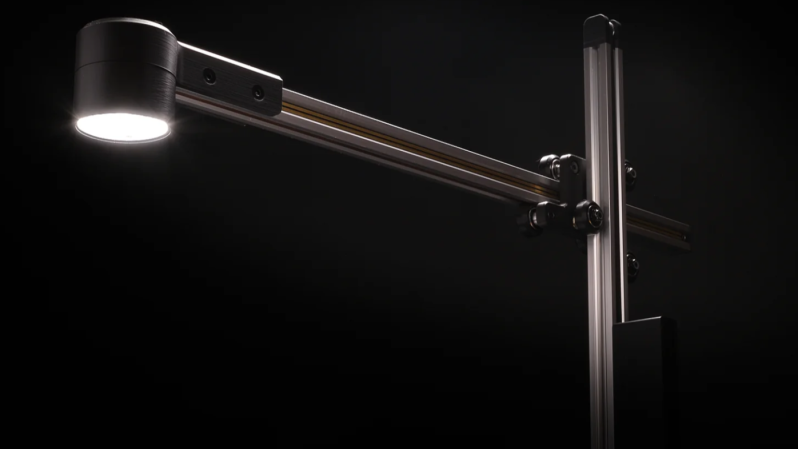
A few years ago Dyson released a desk lamp that could slide up and down, in and out, balancing itself at every position. [Steven Bennett] saw that lamp and wanted to make his own. From this passion, the Open Task Light was born.
We covered the prototype of the Open Task Light back in 2023, and the project is a superb example of iteration. In his 15-part video series on the lamp, you can watch him take on each new aspect of the light, improving the mechanisms, electronics, and production. All those small changes add up to this beautifully finished product.
The first thing you’ll notice about the lamp is how little there is to notice: just a pair of extruded aluminum rails with a lamp head on one end and some rollers in the middle. Look a little closer at the rail and you’ll find a PCB running its length, feeding the lamp through pogo pins and leaving no exposed wires. The lamp uses a heat pipe to dump the LED’s heat, again hidden inside the aluminum extrusion. An ESP32 talks to a dedicated LED driver that runs a Cree high-CRI LED. The base comes in several variations for freestanding use or clamping to a table, and it rides on bearings so it can rotate as freely as the lamp’s other axes of movement.
The original lamp this was inspired by carries a hefty price tag, and while the 50-plus-part BOM on this one adds up, it still comes in at well under half the price of its inspiration. The best part: the Open Task Light is open. You can make it your own, head over to [Steven Bennett]’s GitHub to check out the parts. He has also published a well-documented guide on assembling the Open Task Light.
Given the incredible work [Steven] has put into his lamp, we can’t wait to see his next passion project.












🥵
Nice
Nice development process. Nevertheless, I believe that a well-balanced arm is superior in every respect…
You could build one with a rack-and-pinion that extended a second arm in the opposite direction matching the moves of the arm with the light on it, counterbalancing everything. Would be a little obsessive…
What I mean is that traditional architect lamps, perhaps excluding the cheapest models, already achieve a very good balance that gives the impression of a floating lamp while also being more practical in many situations. For example, the arm typically extends from the back and above, whereas a purely vertical-and-horizontal arm configuration is more restrictive, particularly in a busy space such as my work desk. Additionally, they work perfectly with a simple cable to deliver power. This design has no practical advantages over the established ones. I would call this useless overengineering, which only makes sense as a hacker’s dream. Nevertheless, congratulations to the inventor for achieving his challenging goal!
The type you’re talking about also require significantly less space for proper use.
This type of horizontal bar lamp requires a large cylinder of clear space to prevent hit from the light end when extended, and the rear end when the light is close to the tower.
Very nice project. I remember seeing these lamps when they first came out and feeling inspired to try building one too. If the kits become available in EU I’ll consider picking one up!
Great video too, very down-to-earth and refreshing!
It’s a neat project and video, indeed. However, with the current pricing ($350), it’d be about €450 after shipping and tax. At which point you either really want it, or want to support the creator. (The Dyson version is €550, which is a lot of money as well.)
I remember the original HaD article, I’m glad he finished it to a standard he was happy with, although personally I’m not sure I’d have stuck with it quite that long myself. There are a lot of half finished projects here. It looks great. I quite like the pogo pins with balls on the end, I can see them being useful for a few things. I always seem to get a shock from those telescopic lamps with the exposed conductors, I think I’d like some sort of brush strip or zipper, as long as it didn’t present too much friction. It would be pretty interesting to see if that style of lamp could be electrically actuated and made to follow your hand or a piece of paper.
It looks great. The exposed power rails, not so much.
Same for me, no visible cables is nice looking and cat-resistant, but not kids-resistant – PSU should be capable to survive surges, ideally with power limiter just above max LED power, like lab power supply – set to 14W is enough for 12W LED plus ESP and current is low enough to not be the real problem ~600mA when 24V is used.
I had a Tizio lamp that used it’s metallic structure as conductors for it’s 12VDC. The paint was the insulator. Maybe using the aluminuym rail as the nagative pole and having a single raing on the PCB would have been better?
Contact with anodized aluminum is not as easy task even with fancy pogo pins, so PCB is very nice solution, just current limiting on PSU side (to not hide this open aestetics) or something to cover it like brush cover (not so neat idea) will do the job.
Is it possible to add a lighted magnifying glass with different diopter settings to make it less limited?
I love these sliding-arm devices when they work well, especially things like stereo microscopes.
I hate the arm sticking out the back though: it requires way too much precious bench and shelf real estate.
For workholding tasks Loc-Line hose is nice.
For a simple lamp a gooseneck works great.
For a magnifier, the Luxo-style articulated arm is good.
But for a microscope it’s tough to beat that sliding arm.
But is really needs a motorised Z axis.
– Greater focusing range
– focus with foot pedals or knobs on best spot on the ‘scope
– zoom tracking focus (focus shifts with zoom enough to need refocusing)
– eliminates the focus stage which gets in the way of what you are working on
– automatic focus stacking with camera
– nfc in bench to automatically raise ‘scope by Z mm when you put an adaptor/stage/block/light table under it
– correct focus when filters, or barlow/diopter lenses are flipped into the path
Another option instead of having a big arm sticking out the back would be a pair of hinges 90 degrees from each other. Take a look at the newer model Bosch Mitre saws to see what I mean. It each hinge constrains it by a single axis, without taking up a lot of room behind it. Quite a clever design.
Do you have a model in mind? because I’m on the Bosch website and seeing the mitra saws I still don’t understand what you are talking about. Thanks
It looks like two perpendicular hinges allow movement each in a plane, so the intersection allows movement only in a line.
On home Depot website Im looking at this title:
15 Amp 12 in. Corded Dual-Bevel Sliding Glide Miter Saw with 60 Tooth Saw Blade
Hard to visualize what you’re describing.
Would that be a https://en.wikipedia.org/wiki/Sarrus_linkage ?
I had a similar experience when I first saw a Berenice task lamp (and price tag).
My 3D printed version is here: https://www.thingiverse.com/thing:6770299
What a great project and I love how he has some really elegant solutions in the final design while keeping it open for further experiments.
I tried and hacked so many desk lights because I am also very picky with light. By now I have a 25x100cm Osram panel with max 2000lm mounted over my desk that can be dimmed and color changed between 2700-6500K. Best light ever.
Any model name?
Osram Essential Remote CCT, I paid €40 per unit
Impressive and kudos for the dedication to follow through.
Did you notice – in the background he seems to still be using a regular desk lamp. I would have expected that he built a bunch of the new ones by now and could have replaced it?
Maybe there are still doubts on practicality and everyday use?
Yes, this lamp might be stylish (if you like that sort of thing), but it would never replace my standard (and cheap!) architect’s lamp, which hangs down from above without getting in the way of my work and which I can position however I like, even to provide side lighting or even light from below.
This.
Don’t get me wrong, I love a good project for projects sake and the “why not” of it… but seriously the architect/drafter lamp is so stupid simple, dirt cheap, and just plain functional on every respect… one might even call it “elegant” in the original sense.
The mechanical throw is farther without need for space behind the lamp, the light source/temperature is completely customizable with off the shelf parts (no soldering or programming, just swap out a light bulb [even incandescent!] You get at a hardware store.) Its fully artigulated to any degree and again… cheap as dirt and super reliable!
To re-emphasize I don’t condemn this persons project, it is genuinely coolfrom a maker standpoint. But on the spectrum of utility, function, cost… I’m siding with that this is more of a youtube stunt for clicks.
Have you received any cease and desist letters from Dyson lawyers yet?
I feel in some way the world has overtaken this project. It’s based on aluminum extrusion and 3D printing, the staple of the apartment tinkerer. But now you can order custom metal parts online, or waterjet cut carbon fiber.
Hmmm… get a the https://en.wikipedia.org/wiki/Tizio lamp parts from sheet metal fabricator?