
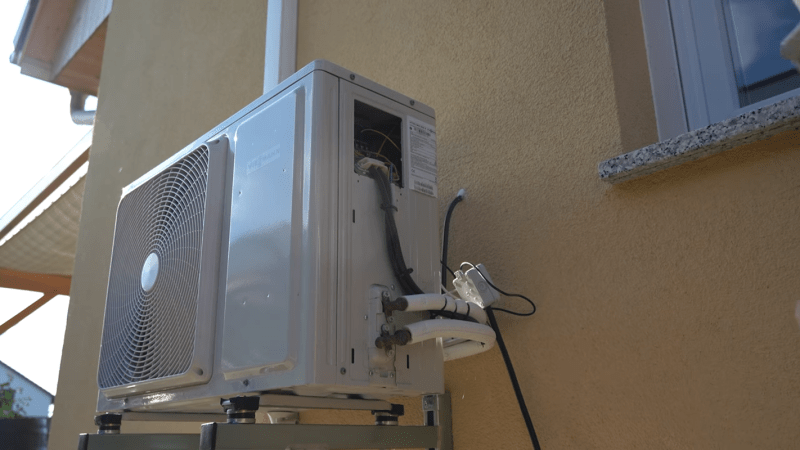
Modern heat pumps, of which air conditioners are a subset, seem like simple machines in theory. They just move heat from one place to another. But in order to operate efficiently, they need specific temperatures and humidities on either side of the pump or they can behave in non-ideal ways. [GreatScott!] noticed this when his air conditioner worked well during a heatwave, but started acting anemic once the outside air temperature cooled down. At once point it was barely able to bring his indoor house temperature below the temperature outside, and he went on a deep dive to investigate why this would be and then found a way trick his air conditioner into working outside its designed temperature range.
Many things can cause this behavior, and some of them are indicative of malfunctions like low refrigerant levels or problems with the compressor or control circuitry. But [GreatScott!]’s unit is pretty new so it was unlikely to be something like that. To investigate, he built a circuit with a small heater which is paired to the outdoor heat exchanger’s temperature probe, tricking the control circuitry into working in a different mode. With a few temperature sensors inside and outside, this was enough to kick the air conditioner into high gear and start outputting cold air again.
While noting that we aren’t HVAC experts, there are a few things that could cause this. One of which is high indoor humidity which might be likely for Germany in the summer, or the outdoor condenser needing a certain temperature or pressure range to operate efficiently. Whatever the case, [GreatScott!] decided to remove his creation to keep from inadvertently damaging his air conditioner. It is possible, however, to use a bit of machine learning to find out more about why one’s HVAC system isn’t behaving as well as it should.












Cool PoC, nut why nog just use esphome?
I have an Mitsubishi AC, and there you can also use an external sensor to the indoors unit to get a more accurate temperature control.
Also using mhi-ac-ctrl to connect to the internal serial bus gives tons of options. There’s also a universal ac controller board that tries to solve this for multiple units.
Never the less, good experiment.
I’m not an expert either, but this doesn’t sound plausible. When the outside unit is getting rid of heat, the cooler the outside air is the better.
If I were to bet, I’d say it was high inside humidity and the system’s protection against icing of the inside unit.
I suspect it’s an environmental override. With the intent to hit certain environmental efficiencies they could be dropping performance since the required output is less work.
Yeah, this feels a bit like my “newer” (as in almost 15 years old) mid-range dishwasher being borderline useless compared to my old one, unless I explicitly choose the “full send” option every time I start it.
Although it’s MUCH much quieter, which is appreciated. Though at the same time, the “approx water in-flow” sensor is literally a reed switch and a impeller wheel, where two opposites of the impellers have a small magnet embedded.
And guess what that does? it makes said sensor a wear item, instead of using a solid-state switching element, like a hall-effect sensor.
I’m not outright accusing it for being planned obsolescence, but it sure stinks like it.
At low outside temperatures with a fixed orifice metering device, the cooling capacity drops off. Need to slow down the outdoor fan to keep the pressure differential high enough across the metering device to maintain cooling capacity.
In case it’s not clear from the article, in the video it is explained that the AC system has different working modes dependent on the outside temperature (he also shows the table in the service manual), and his problem was that the house was heated up from the heatwave but due to outside temperatures being low(er), the AC was not able to bring down inside temperatures.
Simulating a high outdoor temperature with the heater, he was able to get the AC to work, so much so that he got icing on the inner vents.
It’s a it niche use case for sure, and not something you’d want permanently enabled, but clever and hack-ish nonetheless.
So it’s faulty by design…. ?
When I want the AC on I want it on. When I want the heating on I want it on.
I dont want a clanker telling me what to do.
After the hack he got icing. You don’t want icing. The design is sound.
He got icing because manufacturer didnt bother installing temp sensor on the indoor head? and instead hardcoded that stupid table from the manual. Good unit would notice and bump up in-house airflow.
His system was working at a low stage due to excess humidity. If he had waited for the system to do it’s job, and drain away the liquid condensate, he would have seen it begin to cool more efficiently. Instead, he hijacked it’s operations and got a frozen condensate, blocking his evaporator coils, and making the problem worse.
This problem is one I see a lot in homes where they let the temperature swing too widely. They go to work, and set the temperature too high, expecting it will save them money. The humidity builds up all day, and when they come hope, they turn the temperature back down, and the system has a big job to do. It cannot efficiently bring the temperature down until it has removed the excess humidity, which, in the end, costs them more money than if they had just left the temperature as it was.
People only think about the air temperature instead of their entire thermal investment. when the system comes on it doesn’t just have to cool the air. It has to keep cooling the air over, and over again, until it has sufficiently changed the temperature of every floor, wall, ceiling, piece of furniture, and appliance within the home, before it can relax, and just maintain the temperature. Excess humidity just makes it take even longer.
All the same goes for heating, except in the opposite direction.
And for Pete’s sake, put a reminder on your phone calendar to change your flippin’ air filter regularly! You’ve no idea of the future expenses you will eliminate!
I’ve been working with/on air conditioners and heat pumps for and years; from simple refrigerant replacement. to full system rebuilds—compressor/condenser replacements, etc..
One doesn’t need to ‘trick’ a correctly-designed AC/heat-pump into operating in a proper fashion.
Freon Guy as Well..
However you might need to Trick a ‘Legally’ Designed Modern Heat Pump System into doing what you want. Not what the Gov Says it’s allowed to do..
Cap
I suspect it’s less about what the government says and more about the operation and longevity of the unit. There are specific conditions that need to be maintained for proper compressor operation; it’s operating envelope. There are envelope management algorithms that are in place to keep the unit within proper operating limits. Going outside of these limits can reduce compressor reliability.
The problem here is conditions were better than the sensors were reading = machine worked more efficiently and cooled evaporator faster than machine expected = icing.
Good machine wouldnt hardcode a table but read inner sensors instead.
You keep writing that. What evidence do you have of a “hardcoded table” Performance curves in tables are generally established through testing and represent how the units actually function given their design.
Modern heat pumps, of which air conditioners are a subset? I think your Venn diagram is inverted.
Nope at least in the US, Air Conditioning almost always refers to cooling only.
Thus heat pumps are the superset. In fact I’ve ever head people say Heat Pump Air Conditioner to specify that it heats and cools this is usually how home central air is refereed to.
Erm, no? Even in Florida the ac is used to heat. They even must as they have no heating boiler or anything else (usually). Granted, when you speak of AC, it is almost always implied to cool. ‘Turn on the heat’ implying to run the AC in heating mode.
But I wasn’t much in Florida during the winter, mostly just the summers :)
The definition of air conditioning is literally cooling-only…
Could you say hi to your brother for me? Big fan of his work
An air conditioner is a heat pump that only works in one direction.
To further confuse things, “heat pumps” will refer to units that can heat and cool, while “air conditioner” could be a cool-only unit
coolbot has been doing this for decades
Sounds like a dirty coil, possibly low refrigerant pressure
What refrigerant? That new stuff or can you still charge it with like r-22? The newer ones are drop in replacement but less btu power compared to other refrigerant
HVAC control system designer here:
This is almost certainly a trick to hit an efficiency goal at the “ratings point.” In America for example, the DoE rates HVAC systems at ONE particular outdoor temperature (a ratings point) to classify them by Seasonal Energy Efficiency Ratio (SEER).
This AC is probably derating its compressor at whatever the EU’s or Germany’s “ratings point” happens to be, so it can be sold in a higher efficiency category (often with tax credits). It cools better at higher ambients because no one is testing its efficiency there. You noticed correctly that efficiency falls off a cliff when it’s running at a higher speed.
To deal with the icing issue, you need to move air over the indoor coil faster so it loses less moisture on the way. (Roughly speaking, Dehumidification ~ (AirTemp – CoilTemp) / Airspeed.) Check your filter. Also, I’d look at the fan motor and see if there is a tap that’s unused; that might be a faster speed range you could unlock.