
HDMI For The Color Computer 2

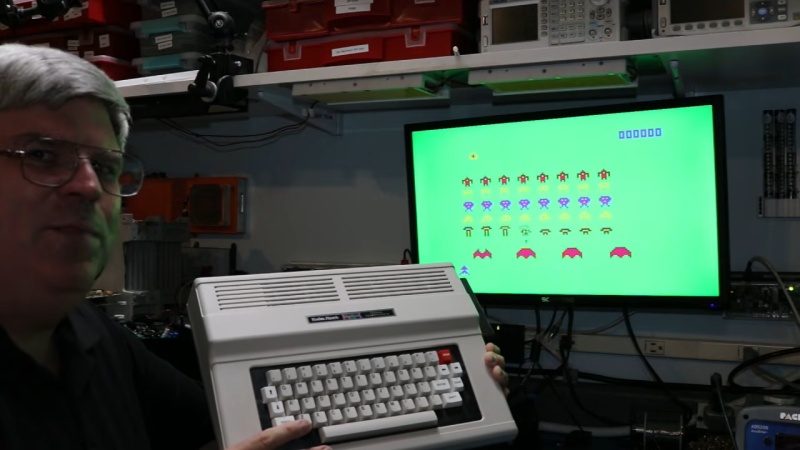
[Scott Baker] bought a TRS-80 Color Computer off eBay some five years ago. He’d always intended to add a CoCoVGA or CoCoDV upgrade to hook it up to a monitor, but the device was sold out and his name never made it off the waitlist. Thus, he decided to build his own solution to give the classic machine a proper HDMI output.

The concept behind the project is simple enough—grab the digital signals that feed the MC6847 IC responsible for generating the analog video output, and use them to create an all-digital video output over HDMI. [Scott] achieved this by using a Tang Nano board, which hosts a Gowin GW1N-1 FPGA. It’s able to snoop the signals heading to the MC6847 and, with some supporting components and level shifters, it can spit out video befitting modern screens. To make the system nicely complete, an analog-to-digital converter is also included to pick up the analog sound output from the TRS-80 and spit it out down the same HDMI cable. Such convenience!

There’s something strangely anachronistic about grabbing a TRS-80 off the shelf and hooking it up to a flatscreen with a single HDMI cable. Regardless, it’s a pretty great way to play with your old machine without having to futz with heavy old CRTs. We’ve featured plenty of similar projects before, too. Continue reading “HDMI For The Color Computer 2”
Creating The Greenest Possible Clothing With Living Fungi

Despite the wide variety of fabrics used for our clothing, they all share the property of not being living tissues. This could be due to them never having been part of an organism, or having been removed from said organism. Another approach here entails so-called engineered living materials (ELMs), with a recent research article by [Ke Li] et al. in Science Advances providing a good example of a fungal platform for such living textiles.

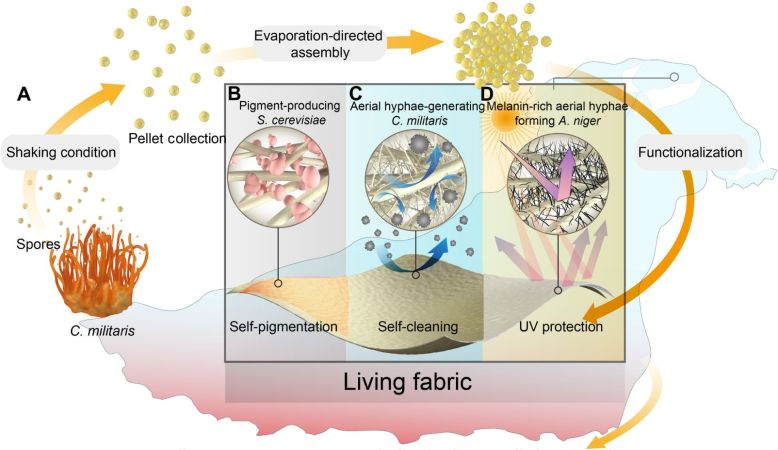
Although it may seem frivolous to create something like this, the direct benefits would be to have a fabric that can self-heal and respond to its environment, including blocking UV radiation and changing its coloring through pigmentation.

The research demonstrated in this paper covers essentially a platform for creating a living textile that can be adapted to a wide variety of applications and colorizations. Of note is that the researchers have not yet tested aspects like washability, abrasion resistance, breathability and wearer comfort, so this should definitely be regarded as setting the stage for more research.

For the basic material the fungi Cordyceps militaris was chosen, which were subsequently placed between films. To this additional microbial cultures were added, including the pigment-producing S. cerevisiae and melanized A. niger for UV blocking.

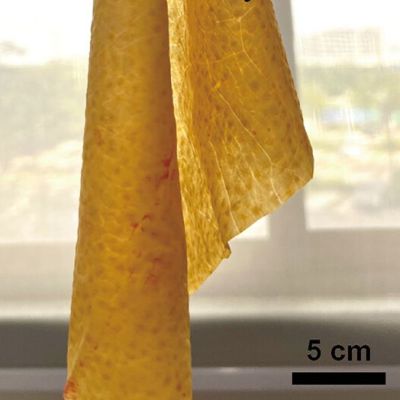
As for what it can look like with clothing, this article at De Zeen gives somewhat of an idea, as well as how the living textile is prepared.









