
HDMI For The Color Computer 2

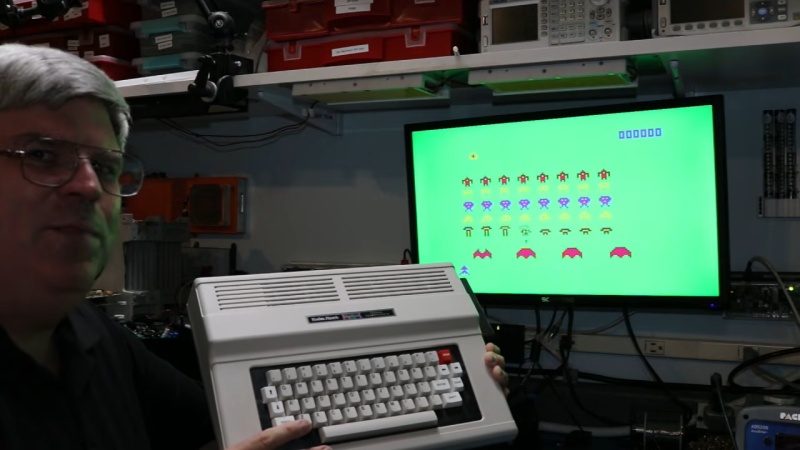
[Scott Baker] bought a TRS-80 Color Computer off eBay some five years ago. He’d always intended to add a CoCoVGA or CoCoDV upgrade to hook it up to a monitor, but the device was sold out and his name never made it off the waitlist. Thus, he decided to build his own solution to give the classic machine a proper HDMI output.

The concept behind the project is simple enough—grab the digital signals that feed the MC6847 IC responsible for generating the analog video output, and use them to create an all-digital video output over HDMI. [Scott] achieved this by using a Tang Nano board, which hosts a Gowin GW1N-1 FPGA. It’s able to snoop the signals heading to the MC6847 and, with some supporting components and level shifters, it can spit out video befitting modern screens. To make the system nicely complete, an analog-to-digital converter is also included to pick up the analog sound output from the TRS-80 and spit it out down the same HDMI cable. Such convenience!

There’s something strangely anachronistic about grabbing a TRS-80 off the shelf and hooking it up to a flatscreen with a single HDMI cable. Regardless, it’s a pretty great way to play with your old machine without having to futz with heavy old CRTs. We’ve featured plenty of similar projects before, too. Continue reading “HDMI For The Color Computer 2”

Modern In-Circuit Emulator For The 6809

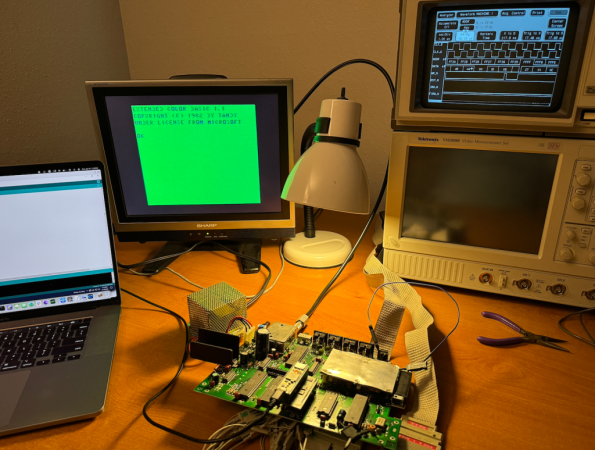
The Motorola 6809, released in 1978, was the follow-up to their 6800 from four years earlier. It’s a powerful little chip with many 16-bit features, although it’s an 8-bit micro at heart. Despite its great improvements over the 6800, and even technical superiority over the Z80 and 6502 (hardware multiply, for example!), it never reached the same levels of success that those chips did. However, there are still some famous systems, such as the TRS-80 Colour Computer, which utilized the chip and are still being hacked on today. [Ted] is clearly a fan of the 6809, as he used a Teensy 4.1 to create a cycle-exact, drop-in 6809 emulator!

A small interposer board rearranges the Teensy pinout to match the 6809, as well as translating voltage levels from 3.3V to 5V. With careful design, the Teensy matches the cycle diagrams in the Motorola datasheet precisely, and so should be able to run any applications written for the chip! A great test was booting Extended Colour BASIC for the TRS-80 CoCo 2 and running some test BASIC programs. Any issues with opcode decoding or timing would certainly be exposed while running an interpreted language like BASIC. After this successful test, it was time to let the Teensy’s ARM Cortex-M7 rip and see what it could do.

Continue reading “Modern In-Circuit Emulator For The 6809”








