
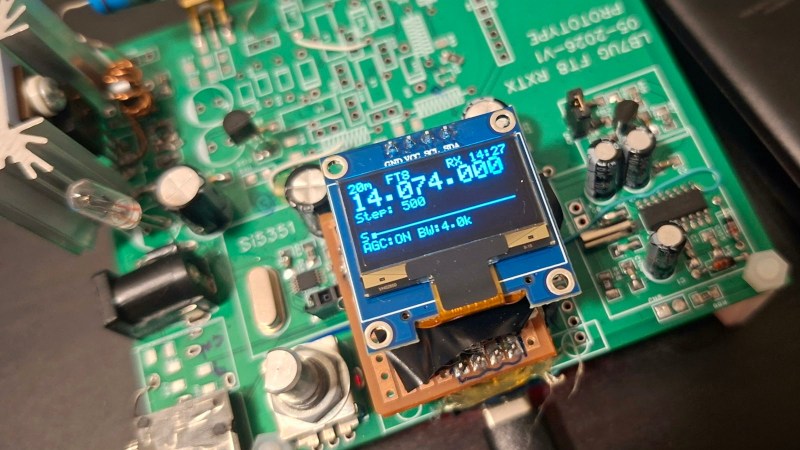
Making a radio is so often a case of taking tried and tested designs and working with them to create something new. It’s a safe way to make something that works. [Riyas] however has gone for an entirely different tack, creating an entirely modern transceiver with as much as possible going on in the silicon.
At its heart are three integrated circuits, the familiar Si5351 as a transmit VFO, an Si4372 receiver, and an RP2040 tying it all together. This microcontroller functions both as controller, and as an ADC to provide a software defined radio via its USB port. The Si4372 having an internal SDR architecture and its output being digitized again is not lost on us.
It’s for digital modes and CW only, but we’d venture the opinion that those are where the interesting stuff is anyway. We certainly like it for its simplicity, and also for the one-cable solution it offers. So many other designs need a sound card and extra cables, this one makes for a lot less clutter. We hope we’ll see more development on this design over time, it could become a favorite in the homebrew rig stakes.
Meanwhile the Si5351 is notoriously annoying to program. A while back we covered a library that might help, if you get stuck.












No SSB, no fun.
No SSB? FT8 operates on USB, so maybe just need audio circuitry?
Everyone in the comments complaining about ‘no SSB’ is overlooking what software can do. With the RP2040 handling the digital stream and the Si5351 capable of phase/frequency manipulation, could this hardware support EER (Envelope Elimination and Restoration) via firmware? That would unlock SSB voice capability without adding heavy analog modulators to the board?
Only pro mode, plus idiotic data…
The RP2040 delivers a (software) USB-Audio codec. So nothing extra is needed for SSB, it´s already all in.
qrp-labs.com sells a digital VFO kit that would be a big time saver if programming the SI5351 is an issue.
You’d venture to be wrong, btw, although there are many interesting things to discover in digital and certainly exciting things to do with CW. So I wouldn’t want to discourage someone from dipping their proverbial toes in the RF waters while also building or exercising their soldering/build quality, but don’t let the writer’s expressed opinion become fact in your mind. You’ll also be able to better understand the circuits and waveforms with the slightly more intuitive analog medium.
I have put together projects using Raspberry Pi with the RP2040 chip. Some DIY project that I have seen with Raspberry pi is receiving
Only fo ham radio . Are there existing schemes
to build a transceiver?
schematics and pcb layouts are in the linked page on the article. It has both rx and tx