
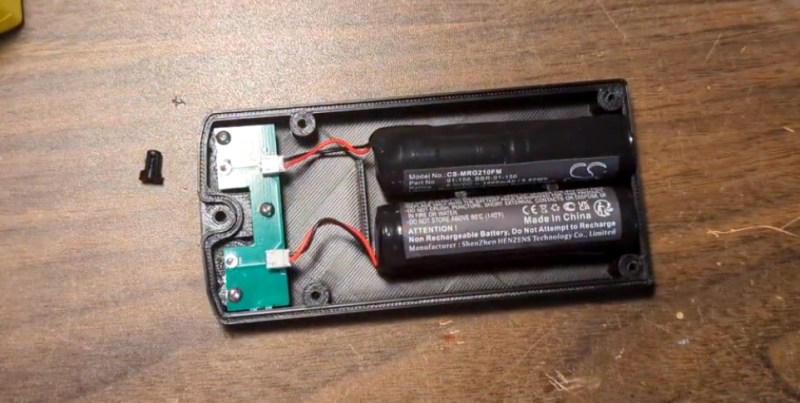
If you find yourself lost in the woods or adrift in the ocean, a GPS-enabled Personal Locator Beacon (PLB) is certainly a handy thing to have as it will pinpoint your location for rescuers. The one [Steve Jernigan] has is relatively affordable considering it might save your life one day, but it turns out that replacement batteries for the unit are extremely expensive and hard to come by because the manufacturer would rather you send the unit back to them for refurbishment. So naturally, he took it apart and figured out how to do it himself.
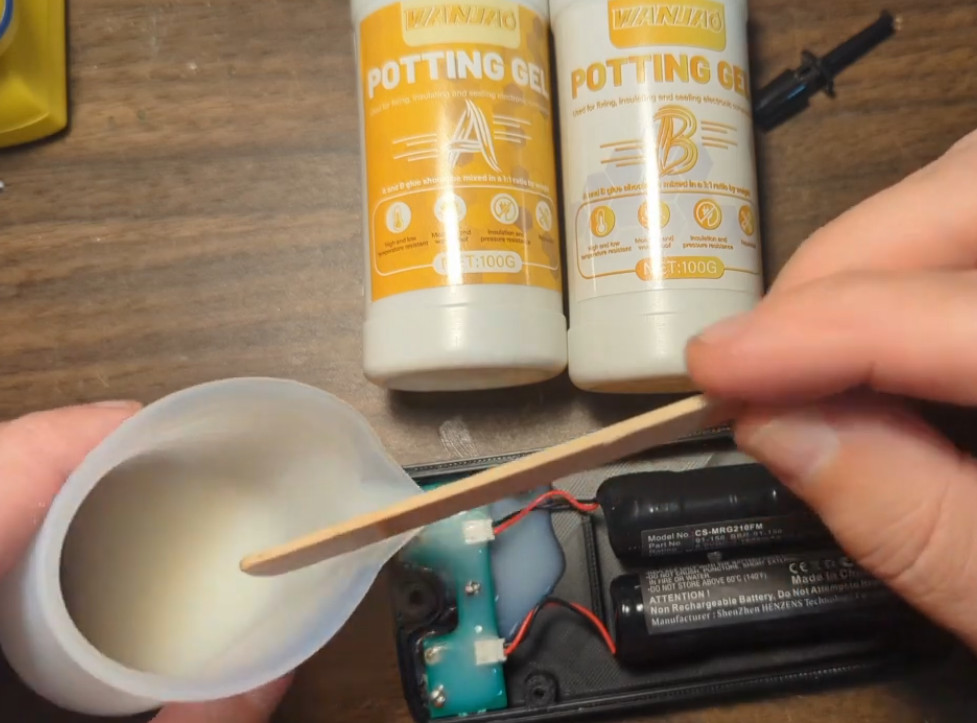 His DIY battery pack consists of a small custom PCB and pair of off-the-shelf 6 volt lithium manganese dioxide cells in a 3D printed enclosure that slots into the rear of the McMurdo PLB. In assembly video below, [Steve] shows how the pack goes together and demonstrates the use of a two-part potting compound in an effort to keep the elements at bay.
Before anyone says it — putting a homemade battery pack into a device which one day might be the only thing standing between you and death is probably not a great idea. [Steve] mentions in the description of this project that this is meant for backup purposes, and that you should really spring for a legitimate battery if there’s a chance you might actually need to be rescued at some point.
If you’re interested in battery pack hacking that doesn’t potentially risk life and limb, fixing the one that came with your cordless drill might be a better project to start with.












This is related but not life-threatening: I have a fancy four quadrant power supply that can measure picoamps of current but it’s not passing calibration because it has an error as a result of the built-in battery failing after ten years. The original battery appears to be completely unavailable. I found another with the same voltage and slightly higher capacity, that is the same diameter so it fits in the same internal clip, and swapped it in via cutting the pigtail and soldering this in (to retain the fancy keyed/locking connector on one of the PCB’s) and it works again. Which is nice because the device would cost $15k to replace. I was tense about it because of the price but it seems to be fine. If the alternative is that it’s useless, give it a shot!
Curious: what is the cost breakdown between replacement of the beacon, refurbishment of the beacon, acquiring the correct battery, and this hack? Sounds like the correct solutions are this hack (as a backup) and acquiring a brand new device (as a primary)…
Fair question. You can buy a used McMurdo PLB for $25 to $50 (with no operable battery). The company would prefer for you to ship them the product for battery replacement and testing. I think that runs about $250. This hack depends on the same batteries which run about $25 each (there are two). The rest of the BOM is marginal. So $100 at most gets you a PLB with no subscription. A new one would cost you $270.
In the UK at least, A 406MHz PLB (and an EIRPB) can be registered for free, no subscription required. It’s a case of buying, register with the Maritime and Coastguard Agency (regardless of use – maritime, aviation or land based).
Honestly something like this I’d be perfectly comfortable with a DIY battery pack done with a little effort – the only dubious bit to me is can you source the same quality of cells, as battery purchasing when you can’t go direct to the manufacturer with the scale of demand always seems to be a crapshoot. Fairly likely you don’t actually get what you paid for, but rather a reject/lower grade cell with fancy shrink wrap substituted somewhere in the middlemen.
But for something like this where you expect years of shelf life and maybe a few days of actual operation it wouldn’t be hard to double or even triple your cell order and test drain one of the extra every now and then to at least have confidence the beacon will last if active. And/Or just cut the expected shelf life before you replace the battery again pre-emptively, for most folks perhaps just put in a new pack every time you actually go out and might need it, as so many folks that would find a beacon like this potentially life saving are only doing those activity once to maybe a few times a year in their holidays during that season of good weather for it.
Some thoughts here – putting a counterfeit battery in does not guarantee it will work as intended. Minor variations in power output can impact the 406 signal, or fry the PCB. The other issue is that the PLB has an internal counter and you need the right software to reset the counter. Otherwise the PLB will not perform corectly. A number of other issues i found is leak testing and correct torque setting on the screws is needs to be performed. Yes a battery change service can be over $100, but the service centre will fit legitimate batteries, leak test, and fit new antenna and gasket. At least this is what they did for my 220 PLB.
James. You seem to know something I don’t about the internal PCB of this PLB. What is the internal counter counting (e.g., number of test cycles, calendar time)? As mentioned, a DIY battery pack isn’t right for all circumstances but maybe it provides a useful backup in some where the alternative was nothing.
Steve- The PCB has an internal counter, which determines the number of tests and run time a beacon can run for. At some point manufacturers had to put something in place to stop a beacon being activated once it reached a certain time/count because beacons like EPIRBs were re-activating in warm water with their water sensor if they hadn’t been recovered after a rescue. Without knowing specifically each model and how the manufacturer deals with it, you could be faced with a unit which thinks the battery is run down, and even though you have a new battery in it, it won’t activate when you press the button. This is the lengthy discussion i had with the service company i used. I can’t see how a back up is ever needed, the units have an expiry so you know when to send it in. Most of the time it’s 6 years or so, so unless someone decided to go out with the unit 1 day before it’s expiry, you have plenty of time to change the battery properly!
Thanks for the information. To be clear, this wasn’t meant to be a backup for another PLB. It’s a backup for another technology. In my case, that’s just cellular or satellite SOS on my phone. Of course, phones can run out of batteries or get damaged. I don’t believe my PLB has ever been activated. It also has a self-test that seems to be responding appropriately. It would be rather devious to make the self-test respond correctly but not send the alert based on a hidden counter.