
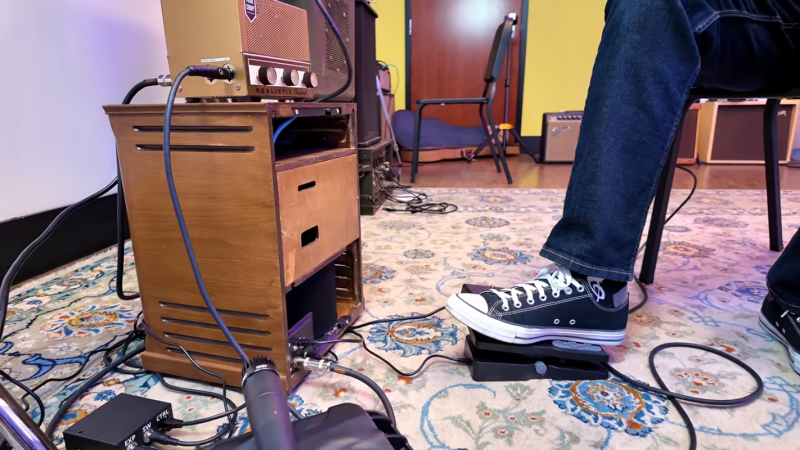
Few pieces of vintage audio gear from the turn of the century (the previous one) inspire the kind of devotion that a Leslie speaker does. Sure, there are plenty of pieces that are rarer or more valuable, but the Leslie speaker has such a big following because of its uniqueness of physically moving sound around a room. Two rotating devices in the speaker physically direct the sound around the cabinet with musician-controlled speed, and this sound remains extremely difficult to reproduce faithfully without the moving components. But originals are enormous and meant for organs, so [Eric] built a 40% replica with a few modern touches for his guitar.
The build starts with a CAD model, where [Eric] works towards making the most accurate enclosure for his speaker as possible. The CAD model heads out to a CNC machine which can care most of the details into the wood, and he eventually is able to finish it, although it took a few tries with stains and paintbrushes of various types. For the speakers themselves, he’s using modern versions including modern brushless motors to drive the rotating elements. Like the original speaker, the high range of sound is sent through a rotating set of horns, of which one is only a counterweight, and the low range is directed out of the bottom of the cabinet through a large rotating drum. Both rotating elements here are 3D printed, and with everything put together and wired up [Eric] has a much more portable, faithful recreation of the original Leslie speaker.
There are some upgrades in the wiring too, which makes it work better with a guitar rather than for an organ. It’s also much lighter, and was a hit when he took it to let a few other guitarists to play as well. It’s not the first time we’ve seen the Leslie’s movement recreated for guitar, but it is the most alike to the classic 1930s-era speaker we’ve seen so far.












Note that because a real Leslie cabinet includes some Doppler shift and filtering change as well as directional change, it is not just a stereo sweep effect. Reducing the size would affect that interaction; the speaker will not be moving as fast for a given rotation speed, so the frequency shift will be reduced.
There are digital audio plug-in implementations. But it’s nice to see a new “practical” version.
There’s also the “Lester” line of pedals by Electro-Harmonix which do actually a pretty good job of recreating the effect.
Also, I have an actual full-sized Leslie unit in my living room which I use for guitar, but mine is an Italian clone from the 80’s with a 100W solid state amp and line-level jack input so I don’t have the problem his full-sized one has.
Interesting.. what’s the brand and make?
I’m wondering why 8″ and not 10″ or 12″. Would you say it makes a difference? Do you run it as the only speaker or in parallel with a “dry signal” speaker?
Grtz from Twente, Netherlands
It’s a DBS Electronic “L 100 S”. But unlike the images google finds of units with tolex covering, it has a nice wooden cabinet. I run it standalone, just for fun.
It has a 12″ and two horns, I have no idea what difference an 8″ would make except for less low end.
Cheers from Enske!
Thanks for the tip!
Excellent project. I have two “original” Leslies a short model 122 and a 22H converted to a 122 (tall). These are used for guitar or my Hammond A100. All are in excellent condition. I had a electroharmonix pedal modified to allow use of a guitar (line level input with either Leslie. These are completely amazing speakers and Organ. Nothing like the sound of these with any instrument. Used by the Beatles (while my guitar gently weeps) as well as Cream (Badge, for example). I also have a motion sound rotary speaker and a ventilator pedal. Nice to see a talented individual resurrect and modify the classic. Beautiful workmanship on the cabinet.
Did anyone use it on an actual organ and if so, how did it do?
Not yet, but that’ll probably be in a followup video or short.
Does anyone make brand new Leslies anymore? Every one I’ve ever seen is old, beat up, has torn/repaired horns, jerry-rigged, etc.
You can still buy a new Leslie 122H and a couple other models. They’ve slightly modernized it, but it’s mechanically the same. Still tube amp.
https://www.sweetwater.com/store/detail/122H–leslie-heritage-model-122h-keyboard-amplifier-with-rotating-speakers?_queryID=fb56f379586ffb3e66e5d102e1c22abc&_index=production_products
Good job with the build. I do beleive there’s a market for a new modern Leslie with multiple inputs.
Look for free organs or visit a piano and organ store, many older organs have a single rotor inside. A Wurlitzer inductive coupled and conventional rotor in front of a speaker will come close to the twin rotor sound.
Will you be making these to sell? If so how would I get one? Thanks
Man…I’d sure like to have one of these….do you sell them?