
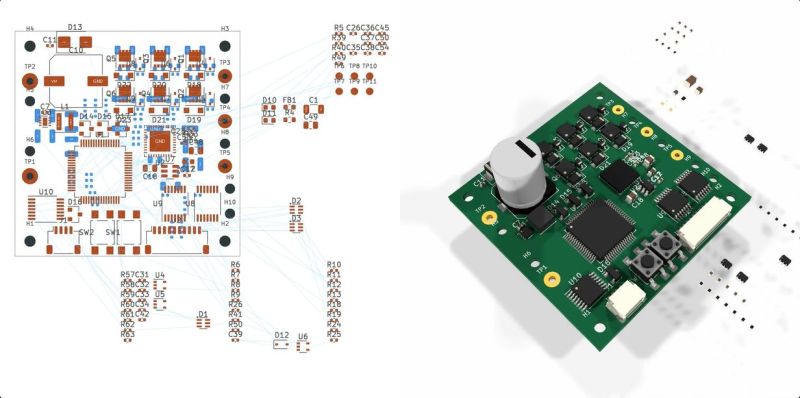
With the recent release of its GPT-6 Astra model, OpenAI explicitly pushed the claim that it is capable of designing complete circuit boards in KiCad, starting from a provided schematic and outputting a fully routed PCB that theoretically could be sent off to be manufactured. This of course raises the question whether this is just a nifty party trick that works under strictly controlled conditions like most auto-routing tools, or whether there’s more to it. In a recent [EEBench] blog post, OpenAI’s claims are put to the test.
Back in 2024, we looked at how LLMs handle circuit board design, starting with the schematic. The conclusion was that you might as well just do it all by hand. Tracking progress here, [EEBench] is an electrical engineering agent benchmark that tests how effective these so-called AI agents are at performing useful hardware engineering work. As their methodology already makes clear, creating a populated and routed PCB from a schematic is just one step of many.
Consequently, GPT-6 Astra scores 69.3% (+/- 10%) on their benchmark, roughly in the same ballpark as Claude Opus 5, albeit cheaper and faster. It should be noted that [EEBench] is run by the developers behind Atopile, which is a code-based system for creating PCBs in KiCad with a strong focus on use by such AI agents.
Despite this, the blog post makes it clear that there is still a long way to go before hardware engineers can receive their pink slips and take up another profession. After all, while vibe-coding a quick prototype PCB can be a nice shortcut, for a one-off project PCB, most boards are expected to handle all the edge cases, be fully validated by multiple independent engineers, and have passed stringent testing before committing to a production run.
(Top image: from OpenAI GPT-6 Astra KiCad video)












I’ve vibe coded 3 pcbs that I’ve sent off to manufacture now using Fable. Each one has come back working first time. It was done via just pointing claude at empty kicad files with no skills/mcp etc. It usually takes me at least one re-spin or some hand rework for boards I’ve done by hand. Complexity wasn’t huge for the boards, but they also weren’t totally trivial. The routing can look a little wonky (which started me down the rabbit hole of making a rust fork of freerouting), but its really wild how well it works.
I´ve directed Claude one year ago at datasheets, telling him what my goal was, hinting it at good schematics practices and got mitigated result. It was for sure a good shortcut in the sense it cut my schematics development time by half. Tried again last month and it was already much better. Yes, KiCAD files, because KiCAD is all text-based.
The leap i am waiting for is when KiCAS API will be finalized, I´ll direct the AI at the API socket, and it will directly handle the software.
“him”
Just what I was thinking
Has anyone asked an AI what it identifies as?
Pronoun selection is a hot topic these days.
Some people are going to be like seriously psychologically broken when they finally have to face the possibility that it’s not all hype… so many have invested a huge amount of their psyche into the anti-AI op (which was funded by like four or five billionaires (who all work in AI lol))
And you point then at us after the bubble pops. Saying things like, “if you people had used it more!”.
Just two more weeks before it pops. Any day now… Remember the dot com bubble burst? Man I sure do miss the internet, too bad it all got destroyed…
That’s a funny example. Dot com bubble had nothing to do with the internet. You know, the medium itself.
Arguably the current AI hype cycle doesn’t have anything specifically to do with the ‘medium’ either if you’re going there. Just a current batch of companies and economic/geopolitical particularities. DanielF implies that it’s overhyped because people simply don’t use it (if you look around you, you’d find that’s not the case).
What AI medium?
You were implying that internet itself was a bubble when in fact it was just a stock market.
And no, it is overhyped because it is subsidized by companies loosing money. Which also makes it a bubble.
PS: I have accidentally clicked “report comment” instead of “reply” …
There is nothing to report.
You gotta stop using the word bubble.
Indeed, “mania” is much more apt, as in “Tulip Mania”.
My opposition to AI isn’t based on it not working. Plenty of things work very well but are still bad. I am not an optimization algorithm, I do not always have to seek out efficiency. In fact, efficiency is often anti-human, and the most efficient world is probably hell.
Thank you! This needed to be said.
100% these folks are telling on themselves hard. The only AI that is acceptable is one you train yourself and self host and even then only training it on things you have been given permission to use. If you use it to replace your thinking your brain dies faster.
Also the bubble is going to burst and its going to be catastrophic and likely tied into the petroleum collapse coming up. AI companies just don’t make enough money and never will, people just don’t like them, and dude bros that like using it are in for a bucket of cold water if they’ve offloaded all their skills to the Robit
What a savage burn! well done.
They couldn’t do it at all last month. They will be better than all that stuff in a little while. People always critique this stuff as a snapshot in time instead of as a continuing trend.
I completely agree, these ai things will improve, and quite rapidly too. But on the other side of the equation there there are the huge ai companies, investing a trillion dollars, wreaking havoc with the economy while making huge promises that simply are not true yet. And that turns them into lying bastards. And that the “leaders” of these companies are the scum of the earth is not hard to see. Just have a look at the many billions that the sugar mountain guy pays in settlements, and for a big part that is to avoid having to testify under oath.
The dark side of me sometimes thinks all these “hallucinations” of the ai things are on purpose. They are learning to be better liars, and learning how to mislead more people more effectively. People who have gotten ridiculously rich by lying and cheating are now teaching monstrous machines to do the lying and cheating for them. One of the latest scandals is that he set up a system to guide teenagers into insecurity and depression, just to make some profit on advertisements for “beauty products”.
It’s now gotten to a point that these machines (and their companies) are evolving at a much greater speed then society can handle, and he main goal it’s used for is to extract more of the worlds wealth into an ever smaller group of sociopaths who already have more money then they can handle.
It’s fine to watch for trends, extrapolate and be excited for the future, but you can only critique a product by its snapshot. As in, it works for the task, or it does not. Version A works, version B is better at this niche task, version C does worse than A. And unless you can run the models on your own hardware, you’ll not know if the tool will work tomorrow.
Hi, professional hardware developer here,
For software developing our society accept, for some unknown reason, that software never works well. There is always an update, there is pressure to the user to use updates, user put pressure to the developer for update. Strange if you think of it? I guess it was different when software was in the mask rom of your devices. :-)
For hardware developing it is different. If I made an issue and the device start to fail 1-2 year later my boss has to lie to the customer (it is your problem!), had to exchange the hardware, the customer go to court, newspaper write about it.
There is much higher pressure to the KI do deliver 100% solution. For software the people accepting 97%.
Agree that the bar is higher for hw than sw.
But this is because:
1) HW cannot be changed once shipped to customers. The cost to recall and rework/replace could sink a company.
2) HW is several orders of magnitude simpler than a modern software package. It’s simply not feasible to even find all the sw bugs, let alone fix them. A well designed pcb can be made extremely rebust.
That said, I don’t think we ACCEPT buggy sw exactly. We’re quick to complain and report bugs. And we are very insistent that the ‘vendors’ fix those bugs immediately – Especially when we haven’t paid anything for them – ask any FOSS team. It’s more that the sw vendors set their release metrics below 100% for the reasons given above. If the bar were anywhere near 100% companies would never ship anything.
Also, re the 97% sw quality metric. For small apps, maybe. But any feature rich app (like kicad for example) it will be much lower. The release requirements might be no known ‘show stopper’ bugs, and overall bug count declining and less than some percentage.
Note also that complex electronics devices (such as cpu’s) have similar constraints to sw. Though they are still simpler, they are complex enough that perfection is unrealistic. The ‘no show stopper’ bugs target is true there too. The onus on validation to identify the show stopper bugs is just much higher because it can’t be changed once it goes to the fab.
I fail to see how a CPU is less complex than (most) software. Especially if considering the necessary production processes tightly coupled to the design.
Having worked on both sw and gpu design I am certain that CPUs are less complex. Yes, there is more physics involved, but this is mostly baked into the libraries and the fab process. It is solved once and then used in multiple designs, as the process is gradually refined to increase yield. And the libraries are composed of simple cells that are straightforward to validate. Finally, that the process has manufactured the design properly is straightforward to test using the scanchain.
I’m not saying ASIC design is easy. It’s not. But software is now vast. It consumes large libraries, that are in themselves very complex, and interact with the application in sometimes surprising ways.
That sounds like a lot of it needs to be rebuilt from the ground up. This is just recursive inefficiencies layered atop one another. This is the exact reason one tool chain change to a dependency on a FOSS tool and brick the internet for 15 hours. I know a lot of people’s take pride in their ability to understand the complexities of these web of nonsense but that doesnt mean it is the best way to do it. This is why hardware reigns. When you have a bug, you get rid of it in the next iteration and the amount of remaining bugs can be feasibly reduced to single digits. Software? No shot.
Well, yeah, make software simpler. And if you can’t, adapt the hardware to run simpler software (hint: we didn’t do that the last 30 years. Only complexity on top of complexity.)
This is absolutely right. Software developers are very reluctant to make backwards compatibility breaking changes even if it saves millions or even billions (excel) of collective working hours. Because, reasons. Even non-breaking changes are difficult to push if it didn’t come from the right person. There is a better way to develop software, but humans have a hard time with it. Any annoying mess in software is based on an old requirement that never got reevaluated and everyone keeps working around it.
This is software developer cope for slipping standards and enshittification. If every update required a new batch of floppies and a reprint of the physical manual, they’d try harder to make it 100% functional and bug free before the first release ever happened. Now people ship whatever minimum viable product they can get away with and trickle out updates later.
A lot of the poor quality of software seems to be enabled by the tyranny of good hardware. The ceiling is just too high, it’s tempting to write slop
I knew a guy who was looking into getting some rideshare type software custom made. It was to be really simple no crazy features ect. One of the metrics he was using to compare between companies was the minimum time between updates. I thought that that’s just plain screwed up because if I was them I would make the thing with preplanned bugs to “fix” in the next update. Is this how it is now? Why make it right the first time if your customers are measuring the value of your work by how often you fix the problems with your product. None the less he went with the the guaranteed updates every 2 weeks and no one was picked up on time, people’s names got mixed up, all kinds of little things that they told him we will get it in the next update. He eventually went back to go old pen, paper, and phone calls.
The consumers are expected to be testers for the next revision.
Looking at the automotive world, since manufacturers started boasting that their cars could do over the air software updates, I have started to see posts in various forums of customers angry because their new car does not receive a monthly software update like their phone does.
I personally rather have a thoroughly tested software and zero updates, unless critical.
An article about AI.
I am sure the usual HaD commenters will be very normal and rational about this.
Variations on all of the existing designs out there should work fine, but edge cases could be problematic. It is like the “octopus in a spacesuit” problem for image generators they all failed badly for over a year because there was nothing close enough in the training data. Google nano banana was the first to pass that test.
“… vibe-coding a quick prototype PCB can be a nice shortcut …”
indeed. 😁
I believe from a perspective of caution we must ask if LLM design of power supplies could be accepted as is? Like if we just build what it outputs, it will be totally safe right? Would you use an LLM to determine if a foraged mushroom is toxic or not?
Your product still needs to be tested for compliance with safety and EMC regulations.
This hasn’t stopped manufacturers though from e.g. bringing those dangerous usb chargers to the market. As creating electronics junk becomes accessible to more people, we can expect that more of it will be coming.
No …. I’d use Random Forest. https://www.kaggle.com/code/atasaygin/mushroom-classification-and-eda-rf-svm-xgboost
The current pipeline is to use AI to get rid of the blank page, make a first draft. You (ideally) have a human with subject-matter expertise go over it afterwards, only using it as a time-saving tool.
Agree with you. Will be interesting though how you become a subject matter expert if you haven’t done the basics yourself. Maybe I’m stuck in the old-school thinking trap that has been argued every time there is a new technology, for example when calculators were becoming the norm…
Maybe you don’t HAVE to know how to do everything from scratch. I can understand stress and strain, but I don’t pretend to understand the shape function for a QUAD8 element, yet I’m happy to use an FEA solver and trust the results after a basic investigation for obvious errors.
People without proper knowledge and experience design faulty powersupplies today, just last week i saw I guy on Reddit who had designed a 230v->5v Buck regulator with less than 0.5mm clearance between 230v traces, no transient voltage protection and no isolation on a Handheld Product. And this guy was asking how much he should charge for his design as this would be mass produced by his client.
Designing A PCB (Footprint placement, track layout) of the complexity as shown in at the top of this article is not difficult. You mostly need a decent GND plane, and sensible placement and connections of decoupling capacitors. Maybe some of the tracks need length (timing) matching. When you have both noisy parts (SMPS) and sensitive parts (analog amplifiers, ADC, etc). that also needs physical separation. SMPS circuits also need extra attention on their layout, but the rules have been established over 40 + years and are well known. So I’m not surprised that an ai can do a decent job.
At the moment, such a city block sized energy guzzling ai thing is barely more intelligent then a 8 year old child. (there are other difference, it does not get bored or tired, and it’s patient to tolerate stupidity from the users etc) It’s still extremely immature and it will take a while for it to get from a few megawatts down to the equivalent of 5 sandwiches and a few potatoes and vegetables per day. But it surely is evolving much more rapid than humans do (or can handle).
And these things are germinating like sprouts at the moment. There is too much mist in the clouds for me to make any prediction of the direction this is going in.
And how much of pcb are as simple as in the exemple ? 25% ? 50% ?
90%
There are PCB design houses and manufacturers who specialize in ai gle sided PCBs. LEDs are just rows of diodes and resistors. There are consumer products shipping now that are raspberry pis and some modules you can find on Amazon. Most stuff people buy is not very complex. If you look at computers all day. Your pov is skewed. Check out BigClive on YouTube. He disassembles all things cheap and examines the PCBa and circuits. Very interesting and educational.
Sorry, single sided PCBs
At the PCB stage, most of the engineering is already done. As in, you have a product idea, iterated through circuit designs and component choices. These components need to match the node you are working on. Completely cost optimized and the choices, and make sure each component is available for both hand assembly as well as in quantity at reasonable prices. Just to name a few considerations. Routing can be done in day for these fairly small boards.
Auto place, as well as auto route has been a thing for several decades, and good ones exist. I’ve been out of the game for a while, but Altium has great semi antonymous for high-speed layout tools in 2018. The previous tools were already fine for a quick prototype, but the tool doesn’t give you insight in how the choices are made, and you can’t easily verify the boards or quantify the quality. I assume the current state of the art is better, except that the tools are not available to the average consumer. LLM are rare, that consumers get access to the cutting edge.
That was my own immediate reaction. Auto route/auto place down to the gate level, with management of everything from cross-coupling to delta-i current surge, was starting to establish itself back in the early 1980s, as “compilers” from cycle simulation language to build specification. And unlike today’s AI hype, since these were driven by human written rules they could explain why they produced specific results. I presume work on those continued.
LLMs are sloppy pattern matching written incredibly large. More precise, designed, pattern matching requires more investment of human effort but can produce better results, certainly with better computational efficiency, when the input data itself is not inherently sloppy.
I’d argue that the part LLMs are currently better at than PCB design/routing is the upfront work of component selection and circuit design. They’re very good at reading PDFs, and scraping the web for component availability, especially for services like JLCPCB/LCSC where the stock is very easy to find. A little less so for analog designs maybe, but I’ve had them spin up spice simulations for simple analog circuits and then do reasoning on the output of the spice simulations. It’s worth trying dropping one of your own KiCAD designs into one and getting it to review it.
My employer literally tried this a month ago, trying to find a replacement for a DC-DC converter module that had gone EoL. Should be simple, right? The sort of problem you’d give to an intern: “This part is no longer manufactured. Here’s its datasheet. Go and find a replacement that meets or exceeds these specs.”
ChatGPT happily recommended a selection of other discontinued parts. So we burned a bunch of kilowatts in some datacentre to simply muddy the waters a bit more.
What DID work was the parametric search at Digikey, operated by a human. This gave us a list of 3 possible candidates, which we emailed to a second human at Digikey. The human confirmed that any of the 3 would work, then suggested an even better part. After ordering one of each module to test, we went with the human’s suggestion.
Sure, this is just one anecdote, but it confirmed my bias that
1. Search is imprecise.
2. LLMs generate plausible bullshit
3. Humans with specific domain knowledge can do the the job with a better triangle of faster/better/cheaper than an LLM.
4. Datasheets don’t tell the full story. A real physical prototype and an oscilloscope are invaluable.
Hmm…a working PCB is one thing. There are some types of PCB designs that require more than a good ground plane and all the traces routed.
A high power switching power supply is a good example. Radiated RF, current steering on high power traces, loops that end up being antenna, etc.
Obviously these are things that AI can and will learn as it is trained.
Indeed. I kind of want to see what kind of bizarre forms a properly trained and iterated RF circuit AI creates. I bet it’ll look incredibly strange. Who wants to place a bet on spontaneous emergent biomimicry?
For general ref:
https://www.learnbiomimicry.com/blog/best-biomimicry-examples
There was a buzz about ML antenna designs that were wacky a while back. They apparently work really well, and I’ve seen them in the wild. POV drones tend to use them. It was pre-LLM and everyone thought it was great.
AI doesn’t “design a pcb”. AI stitches patterns stolen… I mean “learned” from the trained data sets, in a plausible way. We’re so far away from the moment when the ANN actually understand the semantics of the manupulated objects.
To be fair, a lot of humans do the same thing.
That’s absolutely true, but doesn’t make it better.
Where is this large dataset of proven patterns with their pros and cons (price, size, rf immunity…) I can choose from ?
Yet it can’t make a footprint from a pdf datasheet.
Here’s the fun part – it depends on the definition of “it works”.
We had auto-routers for basically ages (I remember seeing auto-routing capabilities even back in 1995, maybe it was CADstar or Protel, can’t remember). The question is that the capability was always available during the years, just of varying quality. So PCB designers had to choose whether/when/how to use this capability, and then to evaluate whether the result matched the expectations. Some products require precise routing due to power/signal integrity or compliance/regulatory needs, so these designs are harder to do in a blindly automated way. But during these years CAD vendors were working hard to provide smarter tools so the PCB designers can actually do hard tasks much easier, like routing impedance-matched traces for differential pairs, or length-matched traces for high-speed parallel digital signals (DDR memories, high-speed NANDs, cpu-cpu links, etc). But this is not AI, it’s just a smart tool with human-in-the-loop, so the human is basically responsible for the quality in the end.
If the human is not in the loop, then who’s going to be responsible when “it just doesn’t work”?
And then, the funnier question – when the stupid managers fired everyone and replaced them with AI cloud instances, then who’s going to get the blame when something doesn’t work? Hahaha!
What avout producing the schematic? How far is AI from doing that? Right it’s producing garbage – open circuits, components connecting nowhere etc.
Here is a radical idea:
takes group of components that are close to each other,
arrange them together on PCB,
move/rotate them for minimal path within group
wire in the easy ones
leave the rest for humans meat balls.
This would eliminate 70% of work.
Really? You have just described the easy stuff. The easy stuff is fast for a human too. If the same human drew the schematic it’s even faster, because that human already knows how the “easy ones” are related.
AI won’t be able to make novel electronics, not because of the limitations of AI but because of the nature of how electronics are made.
If you want to make a textbook circuit connected to a ESP32, RP2040, ATTiny, fill in the blank, yeah AI will be able to handle that. But the most interesting datasheets, schematics, and layouts are locked behind NDAs or are simply tribal knowledge.
More times than not, the way to get an alpha chip working is to wrangle an application engineer to reveal an undocumented feature that’ll be published in an errata a year from now. I don’t even think heavyweights like OpenAI or Anthropic could convince the giants of silicon manufacturing to let AI models train on chip documentation.
On the other hand, ASIC design with a hardware description language could be very interesting in the age of Tiny Tapeout.