
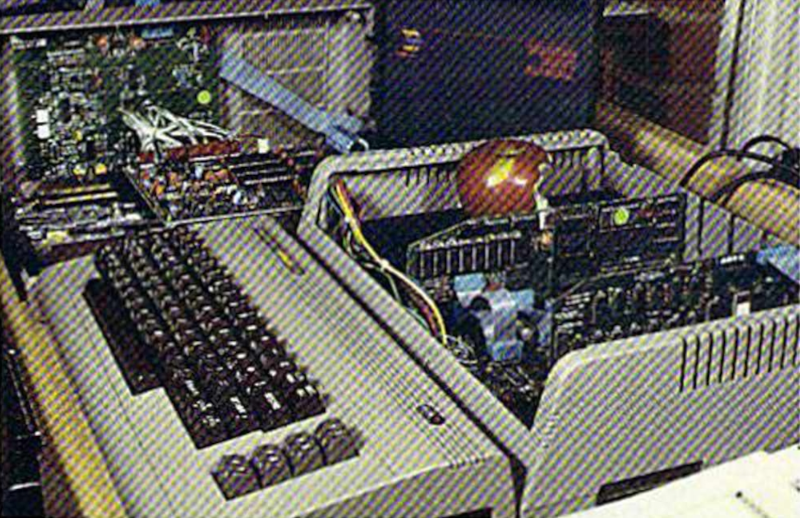
The computer business in 1984 was a bizarre mix of hobby-level companies, a few small companies that had made it big, and a lot of big companies starting to take notice of personal computers. Plenty of money followed, which led to strange products and even stranger ads. [Such Bad Tech Ads] reveals a very bad ad from that time for a product we have barely heard of: the Spartan. The Spartan’s job was to convert your Commodore 64 so it could run Apple ][ software. The ad campaign had, inexplicably, a mime. We think. Or maybe a clown. Hard to say.
On the face of it, the Spartan might not be a bad idea. In 1984, there was plenty of Apple software. Well, relatively, anyway. But a Commodore computer was far cheaper. Other conversion kits like the Intel Inboard/386 managed to find some success in the market later. The problem, outside of strange ads, was one of timing.
If the product was available in 1984, it might have worked out better for the Canadian company, Mimic, behind it. Instead, it was about two years before an actual piece of hardware would show up in anyone’s hands. By that time, there was a ton of software for the Commodore 64. Not to mention that even when Mimic announced the Spartan, Apple had discontinued the Apple ][+ computer.
Why use a mime to promote a product that turns your Commodore 64 into a keyboard and monitor? We have no idea. But he was in all the ads and even on the product box. Strange.
We’ve seen the Spartan before, naturally. Being late usually has bad consequences. Ask FedEx.












What does a mime do? It mimics behaviour. What was the name of the company? Mimic. What does the product do? Allows one system to mimic another.
I’ve wanted one back in the day but never got it. “too expensive”
The mime is perhaps a dodgy Franglais word play on the company name mimic. Where mime and mimic can sort of translate to the same thing in French.
It may or may not be worth noting that some of IBM’s earliest PC ads featured a mime playing Charlie Chaplin’s “Little Tramp” character.
The linked article mentions that, too.
And also install Apple][ expansion cards, of which there was quite an ecosystem – the C=64 didn’t have a comparable capability.
However the Spartan was so expensive that there wasn’t a compelling case to buy it over the real thing.
Hi! I think that the creators’ logic behind it was like this:
The C64 is a new, cheap, widely availabe and 6502 driven terminal and the Apple II is an existing standard in the lab, office and industry.
And that way it makes sense, sort of.
There were IBM PC+Apple II hybrids in a PC desktop case, back then for same reason.
Gigatronics KAT and Cordata WPC Bridge.
They could boot both MS-DOS and Apple DOS.
https://www.youtube.com/watch?v=LFlbjLWzPUQ
https://www.reddit.com/r/vintagecomputing/comments/1k40sfe/cordata_wpc_bridge_ibmpc_and_apple_iie_compatible/
In addition, a Microsoft “SoftCard” (Z80 card) and an Apple II was able to boot CP/M, even.
Which to my dad’s and my own surprise, used to be a very popular CP/M platform, it seems!
Apparently, many CP/M applications supported the Apple II as a supported terminal type or CRT type.
Who would have known!? 😯
To make things even weirder, there was an 8088 card for Apple II.
The “PC Transporter” allowed running DOS software, even had CGA support.
https://www.youtube.com/watch?v=wFNbRQo8drA
I sold computers in retail from 86 to 87, in Australia. Apple used to claim 10,000 apps for the Apple II, but honestly, I had maybe 50 I could order. I had a couple of thousand for the C64, and although most were games, I probably had 200-300 utility and professional titles. Maybe Apple did have a database somewhere of 10000 titles, but a quick analysis of TOSEC databases doesn’t seem to support it (maybe 8000, many released years after this claim was made). Also, many Apple II titles weren’t available via mass market channels, and mail ordering something from an overseas supplier was difficult back then (anyone else remember “international money orders”?) In short, I am fairly confident Apple was telling extreme porkies, and this general belief may not have received the analysis it deserves.
Yes, the Apple II had a lot of titles, and probably some in education which weren’t available on other platforms. But for a normal user, I would question whether this old chestnut of “so much more software” was ever true.