
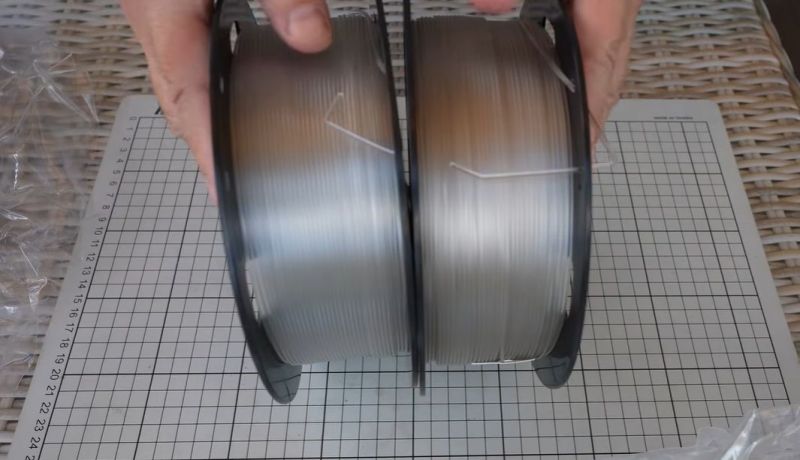
The average 3D printer owner knows a few types of filaments – PLA, ABS, somewhere in the middle, PETG. PCTG is another option that can be confusingly similar to PETG. Recently, [Igor Gaspar] of [My Tech Fun] took a poke at both types. He obtained both PETG and PCTG transparent filaments from the same manufacturer to compare them directly.
As we recently detailed in an article on PET polyesters, PETG is glycol-modified PET, meaning that some of the glycol monomers are replaced by CHDM monomers to create a more flexible and robust material. PCTG is very similar to PETG, except that more than half of the glycol monomers are replaced rather than less than half. This creates a PET-type material that has distinct physical properties from PETG, which might be desirable for some applications.
PCTG is more ductile due to the addition of more CHDM, but also requires higher temperatures to print, closer to ASA presets. During testing, it’s obvious that PCTG is indeed much more flexible, making it potentially a good choice for springs and compliant mechanisms. PCTG is also highly impact-resistant, unlike PETG, and resists higher temperatures much better.
Overall, other than the higher printing temperatures, PCTG seems like a solid option for more extreme environments, potentially as an alternative to ASA and similar filaments.












Very informative video with no fluff.
I’m not an advanced printer and I’ve never tried PETG, but I really like PCTG. My printer is a relatively old (an Ender 3 S1 Pro with an enclosure), but it has no problems with the temperatures (nozzle 260C, bed 95C). Printing slow on a PEI sheet with glue stick. Some stringing, but not enough that I’ve bothered trying to tune the profile. Submitted a test part to an “upper dishwasher rack” test with no distortion. Much more flexible than PLA. In my opinion, it’s worth a look if you are making functional parts.
You should definately try petg! These days it prints about as easily as pla just with a higher bed temp, and is also amazing for functional parts. It’s slightly less stiff than pla, but a lot more resilient. Also has great layer adhesion.
One tip though, don’t go with the matte finish or metallic finish stuff if you want good material properties. The cheapest glossy stuff prints the best and is the strongest. Overture and voxel both make good stuff.
How does it degrade?
After a few years, PLA begins to crystallize.
Look to PETG not PLA.
PETG is hydroscopic so unless you have a filament dryer or another method you may want to use something else. Other than that it’s great, some can be stringier than others.