
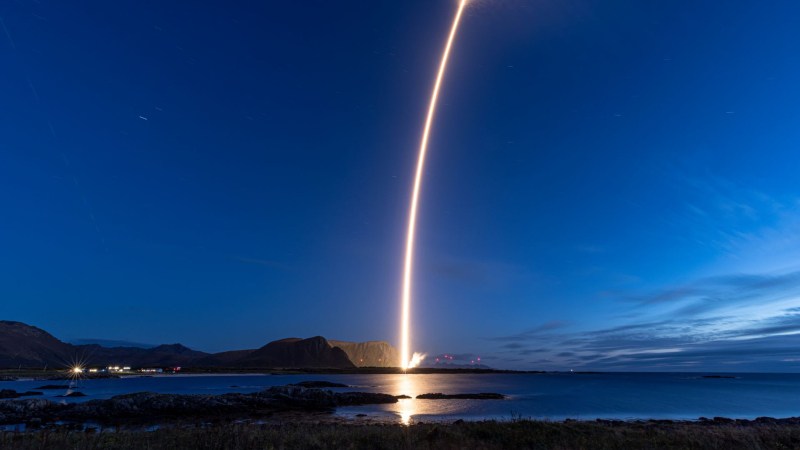
The history of European space exploration is a long and distinguished one, with many decades and whole families of launch vehicles. It might therefore come as a surprise that despite all this, it’s taken until 2026 for a European rocket to be launched into orbit from European soil rather than from somewhere close to the Equator. The German company Isar Aerospace launched one of their Spectrum rockets from Andøya Space in Norway and deployed its CubeSat payloads to orbit.
The five satellites were a selection of projects from the German space agency’s Microlauncher Competition, which offers the chance of a launch to start-ups and educational institutions. The press release doesn’t name them, but Wikipedia has the following list: TriSat-S (University of Maribor and SkyLabs); FramSat-1 (NTNU SpaceTeam); Sat1 (TU Wien Space Team); CyBEEsat (TU Berlin); Platform 6 (EnduroSat) and Let It Go (experiment, Dcubed).[46].
Interestingly, the company is also working on a space launch facility in Nova Scotia, Canada, to gain access to lower inclination orbits and to provide Canadians with their own launch capability. More is evidently yet to come.
We’ve mentioned Isar before, when we reported on the building of the spaceport.












While EU is busy with cube sats and uni projects, Elon launched an entire global sat network that provides low latency internet. And for to do that his company invented reusable rockets…
You deserve it: https://www.youtube.com/watch?v=tJuqBlamd6o
Yeah, all hail Elon! We should all be like him! Well, there’s probably not enough ketamine to go around! /s
You think the rocket and engine design burst full-blown like Athena from his Zeus-like forehead? All built on the existing technology of NASA, Roscosmos and the ESA.
If Elon gets a stroke and becomes a vegetable, the reality distortion field will collapse and probably so will his enterprises because they run as a subsidy/investment scams more than on profitable business.
There’s enough capital in his empire that losing it would trigger a minor depression, probably worldwide. It would count as roughly 10-20% of the size of the subprime mortgage crisis. Musk is the only individual who is approaching the point of being too rich to fail.
That says far more about the failings of humanity as a whole than the success of any single individual.
https://en.wikipedia.org/wiki/Mansa_Musa
A man so rich that when he went on a pilgrimage to Mecca, his spending along the way collapsed the value of gold in Egypt.
I mean… let’s at least give him the electric car, or better put, goading the entrenched incumbent manufacturers to make electric cars again – They’d have never done it otherwise, y’all know it’s true. But the rest of it? ANYWAY Good for the Germans, it’s where it all started. Also, very amusing video.
Unhealthy obsession
That Elon sounds like a very sharp dude! We should put him in charge of cutting government waste! We could save billions of dollars and if anyone died as a result, they would be in poor shixhole countries nobody can even find on a map!
What could go wrong??
Good point, indeed. There’s no doubt that we are a little bit behind over here.
As a German, though, I’m simply genuinely positively surprised by this news and I think it’s still remarkable.
I wouldn’t have thought that we Europeans would still manage something like this in this decade.
I mean we have the Ariane rocket for decades, but that’s a different beast, likely.
Looking back at 20th century I’m kind of glad that this launch had a peaceful, humble start without much fuss.
The focus on university projects or research brings back memories of a time when space exploration meant team work, peace and a better future.
In general, we Europeans have (or used to have) a more, um, romantic vision of space, I guess.
More of a StarTrek-like future, maybe?
Less about big profits or business, which some other nations currently are into?
I mean, sure, these things are pretty important to companies here,
but I think we still have audible voices concerned about the consequences, as well.
Such as a crowded orbit (Kessler syndrome), light pollution or satellites interfering with astronomy and astro-photography.
For example, here in Germany the TV programme “Space Night” from the 90s used to be quite popular.
It was about archived space footage (NASA, ESA etc) with an ambient music playing in background.
It also was combined with some short science programmes in-between, if I remember correctly.
Anyway, last time I checked it still ran in the night programme, as it used to.
That being said, I can’t speak for all my fellow citizens or Europeans in general, of course.
So this comment remains pretty vage, understandably.
My apologies that it is so long, as well. I tried to keep it short.
Europe has been falling behind because the ESA is basically an industrial tug of war between France, Germany and Italy, where each wants to maintain and grow their own aerospace industrial base with the common money allocated to the space program rather than work together for a single economical launch system.
The “fair return” principle means that each state gets contracts according to how much they pay into the system, so projects are not free to choose the cheapest or most efficient suppliers, they’re forced to procure parts and services from those who fund the ESA in proportion to their funding.
For example, when Ariane buys boosters from Italy, they’re also propping up the parallel Italian Vega-C launch system that uses the same boosters and serves a different market segment, and vice versa. This is both a synergy benefit, but also a synergy cost because neither can choose a different supplier or design as they’re mutually locked in to a shared architecture serving two different purposes, so the overall market is less competitive and more politically driven.
Put simply, the point of the system is to maintain demand for every country’s industry, not produce the cheapest or most capable launch vehicles.
I see, thank you for the information! 🙂
Not exactly sure if it’s good or bad, though.
The participing parties seem to have no issue with that model, otherways they would have changed contracts years ago, wouldn’t they? 🤷♂️
Of course not. It’s an efficient way to launder public money into private money through well-meaning international collaboration.
Sure, but is this “dependence” on other neighbour countries and their industry not also strenghten the relationships?
Europe isn’t the US, after all. We all have a common heritage, but no federal states.
Many countries have different ideas how to approach certain things, making matters a bit tricky.
That inevitably leads to lenghty discussions and compromises in common projects.
Each European country thinks about its own needs first, rather.
Except some countries like Germany, maybe, which used to believe in the “European idea” and have ‘no’ national pride.
That’s what we ordinary citizens grew up with for a while, at least.
Not sure about business men, big business and politicans.
Our neighbour France used to be similar here (except for the pride thing), playing a central role in heart of Europe.
I vaguely remember how our former chancelor worded the European idea.
She said, that countries who trade with each others
and have a common currency are unlikely to go at war with each others.
Looking back at centuries of conflict in Europe, it sort of is plausible as an argument, even if may seem a bit naive or simplified.
When people talk of eradicating borders and having universal solidarity and friendship, there’s usually a Hintergedanke. There’s a reason why the countries that were already dominant in Europe, like Germany, started driving for the union: they’d still be the biggest, most dominant economies in it.
And now, it’s not the smallest members who are arguing for federalization either.
We often have the same problems here in the US between the states. Especially with Spacex… see the fits Elon has gone to in order to try and coerce California into not taxing his companies. Thats why only Texas and Florida allow it because they’re willing to sacrifice their public lands and environment at the whims of a company since they don’t worry about having a future for anyone with a vision that can see beyond quarterly profits.
It’s just as bad with NASA’s SLS program though; because it’s congress who allocates funding, it becomes a game of “I’ll only vote to fund if you keep contracts flowing to this manufacturer in my district”. Which is the real reason SLS re-uses shuttle tech. Not because it is cheaper (SLS has cost over 31 billion so far), but because it keeps the money flowing to the same jobs. Unfortunately, this can lead to innovation stagnating, as it decreases competition.
To compare, the estimated development cost for falcon 9 (including reusability upgrades) has been under 2 billion. Falcon heavy is another 1.5 – 2 billion. Order of magnitude lower cost.
A more fair cost estimate considering rocket size and objectives would likely be starship. Looks like estimates place it’s total cost so far in the 15 billion range. Closer to SLS, but still half. Given that starship is a much more ambitious project technically than sls (in terms of new tech to develop) I’m still impressed.
(Full new full flow engine, full resuability including of the second stage, etc.)
They’re also funding it partly through starlink revenue, which was roughly 11 billion last year, so in many ways it’s a return on the invesent of the 2 billion that went into getting falcon 9 to be as capable as it is.
There are many valid critiques that can be made regarding Elon. However spacex does seem to have figured out how to do rocket development on a much more efficient timeline and budget than the SLS program.
How much of that is subsidized by NASA/JPL where the technology and the engineers originally came from? Remember that Musk poached the engineers who were already working on it under public funding.
I think that there are other, historical factors, too.
In Germany, or old Europe in general, humanism and basic research still mattered, were a part of culture. Until a few years ago, at least. 😢
We had universities funded with public money that did basic research without aiming at making specific profits.
It was research itself that mattered, to advance society.
I’m sorry, I’m not sure how to word this properly.
SpaceX did pretty good indeed. But crediting that all to Elon is a bit silly. As it took thousands of engineers and a lot of government grants.
It says right there “his company invented.” Not the man himself. You people are mentally unhealthy
I forgot to mention, a few of us are a bit sad about the thought that internet now is available nearly everywhere, all the time, at high speeds.
It’s a bit disturbing that there are almost no internet-free/cellphone-free zones anymore.
It’s a burden to be expected to be connected all the time.
After a long day, some of us just want to retreat from all this stress, log-off, slow down, have privacy.
My philosophy is this: I only look at my phone when I want to. I bought it with my money to serve my needs. My being able to receive a message at any moment in no way implies that I am required to check those messages as soon as they arrive nor reply to them within seconds. If it is an emergency, you’re welcome to call, but if I don’t already know who you are, I’m very unlikely to answer unless I am expecting an unknown number to call. My phone is to serve me, not others. If you don’t like that, I don’t really care. In that case, you’re probably not the kind of person who I would reply to anyway. I also do not have to give anyone my number if I don’t want to. If you think it’s crazy that I tell you I don’t have a phone number, I really don’t care.
In short, stop caring about the opinions of people you don’t want to talk to.
Hi, I understand. And I believe that works in an egocentric way: I can decide for myself.
With all the consequences that go with it (friends, family, job etc feeling being offended).
However, what I do have no control over are other people.
They’re still there, do constantly use their cellphones, capture videos etc. Then there’s AI..
It’s an unpleasant thought that there’s almost no place anymore to retreath to. No off-line land.
It’s as if there was a wast concrete desert everywhere (-> cities) with no forests anymore.
It’s dystopian in some way, in short.
Well Elon didn’t do anything for that.. engineers he hired did, and he used government money to do it. Theres very little for him to take credit for in all of Spacex or Tesla. He’s a figurehead that gets to choose the colors of the paint and talk to the press while the real work gets done by everyone else.
Why is there now more interest / acceptance of launches at high latitudes?
Because the target orbit is a highly inclined one that sweeps across more ground as it goes around.
For geostationary orbits that put a satellite on top of a particular point on earth, like a TV relay satellite that stays relatively fixed in the sky, you want to launch from the equator to add the rotation of the earth to your orbital velocity.
For a polar orbit that scans across the entire earth as the earth turns around underneath it (e.g. weather/climate observation satellites), you want to launch from the pole so you don’t have to use rocket thrust to cancel the sideways orbital velocity.
For something like Starlink that wants to put the satellites onto highly inclined orbits, the best place would be somewhere in between. Such as Norway. It’s a bit too high for most purposes, but it’s up in the right ballpark.
What’s old is new again. In this case, it is the Molnya orbit, as “Dude” describes well. This hearkens back to the days where the USSR had limited capability to loft something to geosynchronous orbit and have it work with dishes in the northernmost reaches of their territory. So instead of having a dish aimed at one spot on the southern horizon, the Molnya orbit allowed a slowly slewing target overhead instead.
Russia has two cosmodromes in Europe, I’m not sure that headline is accurate
In non-geological terms they aren’t part of Europe.
All it takes is one Tsar Bomba (50MT motherf*cker!) and berlin or paris won’t be part of europe too)))
why worry about something which isn’t going to happen?
Why suggest something that would cause your own demise?
Most reasonable and mentally sound Russian person online
agreed a poorly written headline or ai slop article, either way it should have probably said European union. I was coming here to point out the same thing.
Is Norway somehow in UE?
“Wolfenstein conquest to mars ”
That would make a great video game, wouldn’t it?
You’re doomed.
Really strange that it has taken this long. I thought surely they had launched something at some time in the past… highly inclined orbits for satellites aren’t that unusual.
i was struck by the thread above comparing space programs as if it was a competition, perhaps a source of shame.
one of the things i’m confronting with AI is that i’m not at the forefront anymore. i still feel like i’m good at what i do, like i have a rare and valuable skill. but i’m not even interested in becoming a prompt engineer, or really a lot of things. fundamentally, i’m reminded that i do this stuff because i enjoy it. i don’t need to be better than everyone else. i don’t need to conquer an undiscovered country.
as AI redefines labor, china redefines industry, civilizational collapse redefines class, etc., it will become ever more important to succeed at finding meaning in something that isn’t necessarily pioneering or best.
I think that is a very healthy take on the world and life.
I think that for some of us who enjoy using AI, it’s all about doing what we enjoy. We’re not really trying to become anything with AI. We’re trying to create things we haven’t yet created. In my case, it’s always been a matter of too many interests and not enough time. Before, I could do anything I set my mind to, but learning what I needed took a lot of time. Now I can do those things by learning a much simpler adjacent skill and using technology. AI compresses the time required to discover and create. So I like it. There’s not really anything else to it.
Europe is launching rocket and satellite from its ground since 1979. It seems German are either too stupid or blatantly lying to impress investors. As for the why, Arianespace (which makes the Ariane launchers) is launching from Guyane, which is a French territory, hence it’s part of Europe, thus it’s an European territory. It’s located in South America for those you don’t know. France has many territory around the world (La Réunion, in Africa, Tahiti in Polynesia, …), and they are all Europe.
than, was USA a part of Europe in old good days? Was Africa in Europe in XIX century?
As a German, I think that we’re a bit stupid sometimes and that we would tend to try to impress investors, yes.
However, the country has some wonderful people and beautiful landscapes, as well.
It’s just that we have a hard time to differentiate between “investment” and “financial loss”, I think.
That’s why one-man companies and start-ups have it so hard. Paperwork does the rest.
The focus is always on possible risks rather than what can be gained.
And in some cases that’s good, too. Like in airplane business, for example.
We’re overly worried about complying to standards and safety regulations, which is good for passengers and crew.
US companies by contrast do calculate wether safety or paying the surviving relatives is cheaper to the airline company.
Oh, and fax machines are neat, I think! Our country depends on them. No kidding.
Because it’s the only real, established alternative to written documents.
If it was truely removed, there wouldn’t be an improvement in digital life.
Certain people in administrations, hospitals, curts or at the doctor’s practice
would rather go back to mail delivery services or
would demand physically traveling with the papers from A to B (by car, feet or train). Even for a signature.
I’d like to see winged fly-back boosters before I fall over dead.