
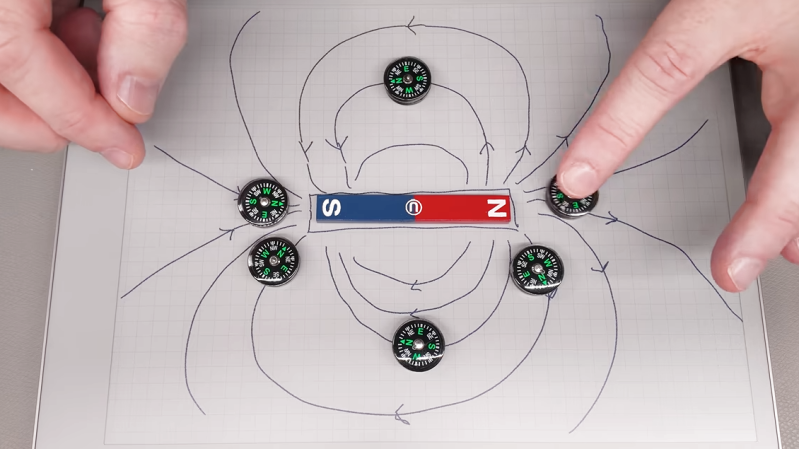
Every magnet has a north and a south pole, but which is which? Sometimes it matters. If a product one builds features a magnetic closure or other part, the polarity of those magnets should be consistent in assembly. So how does one ensure they never glue a magnet wrong again? [Clough42] shows several ways to identify a magnet’s north and south poles using things many of us probably have ready at hand, and goes into a bit of theory while he’s at it.
Probably the easiest way is to use a known-good and clearly labeled reference magnet. Same poles repel, and opposites attract. But if that’s not available, a simple magnetic compass can help. Because opposite poles attract, a compass’s north point will be attracted toward a magnet’s south pole, and vice versa.
A Hall effect sensor, or an electromagnet — the winding and current flow determine the polarity — are other ways to measure a magnet’s poles. And here’s where [Clough42] dives into some details of how magnetic fields actually act, because it explains some seemingly strange behavior.
For example, at around 4:08 he demonstrates a Hall effect sensor board that is documented as lighting an LED when the south pole of a magnet is held to its front. It does that, but it also lights the LED when the north end of the magnet is held to the sensor’s back. That’s because the sensor isn’t actually directly sensing the magnet’s pole, it’s sensing the orientation of a magnetic field. The lesson is clear: make sure you’re measuring what you think you’re measuring. Near the end of the video he demonstrates a similar experience with a handy mobile phone app that senses magnetic fields by reading the device’s internal magnetic compass; by waving a strong magnet around, the detected polarity flips back and forth even though the magnet’s orientation isn’t changed.
So what does one do after positively identifying a magnet’s north and south poles? Label it clearly for use as a known-good reference magnet in the future is our suggestion. Watch the whole video below, then take a few minutes to dive into the nitty-gritty of what magnets actually are and how they work.












What a delightfully upper class tip: “If you don’t have any other means, your coffee grinder has a magnet for accessories that’s oriented in a particular way.” Of course, everyone just has a fancy coffee grinder.
Though it was designed properly, it wouldn’t have an opposing magnet, it would have an iron insert that pulls the magnet regardless of polarity.
3D printing community of 2020s is like Arduino community of late 2000s and early 2010s.
Their motto is ditch the old ways (which required learning) and solve every problem with brute force. They see a basic M6x50mm bolt and they hammer it down like a nail. They see a torque to yield fastener used in engine block and they hammer it down like a nail. They see a lag bolt used for woodworking and they hammer it down like a nail.
etc.
But that’s just how Soviet/Russian axially threaded fasteners are supposed to work.
And accelerometers in their rockets too apparently, when you want to install them upside down…
Da tovarisch, see if we use boolit instead of bolt (glorious proletarian .30 caliber of course) yuo never have to pay for pyrotechnic fasteners. Install with hammer, sickle not necessary!
I watched this video a day ago and promptly grabbed a compass, magnet, and popsicle stick and made one. Marked the stick with red on the North and blue on the South (not that it’s a political thing). There is a Danfoss ref tools app that works on any phone with NFC. It has a magnet tool that will indicate the presence of a magnetic field. It is intended for use with solenoids for refrigeration testing. I have used it with both AC and DC solenoids and it works GREAT. It does not indicate North South however. I have succesfully used it to test solenoids in refrigeration and in the repair of snow plow equipment!
The app he uses in the video is called “Magnet S or N Pole Judgement” for Android. Shows polarity and strength. Nice and simple, worth installing.
And my polarity indicator is also a stick painted red & blue on opposite sides with a magnet jammed into it. Hardest part was finding the paint. I’m not waiting to print an inferior version.
Magnetize a sewing needle,
Float the needle in a glass of water to make a compass,
The end pointing north is properly the “North seeking” or “N” and the other end is “S”
Bringing any magnet close to the floating needle “N” or “S” will push or pull the needle pole.
Definitions suck sometimes… The Earth’s North Pole is the South end of the Earth’s magnetic pole.
Think of it as opposites attracting instead. Works fine then.
It’s the RX/TX problem. We should be experts in this by now, and it should never cause any confusion, ever. Nope, not a single board respin. Not once.
RX is the port that listens. “North” is the pole that points north.
Some things are just wrong and will never be fixed.
Current flows from positive to negative. (But electrons flow from negative to positive).
To change would invalidate so much pre-existing documentation, that it will just never happen.
Even something like changing from degrees kelvin (1954 until 1967 °K) to Kelvin (1967 on K) caused much confusion. I still reference physics papers that used °K.