

Sometimes you find gold in unexpected places. In this case, it’s from a video about the CH-53 helicopter. The CH-53 Sea Stallion first entered service in 1966. It’s a huge helicopter, capable of lifting immense amounts of weight. All that weight hangs from 6 (or 7 on some models) rotor blades. The problem was detecting problems with the blades before they grew into a catastrophic failure.
Much like a fixed-wing aircraft wing, the CH-53 rotor blades are designed with a spar as the main structural 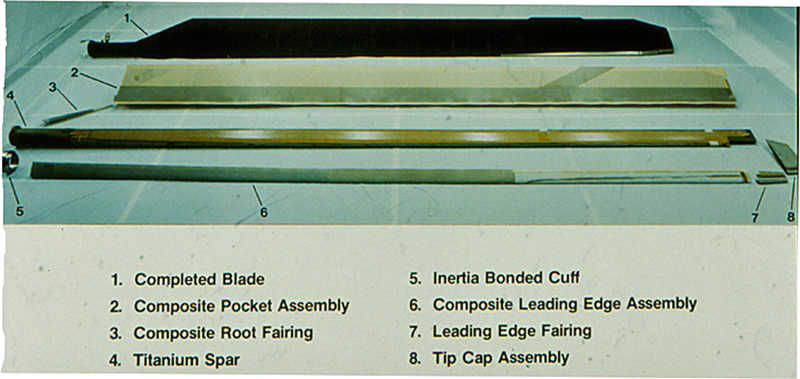 member. On early designs, the spar was extruded aluminum. The CH-53D and other variants moved to cold-formed titanium.
All of these blades shared the same problem – detecting tiny cracks in the metal before they grow into blade failure. Detecting cracks turned out to be rather easy. The blades are sealed and pressurized with nitrogen gas. Cracks allow the gas to leak out. A barber pole pressure indicator on the blades allows mechanics to tell at a glance if everything is ok.
That’s all fine and good on the ground, but if a blade begins cracking in the air, the pilots want to know about it immediately. What was needed was something akin to the tire pressure monitoring system on modern cars. A pressure sensor that would turn on a light in the cockpit. Modern automotive TPMS systems use wireless sensors inside the tire. In the early 60’s though, electronic components were not reliable enough to survive rotating on a helicopter blade. Wiring the sensors through the spinning rotor head using slip rings would be incredibly complex. Expecting wireless electronic components to survive life in a rotorhead would be even more problematic.
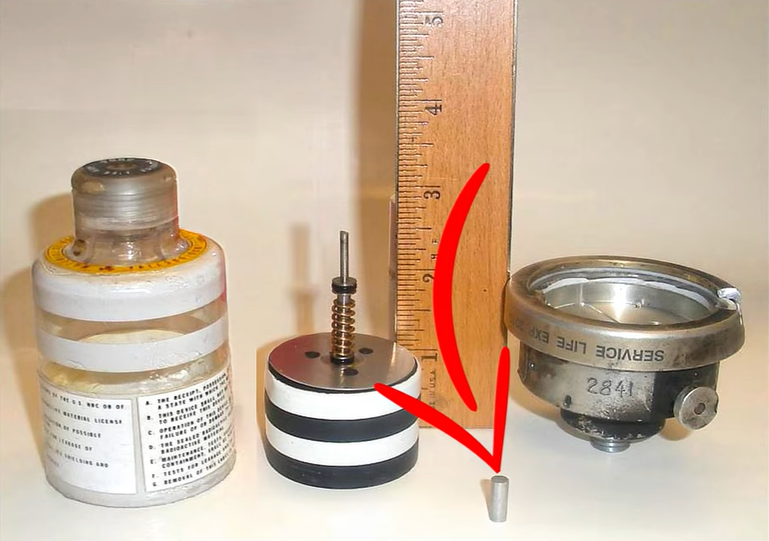
The solution turned out to be simple: Throw a little ionizing radiation into the mix. Called IBIS, short for Inflight Blade Monitoring System keeps the CH-53 safe. The magic happens in the same pressure indicator we mentioned earlier. Rather than just a shift from a green to a barber pole indication, the IBIS module also exposes a tiny amount of radioactive Strontium-90. The Strontium is a beta emitter, meaning its radiation can be detected by a Geiger counter inside the helicopter. It’s also relatively safe for humans as long as they don’t eat or breathe it in. No batteries, no electronics on the rotor blade. It’s a simple mechanical solution to a difficult problem.
The solution is so elegant it’s still being used today. The newest versions of the CH-53 of fiber optics to detect faults in the newest all-composite blades. The older variants? They’re still going with the nuclear option.












Yes, Sr-90 is perfectly safe for humans.
Except… along with Cs-137 it is the main pollutant of Chornobyl Exclusion Zone. Something doesn’t add up.
Says right up there: (unless you eat or breathe it)
It’s all fun and games until helicopter crashes and what should be a minor incident turns into a nuclear emergency where you have to call very specialized decontamination units to remove radioactive material from the site.
That’s just more incentive for the enemy to not shoot them down.
unless they shoot ’em down on your own territory 😂
then you don’t have a helicopter but you have mini-hiroshima to clean up.
Why do you think it would be a “nuclear emergency”?
What do you think is going to cause more contamination? A grain of Sr90 the size of a mustard seed, or 3000 gallons of jet fuel?
The amount in those blades is negligible compared to average background radiation. Stop being alarmist for no reason.
Safety is relative. A tiny blast of radiation will do you a lot less harm than dropping out of the sky.
It’s not the fall that kills you, it’s the inertia of your organs during the sudden stop at the bottom. If we could stop things sloshing around, humans would find falling a fair bit more survivable.
Internal airbags?
Wait, so all we gotta do is hold our breath? BRB, going to grab some empirical evidence.
Eat more beans sir if you are scheduled to fly tomorrow!
So if you filled your body’s interstitial spaces with expanding polyurethane foam like you use around window frames, it would stop things sloshing around and you wouldn’t die if you fell a long distance.
Okay so you’d die from being all full of polyurethane foam, but that problem isn’t in scope today.
https://journals.viamedica.pl/ginekologia_polska/article/download/46503/33290
Apparently, when they were having a good time, the very drunk woman screamed to her lover (who was also very drunk): “fill me!”. The guy grabbed a can of PU foam and filled her.
The story has a sad ending however. When returning home from hospital, the woman was beaten and thrown out from the train. She died a week later from her injuries (not the vaginal ones though).
I do understand your sentiment about the radioactive source. And it is true that Sr-90 is a dangerous part of radioactive fallout. I looked up more information on this and the source is spicy, about 1000 times more activity than a household smoke detector.
The hazards are very small. The sources are on the helicopter blades, quite some ways from the body of the copter. In addition, when the blades are OK the source is shielded inside it’s container. It’s only when the blade losses pressure from a crack that the source emerges. The blade itself will absorb all the radiation. Even in air beta particles have a range of only a foot or so.
The only danger I can see from this scheme is improper disposal. And even then, eating the source would be needed to pose any real danger.
Cheers.
In my research I found the navy has registered the sources, and has everything documented with the NRC in terns of processes for handling and disposal. (example https://public-inspection.federalregister.gov/2019-08531.pdf?1556282725 ). During normal operation the source is shielded. It only comes into play when a blade is damaged. Still – given the current state of some of these older airframes – it is a concern.
Yesterday I was researching Thomas the tank engine to my kid.
The Boeing 747 also had radioactive parts weighing several hundred kilograms.
I worked on UH-3h Helo’s when I was in the Navy and we had the same indicator system on our main rotator blades.
Where’s the geiger counter’s sensor?
And the video thumbnail is AI-generated. Just look at the angle of the blade at the 7 o-clock position.
MH-53E maintainer here. The system is IBIS (Inflight Blade Inspection System) and the little pods are BIM (blade inspection monitors). The box is pretty obvious sitting just behind the main rotor on the deck above the center engine. I found a random picture on the web: https://assets.verticalmag.com/wp-content/uploads/2017/01/MHM_6001.jpg.
Thank you, the question was prompted by “The Strontium is a beta emitter, meaning its radiation can be detected by a Geiger counter inside the helicopter.”
The radiation from the blades is less than the radiation from a six hour flight at high altitude. So, if this scares you, drive on your next trip.
It isn’t just the blades, many older helicopters also have thor-mag in the engines too.
Most 53s belong to the Marines. Jarheads will eat or snort anything, upon given a double-dog dare. The more senior NCOs will most likely hold out for a triple-dog dare before consuming radioactive materials.
I notice that the “Report Comment” button is not here. Sacrosanct topic or staff screwup?
What’s there to report?
Probably a motivated keyboard commando, that’s all butt-hurt and desperate to preserve the stately imagery of Marine recruiting videos and posters. Newsflash, boys and girls: few people wearing MARPAT care. I know, I’m a (very) former jarhead.
Missing a verb here
“of” is clearly the verb. After all, why do they call it oven when you of in the cold food of out hot eat the food?