
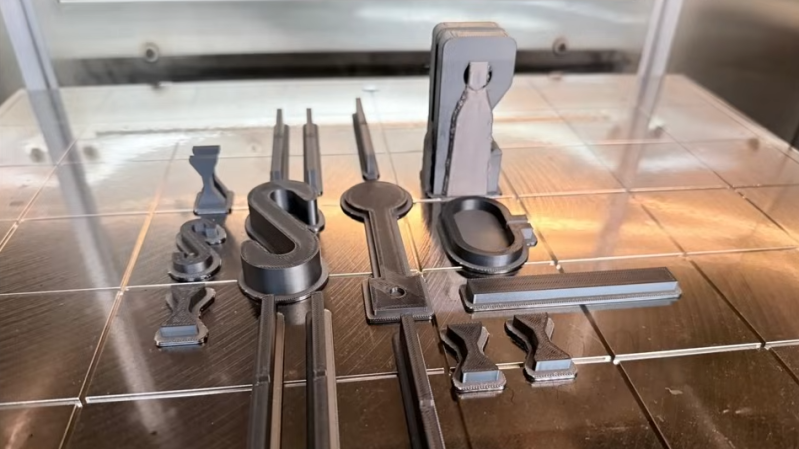
[Igor] of [My Tech Fun] set out to discover what differences, if any, can be found between parts printed in PC-ABS filament on an industrial 3D printer, and those from prosumer-grade machines and filament. His video is full of his usual attention to detail as he compares a test suite of parts printed at home in Polymaker PC-ABS with those from a Stratasys Fortus 450mc using proprietary PC-ABS filament.
PC-ABS is a filament that strives to deliver the benefits of both polycarbonate and ABS. It’s durable and has fantastic impact resistance, but it costs a bit more than either PC or ABS and requires a heated chamber.
[Igor] has previously compared industrial ABS with comsumer ABS, but what made him curious about PC-ABS in particular was the large difference in print temperatures between Polymaker PC-ABS, and Stratasys’s own proprietary PC-ABS.
[Igor] prints Polymaker filament at 280º C in a 60-65º C chamber, whereas the Stratasys filament prints at 325º C with a chamber temperature of 95º C. That’s quite a difference. The industrial printer has over double the print time, to boot. Would test objects printed from the industrial filament, on an industrial machine, be noticeably different from those printed at home?
To find out, [Igor] orders a test suite of parts from a company with a Stratasys Fortus 450mc (who was also kind enough to take a short video of the machine in action) and prints his own on both a Prusa Core One L, and a Bambu Labs H2D. He then proceeds to compare them in a variety of ways while testing them to destruction.
What’s the bottom line? The industrial prints have better dimensional accuracy, but the home prints have the edge in appearance. When it comes to performance the differences are mostly minor, and not always in the industrial system’s favor. Broadly speaking, PC-ABS from the home workshop compares very favorably from an expensive industrial system and proprietary filament, at a fraction of the price. See it for yourself in the video, embedded just below.












The comparison is fundamentally flawed: Unless both models are sliced exactly the same, it is like comparing apples and pears.
Disagree. The focus was on the part quality of an industrial print vs. printing in-house or at-home. The conclusion is: assuming the part /can/ be printed at in-house or at-home, there is no compelling reason to pay a substantial premium demanded by the industrial service. A full kg or Polymaker PC-ABS is about half the cost of those parts.
Yeah, but the cost of the print on the big machine is also covering their staff, building, insurance, and investment in the machine. Comparing that to just the weight of filament you use at home is apples and chickens.
Quality and strength can be compared, assuming that they’ve sliced it optimised for whatever you’re comparing.
That’s the point. Why pay for that stuff if you don’t have to?
Then what ? You could include your time, cost of your printer and electricity if you think it’s unfair.
If there’s no slicing options when ordering a print then this is the best YOU (or most of us mortal makers) can get from a Stratasys. Unless you can spend x100K $ to tweaj it yourself.
wrong. They in theory pay for those things to gain economies of scale to be able toproduce at lower cost then we can without those facilities. When they fail at that its their problem to solve not ours to pretend away.
Lets face it there are 3 scenarios here
Commercial low volume requirement – Use a sub contract company, they have already gone through all the aches and pains you are about to on this journey
Commercial high volume requirement – For goodness sake get your own print equipment, dial it in and enjoy the benefits of in house
Home / Hobby – Is it cost effective to have your own multi thousand (insert preferred currency here) printer, filament, tools, space and time for that fancy garage hook? No of course not, BUT its a hobby and thus worth the money to DIY.
Just my 50 pence
More like apples and a different cultivar of apples
pears and apples are basically the same thing. sometimes i can buy ‘asian pears’ that seem like the exact mid-point between them. there’s a cultivar of apples that i’ve only seen locally (an orchard that has since folded, sob), which is very good, and which has a distinctly pear-like flavor.
not sure if that was your point but i’m excited about apples.
I agree. The Stratasys printed significantly longer. Makes me think it had many more layers.
He actually mentions that in the video that the stratasys has a similar layer count he figured from the progress reporting during the print (which seemed to just be the layer count).
But they can’t be sliced the same. They are different machines with different materials.
the dimension difference comes from the shrinkage of the print in the heated chamber and the ignorance of the slicer to compensate for that. i think the stratasys does this correction. of course the shrinkage is not uniform in all directions as well.
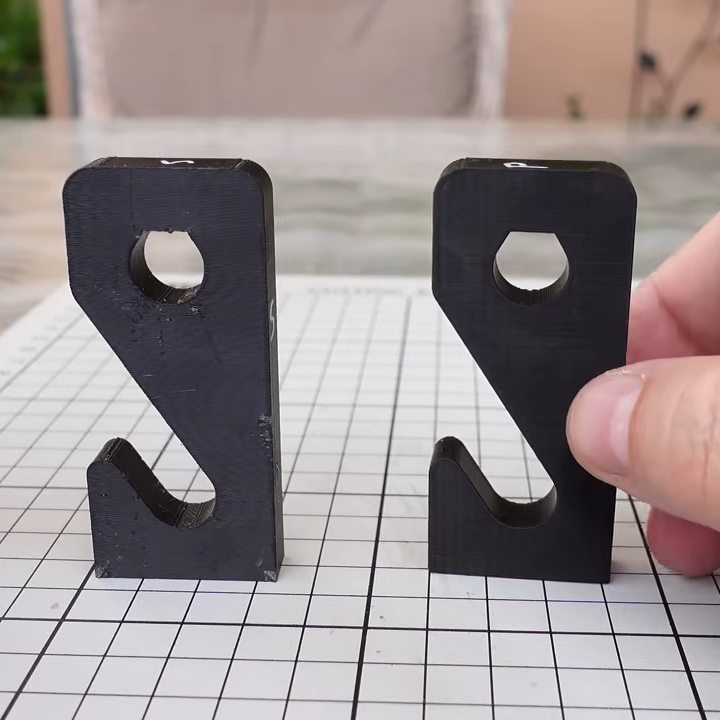
Bugs me that the layer lines are oriented in exactly the weakest axis for that hook part, but I suppose that’s what they want to test.
Yup, that’s what the model was designed for.
Very interesting. I’ve always assumed those workplace stratasys printers were outdated and overpriced relics, and this seems to prove it. Also to add another nitpick to the slicing, I’m not sure why anyone would use 100% infill instead of 100% vertical shells, but that doesn’t change the validity of his results.
100% vertical shells as is full concentric infill? Yeah that’s what I usually go with when I need a dense solid structural part
They have a Stratasys at my place of employment. I was never really impressed by anything that came out of it… Now whether or not that’s the printers’ fault or the office full of beta-male, wannabe-engineers’, is no matter of small debate.