

Professional Stratasys FDM printers demand a pretty hefty price premium over your typical hobbyist-level machine, with the gold-plating continuing even with the special filament cartridges that you buy for some of their printers.
This raises the question of in how far this eye-watering price tag is justified, and how much is just you paying for support and the brand name. After acquiring a spool of Stratasys ABS filament via a US viewer, [Dr. Igor Gaspar] set to work to try and answer this question.
The viewer had already liberated the spool of ABS+ P430 filament from its cartridge, making it easy to use that directly with the Bambu Lab FDM printer.
To make it a fair comparison, [Igor] also needed to have a sample printed on a real Stratasys printer, for which he used a local company’s services. An interesting sidenote here is that the US viewer’s company moved away from Stratasys to Bambu Lab printers.
[Igor] was able to see his test parts being printed on the Stratasys printer, as said company is in the same city. This showed him that it took 14 hours to print the parts versus 3.5 hours on the Bambu Lab printer, suggesting that his worries about the right printing parameters for the Stratasys filament were warranted. Sussing those out was thus paramount for a fair comparison and warranted some test prints.
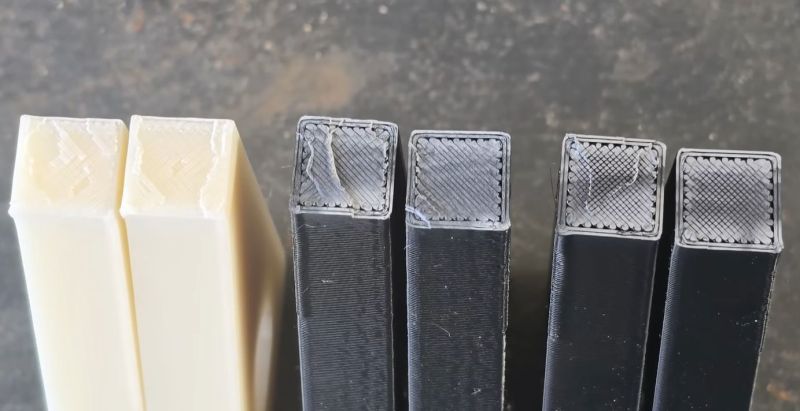
From a sheer aesthetic point of view the Stratasys-printed parts looked much cleaner, and their dimensional accuracy was also significantly better due to the slicer adjusting for this. Between the used Stratasys M30 and Bambu Lab ABS filaments there’s no clear winner, with both trading blows. Amusingly enough, the older Stratasys ABS type in the form of the ABS+ P430 filament performed the best of all when printed on the Bambu Lab printer at its preferred temperature setting.
Moral of the story is thus that – unless you really want to pay for that service contract – to loot old Stratasys ABS spool cartridges and use them in your hobbyist FDM printer. As [Igor] says in the conclusion, the nicer looks is probably due to them printing very thin layers, much finer than the 0.2 mm layers he used. This would also match the much longer print time and is thus something we can replicate on any FDM printer with a temperature-controlled printing environment.












I hope Stratasys don’t react badly to this, given their history of litigation.
They will as always. Let them aggressively sink into oblivion.
This is one of the reasons Stratasys is suing Bambu Lab, because a lot of their expensive industrial printers have been rendered obsolete by much cheaper high end consumer models. Patent warfare is their tactic to hold back the tide.
Given that Bambu Lab are scumlords I hope both of them lose.
A prolonged legal battle in a stalemate ending in a settlement neither of them are happy with and has no wider (negative) consequences for the community.
Oh, don’t wish for that. That just feeds the lawyers, and they breed ferociously.
Rather, wish they come to some agreement, like gentlemen.
Yes, like gentlemen of the 1800’s, an agreement to a duel.
No stratasys wants to sue anyone who infringes out of business. Thats the goal. For many years they had enough unexpired core patents and 5-6 figure machine sales per quarter to afford to do that. These days they realize that the best their going to do is get a feature stripped with a court ordered cease and desist, and ding the offender with a fine, In some cases the best they manage is to reach a patent licensing agreement and collect some recurring fees.
They certainly dont go in like gentlemen, they just grudgingly wind up there.
Not exactly the same, but had an Objet a few years back – We couldn’t get rid of that damn thing fast enough. It cost an arm and a leg to operate, print cleanup was a nightmare, prints were brittle, and the amount of HAZMAT that it was responsible for was sickening. It was sold to some dirtbag in Oakland for $300 in perfectly working condition and we figured we fleeced the guy. Sigh. The whole 3D printing thing is an excellent case study in the unintended consequences of the US patent system – that is basically nobody even knew what 3D printing was before the patent portfolio started to time out. And now California and a few other states are about to kill it again. That’s progress nowadays I guess.
Do you ever have anything useful to say?
I prefer companies that DO NOT violate the GPL.
The accuracy of the Stratasys looks very nice. Those are some excellent sharp corners. Even the infill looks accurate. Clearly open source slicers can still improve and probably will.
Sadly this video was a mishmash of filaments and printers, concludes nothing.
As a industrial user running two Stratasys F3300s, 14 Prusa Core Ones, and 2 Bambu Lab printers, I think this comparison only scratches the surface of where the real divide lies.Stratasys’s true, unmatched advantage today isn’t in standard ABS—it’s in high-temperature, large-scale engineering materials. When we were looking to print massive $600 \times 600 \times 700\text{ mm}$ parts in ULTEM 9085, we benchmarked almost every industrial player on the market. Machines like BigRep offer massive build volumes, but they completely fail when it comes to printing large-scale ULTEM 9085 because they lack the necessary chamber temperature control. Stratasys remains the only option capable of full-bed ULTEM 9085 printing. We compared the F900 and ultimately went with the F3300, which has been a beast for 9085 and ASA.That said, the author and comments are spot on regarding the low-to-mid end. The desktop F123 series has lost virtually all competitive edge against modern consumer/prosumer CoreXY machines (like the Bambu Labs or Prusa Core One) in terms of speed and cost-to-performance.Another hidden gem people overlook is Stratasys’s Insight software. The level of toolpath control it offers—allowing you to manipulate individual layers and specific toolpath traces—is something open-source slicers still can’t replicate.Lastly, keeping an eye on their recent acquisition of Markforged. I’ve been eyeing the FX20 and testing samples, but I do share the concern that Stratasys swallowing up competitors might stifle market innovation in the high-end sector.
Here we see that it even costs more time and money to rationalize the use of Stratasys printers.
Will never own a printer from either company.
Exactly this. I’d show some interest if they were printing titanium but, as they’re both shit-hawks, I couldn’t care less.
Ironically our company has an Objet, a Bamboo, two Makerbots, and (had) a Form 3 (it died, a Form 4 is on order as I write this).
Oh yeah, we also now have a Mantle.