
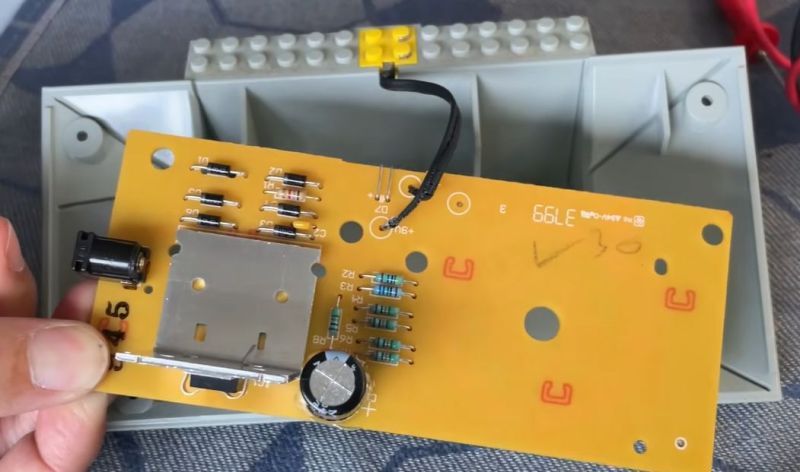
Before LEGO train sets moved to battery-powered locomotives with plastic rails, all of them worked pretty much like any other train set of the era. This meant metal rails that the locomotive’s wheels would use to pick up power from and a central controller that would inject said power and also regulate the train’s speed and direction. The LEGO 2868b Electric Train Speed Regulator is one such example, and [Nonsense Wars] recently had one under the knife to repair it.
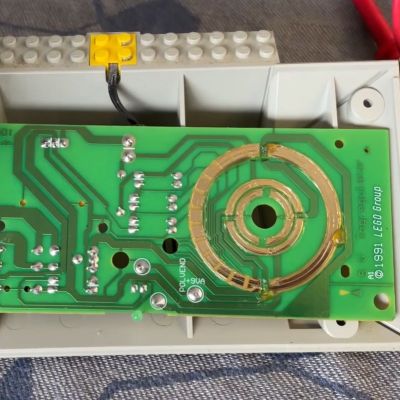
The single PCB inside is quite straightforward, with the 9-12 VAC supply input from an external power adapter, and a variable voltage regulator that sees its target voltage switched by a bank of resistors.
It are these resistors that the big yellow control switches between when you operate it, changing the output voltage and also output polarity you cross the midway point. Effectively this means that there is just one non-passive component on the PCB, in the form of the TO-220 package strapped to the big heatsink.
In this particular unit it was found to be a Fairchild KA317, which is for all intents and purposes here the same as an LM317T. One quick swap later and this controller was back in business like it was 1995.
Compared to the engineering crammed into a modern “smart brick”, things really have come quite a ways in the world of LEGO.












Are those gold plated contacts? Pretty sick for a simple toy.
That was Lego, not Fisher-Price or Playmobil! ;)
Seriously, though. These Lego sets were not cheap, at all.
Like anything related to model making or model railways.
I remember the Lego model railway was very sturdy, also.
That motor block was comparably heavy and robust.
Someone could toss it accross the room and chances were
high it would still work without having taken any damage.
Only thing with Lego railway motors of this age is little clips that are not hugely important are a little delicate compared to the mass and power of the motor – relatively breakable by Lego standards. But the motor, studs and technic pin the motor actually uses in 99.99% of designs won’t die easy..
Might want to recheck the first word, it looks odd to me.
Editing are hard.
At least we can assume it wasn’t written by AI Williams LLM.
I get it it’s a running gag. 🙂
But to those not knowing, he’s a real writer who has worked on articles for (-now-) classic magazines in hobby electronics and computing, long before LLMs existed.
No, it aren’t
In defense to the author: Tanslated to my native language, such a sentence would seem correct.
So I guess it’s fine in some English dialects, too. There are many of them, after all.
But I’m curious, what would look right to the native English speakers? “They are”, for example? 🙂
Because “it are” looks fine to me in a sentence like “It are the small things in life that make you happy!”
“It” is singular. “Are” is plural. In English, if the subject of a sentence in singular, then the verb is also singular. A plural subject has a plural verb.
This particular phrasing is tricky because parts of the phrase is singular (“it”) while another part is plural (“these resistors.”)
It would have been smoother to sidestep the whole mess:
“The big yellow control switches between these resistors, changing the output voltage and, as you cross the midway point, the output polarity.”
the iterpreter of my compiler made the translation
“Before LEGO train sets moved to battery-powered locomotives with plastic rails”
Back in the olden times, I had Lego train parts that were blue plastic rails: inner and outer radius curved sections, red plastic wheels, and I don’t remember what else now. Once I got the motorized set, the trains were battery powered. Before that, they were me powered. The internet seems to think this was called the “blue track era”: 1960’s and 1970’s.
Had one of those sets as a kid as well. It also had a microphone, transistorized circuit board inside a large clear block, and a small whistle. Blowing the whistle would make the train go forward, stop, or reverse. I’m pretty sure it was a prototype as we had several neighbours working at the Lego plant in town. I’m sure we still have the locomotive and the coal (battery pack) car. I think the box original is long gone now.
I had the same set of parts. I remember for the curved sections it was either the inner or outer rail that had a smooth surface (vs the ‘rack’ surface) because the motor didn’t have a differential gearbox.
The “blue track era” was still current when I had my first Lego trains (1976 or so). I had the “train without motor” (set 121) and later added the battery motor to it. This was in Britain. In Continental Europe they also sold mains-powered 12V trains which added conductive rails to the middle of the blue track and had a transformer somewhat like the one illustrated to regulate them. In 1980 the railways were heavily revised with grey track, and at that time 12V trains were introduced in Britain.
From what I remember of my childhood, with LOTs of Lego “technics” stuff – they never skimped on quality.
I recently found an old “8094 control center” in my garage. The board is all SMD, with plated through holes, and pretty decent quality. Not cutting edge for 1990, but for toy/consumer electronics where single-sided paper substrates ruled (no vias), really quite rare. The battery contacts were still shiny, in spite of being in a damp garage for three decades.
I second that. It seemed that Lego used to be proud to produce high-quality plastic products.
– Perhaps comparable to that elitary “Tupperware” stuff, maybe.
Their sole business was based on these plastic bricks and they took it very seriously.
To them, plastic was not cheap thow-away stuff, but a modern next-gen material.
It makes sense that Lego didn’t make any other compromises in quality, thus. Having a good reputation mattered to them.
Computer motherboards used to have gold-plated contacts, too, because of preventing oxidation.
(Silver conducts better than Gold, but Gold doesn’t oxidate.)
It are?
You guys had electric trains?!