
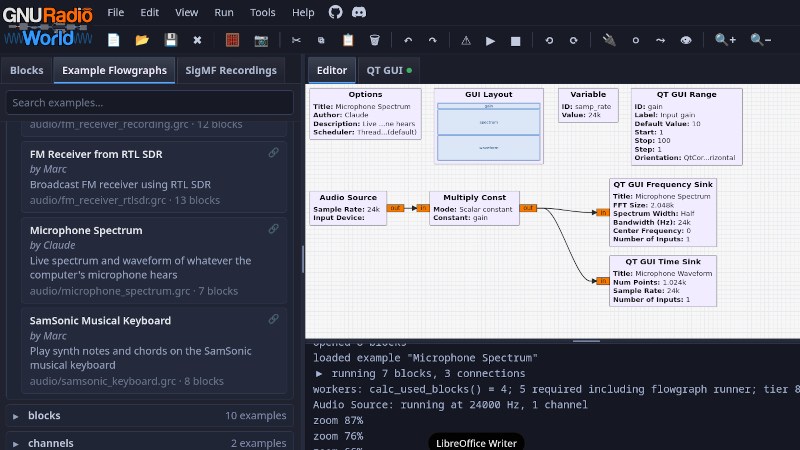
The progression of the web browser from a tool for simple static information browsing into a do-everything computing environment has been inexorable, with package after package making the jump. Today it’s the turn of GNU Radio Companion, lowering the barrier to software defined radio considerably. It’s the work of [Marc Lichtman], who’s name you may recall if you have ever used pysdr.org.
Loading it up gives you a very familiar window if you’re used to GNU Radio Companion, and it comes with a set of example flowgraphs that cover a large range of applications. It supports a collection of software-defined radios (SDRs) including the well-known RTL-SDR, and if that’s not enough it can also use your sound card. There is even a set of recorded off-air captures to experiment with.
We’ve spent a while here playing with it, and it does everything we’re used to from the version outside the browser. The only thing we’re told it won’t do is work with a networked SDR, but that’s no deal breaker.
Thanks [Marcus Müller] for the tip.












I don’t understand. Why would you want to run a bloated clunky web browser wrapper around a less functional (or even with functional parity) version of an application when a native application exists? And the Electron web apps that include their own 2GB+ RAM eating dedicated web browser instance, are even worse.
Installing GNURadio famously sucks ass. I even had to remove it from my arch laptop because the AUR version of it broke completely. I welcome being able to use GNURadio without spending a whole ass day fighting with Python bullshit.
I currently wrestle witb my B210 being detected by conda uhd driver but not GNU Radio.
Python really is getting annoying since past v2! 😟
Ever tried to get it to install all of its important versions on MacPorts on OS X Tiger (x86)?
The need for Python 3+ and GCC 3+(GCC 3.x, 4.0, 4.2) is really annoying these days.
It would be nice if modern nix software was just a tad bit more humble
and would only have dependencies *for what it really needs (bare minimum).
So that it would successfully compile with the older, more lightweight libraries from the mid-2000s -or 90s, even-.
Why does even a recent, yet simplistic nix text editor or *nix basic image viewer have more dependencies than GIMP v2?
As a counter example, good old *neofetch does require no dependencies.
Like it’s normal for a humble text-mode application.
Just make a small VM specifically for GNURadio and only do GNURadio on it. It’s more manageable that way. These days I’d try running it in a docker though.
I’m sure there are valid use-cases/situations where the convenience outweights its drawbacks, in any case I’m almost always in favor of we all having more options.
https://cyberether.org/ Seems like a better alternative
Additionally accorsing to the readme this is just more AI Slop, wish Hackaday woukd start vetting the projects they post about for this junk.
As it was discussed in the big comment section on a pinned article, the only thing that HaD has to do is to display a tag like “slopware” or equivalent when they’re talking about a vibe-coded project and provide a toggle to filter out these tags. That way people can simply not aste time reading about these projects.
+1
That must be possible somehow, mustn’t it?
Because the Americans do successfully tag “nsfw” content all the time, all over the web (MobyGames etc),
even if it’s just harmless and barely any saxual. ;)
Yeah slop is staining everything I used to love.
It reminds me a bot of the times when “website construction kits” appeared.
They generated bloated HTML code with bad things such as JavaScript, Java, Flash/Shockwave, CSS, XML and so on.
It’s not same thing, of course. But that kind of automatisation felt like a downgrade, too.
Well, nowadays they use a framework whose developer only knows JS and the
<
div> tag. Or it’s in WASM, which only runs on some platforms the 3 major browser engines support.
Oops, HAD didn’t like the
<div>.Yeah, I’m in agreement with the other commenters. I have one computer dedicated to SDR and one computer dedicated to embedded electronics. The toolchains just require so much setup and tweaking that having a known-good version freely accessible is nice.