
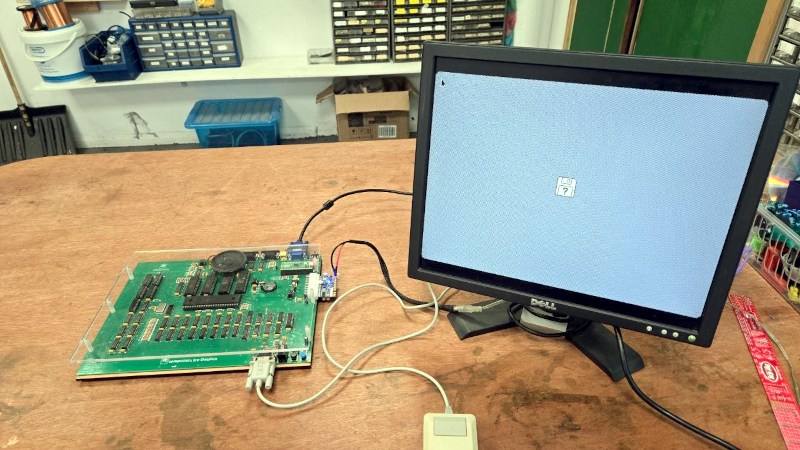
Apple hardware has always been proprietary, sometimes to an extreme. But that’s not to say that it’s impossible to make something that does the same job, which is what [DosFox1] appears to have done with the OSHintosh. It’s an open source PCB that implements a Mac 512k. Is it a 68k Hackintosh? You decide.
While it boots into a classic Mac OS image, it’s not quite a Mac. For a start, there are no disks, and no SCSI. Instead it boots from a disk held in ROM, which we guess will be a lot faster than the floppy from back in the day. They’ve even managed to do it on a 2-layer board, which means that despite its size, it shouldn’t be too expensive to have made.
We’re not sure quite what the legality of dumping a Mac ROM image to the ROM on this board would be, but assume for a moment that you own a copy in a defunct original Mac. This board can’t yet replace the original due to the disk issue, but given that original Macs are now long in the tooth, a modern replacement for those who must have hardware rather than an emulator sounds like a good idea. Perhaps for some people it will join the FPGA Amiga.












This is really cool! 😎
I wonder if that Unitron firmware might run on it..
Its hardware was based around a Mac 512k, after all!
That’s a good point actually, I have a copy of the Unitron ROMs – the main problem would be trying to see if the bootrom driver would play nice with them!
anyone who puts an image of a 512k Mac ROM on this device is STEALING! you are literally robbing from Apple, theoretically replacing one of their devices that you would otherwise buy with this one. don’t glom that ROM!
Does Apple even sell 512k Macs? This is more like a car in California that no longer needs to pass smog because its “vintage” (or “retro”).
I agree. Never steal an Apple. It’s immediate minus 10 points karma, and a sure ticket to hell !
was 1985 calling?
probably using other screen is illegal too.
Because Apple is still selling them new? Umm, no.
Tim Apple gave that gold bar to the Hero of the Universe, and every bit of Apple IP not being paid for makes gold bars like that one a little bit smaller. Sounds like you are on the side of people not being bankrupted by health care costs. Socialist!
Ha ha. Obvously an homage to the “Don’t Copy That Floppy” campaigns of thr 80s
Your argument goes mute in 2079 when the code becomes public domain just like Steamboat Willy.
I doubt Apple is going to sue anyone for illegal use of 40-years old code.
Apples and Pears. It’s a different Apple now.
After a re-orientation of the company, Apple Computer, inc. became Apple Inc. in 2007.
So strictly speaking, the copyrights in the old software refer to a company that nolonger exists. ;)
IP conveys with corporate reorgs, renaming, mergers, unless the IP is specifically sold or transfered. There is a small army of corporate lawyers that ensure such things happen.
IF an individual were to extract the firmware and use it only personally, nothing would happen unless it became publicly known due to posting online or reported by a witness. Were someone to attempt to do a KickStarter project, Apple may get involved and issue a cease-and-desist letter. Beyond the hypothetical, Apple’s reaction is unknown.
Literally taking food out of Steve Jobs mouth!
Robbing implies the original being removed. Is it a illegal copy? I dunno, anyone in US-legslese here? And is DosFox a US citizen?
UK based, and I have a literal pile of Mac Plus boards to nab the ROMs from if needed.
At any rate, the SMC are selling rominator kits (ROMs included). If Apple aren’t happy for whatever reason, I’ll happily take the firmware files down
I need USB disc similar normal disc in mac
I need …. better rom. Orginal rom is slow and have many dirty hack.
Been doing it for 30 something years why the outcry now
Poor Ole apple going to loose its rights?
I’m surprised that no one mentioned yet how pretty and clean this build is!
It even has the original serial ports, which isn’t to be taken for granted.
Someone really has put his/her heart into it and spent some thoughts on it! Kudos! 😎
Let’s think about it: This 512K logic board is able to interface with real vintage hardware and AppleTalk/PhoneNet networks!
The logic board could be used to run some Mac software for multimode TNCs from the 1980s, also.
Or interface with some robot arms or talk with some computer interface boxes.
Just think of all the fun! The MS 4 Flight Simulator can be run on this, for example! 😃
And if there’s an interposer board used for the 68000,
then more RAM or additional i/o perhaps can be added maybe.
Such upgrades existed in the 1980s for the original 512k, I think.
With such an upgrade, System 7.x and older versions of MacAPRS could be used, maybe.
About 4 MB are minimum for bigger 90s era software, I think.
Thank you! That was sort of my plan from the start, so it could be used as a standalone TOPs Terminal, printer server or even a Macintosh games console if you swap the ROM sockets with a pair of ZIFs.
There’s also been a fresh flurry of development for running Pistorm on the Macintosh, which would be pretty neat.
If not, I’ll probably get around to designing a scsi interface based off the macsnap for it.
This project pretends to be open hardware, but you only got a pdf, no source. I already commented this, and my comment was first displayed, and soon after dissapeared. Very much probably because I accused hackaday to do that often. Shame !
As someone with an original 512Ke in storage – this is an interesting project.