
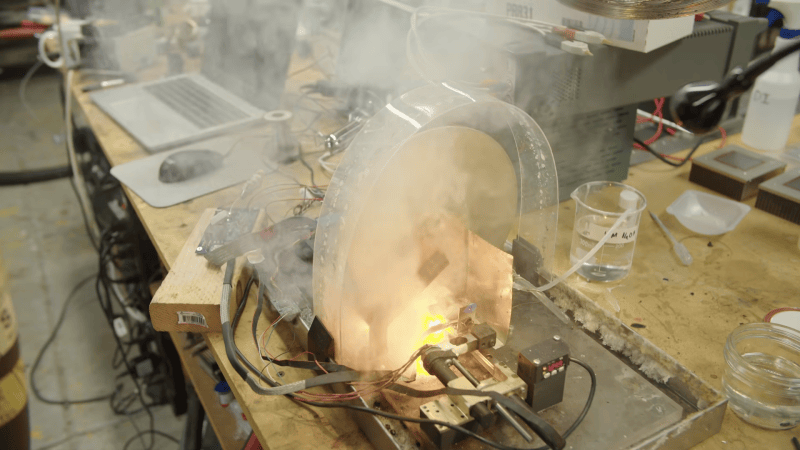
[Applied Science] has a new demo of an old 1970s patent for a portable generator that is both interesting and terrifying. The generator uses sodium and water, which, if you remember your old chemistry classes, will combust spontaneously. Turns out, though, it won’t if you draw power from it fast enough. Don’t draw enough power? BOOM, apparently. Check it out in the video below.
Of course, lithium-ion batteries might catch fire, too, but this looks a lot more likely. The patent made some wild claims about how much you could draw from the device, but the video shows that practical results are somewhat less.
Mechanically, a spinning metal disk has a sodium electrode extremely close to it. Water flows through the tiny gap, and electricity will flow between the two electrodes. This seems to be the only practical device built on this principle that is available to the public. We presume the original inventor built something, but there’s no record of it.
The mechanical challenges are obvious. You have to connect to the spinning disk. In addition, as the sodium electrode goes away, you have to keep narrowing the gap. The patent mentions a spring, but doesn’t provide any details.
We were expecting a slip ring arrangement, but the resistance was too high. That led him to use a liquid-metal contact with a homemade alloy of gallium, indium, and tin. The original disk was made with stainless steel. Later, he plated the disk with nickel to improve the conductivity.
This doesn’t seem very practical and certainly seems unsafe, but it is still pretty cool. If you do try to duplicate this from the data on GitHub, he has some ideas on how to make it work better.
Of course, there are sodium-ion batteries. We’ve even seen liquid sodium-based fuel.












I’ve never heard of sodium and water for power source so I am guessing, not much research was done in this in the past 50 years and is probably not practical due to high risk of fire.
hmm. making pure sodium costs energy as well, so this is a complicated battery?
Yah pretty much.
I can just feel the free energy crowd getting all excited. But if you produce your own sodium you are using more electricity to do that than you could ever recover. And if you buy the sodium you are just buying the electricity someone else used to produce the sodium and recovering it at a loss.
If the efficiency is high and the energy density is large then it might be good battery… if it weren’t so dangerous.
But unless you can harness Maxwell’s Demon you won’t be generating your electricity this way.
Still cool that someone actually built it though. Good hack!
Good point, one that should be made relentlessly. Fun fact: hydrogen fuel cells? Same same.
As he points out, the patent is from before the invention of (practical) lithium battery chemistries, and could (on paper) have offered much better power and energy density compared to batteries of the time.
Of course, its numerous other drawbacks vs., say, a conventional fuel-powered electric generator, make me wonder what scenario they could have possibly envisioned using it in.
For that matter, given the poor performance in reality, I wonder if you’d get better results just reacting sodium and water to power a steam turbine or stirling engine
Maybe because the inventor blew himself up? :D
“The design documents were found in a smoking crater in the place where the inventor’s house used to be. We’re not sure what happened”
Puts me in mind of Ned Simnel from Sir Terry Pratchett’s Discworld.
“Ned is now deceased, following a regrettable miscalculation involving a large explosion, lots of misshapen metal parts, the ruins of his forge, and (for reasons which are quickly obvious when you stop and think about the processes involved) a cloud of bright pink steam.”
Well yeah, if heat is a problem, i would’t start with a thumb-sized rod of reactive material pushing on a disk doused in water.
” i would’t start with a thumb-sized rod ”
You did watch the video,,,,right???? before posting???
The video has him showing…wait for it.. a thumb-sized rod of reactive material.
Did YOU watch the video at all? (that was a rhetorical question, you obviously did not)
I wonder if Captain Nemo’s description of the Nautilus power source is a garbled version of this. It used some sort of sodium based electrochemistry, at least in the original book.
Well…. I recommend checking out the book “Monturiol’s Dream”. True story, about Narciso Monturiol’s efforts in the mid/late 1800s to build a submarine in Bacelona. He ends up using chemical powered steam engine to power his sub. The reaction was from potassium chlorate, zinc and manganese dioxide. It produced oxygen as a by-product, which was used for the sub life support system.
A passerby sodium and eel salesman in his Kia Cee’d…
IMHO, there was kind of safer alternative, liquid ammonia, although still not tremendously safe to store or move around, but already mass-made as part of the Haber-Bosch reaction, so produced worldwide at all times. Obviously, it is dual-use thing, but then again, so is ordinary gasoline regularly sold in bulk.
Have not watched the video (yet), but my initial thought is – I wonder if this could be used to power an EMP. And if the magnet field from the EMP could somehow be used to increase the current by compressing the sodium somehow as the whole devise self-destructs.
Now to watch the video.
“combust spontaneously” That term is already taken. Perhaps the writer is thinking of linseed oil soaked rags. Sodium and water react. Words are hard.
They DO react…
And the byproducts of that reaction are flammable.
And the reaction produces high current, which results in high heat.
And fuel + oxygen + heat = Combustion
But the whole point of this battery/generator/whatever is that the current is tapped off in a way that reduces the heat accumulation enough to avoid the Combustion.
So… Any issues will take the non-combusting state we want, and make it combust. Spontaneously.
Spontaneous Combustion.
Literally the correct term because we are talking about the whole device, not just the Sodium reaction.
Number of times Ben hasn’t done an interesting experiment: 0