
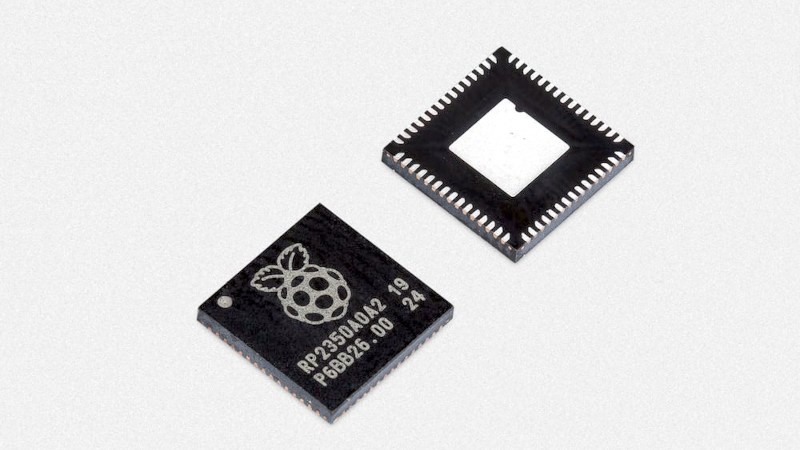
Coaxing a DVI signal out of a microcontroller to drive a DVI or HDMI screen has been possible for a while now, but limitations in what the devices can do has, in turn, placed a limit on the resolution that can be delivered. Now [Aaron Gayle] has broken through a barrier by generating 1080p video from an RP2350. The previous best from Raspberry Pi Pico-class microcontrollers was 720p, which an RP2040 could deliver. The 2350 is faster and has faster peripherals, but even then, to reach this resolution he had to overclock it to 372 MHz. For all the impressive achievement, there’s still a limitation. Lacking space for a framebuffer, he generates scanline by scanline, a technique we associate more with 8-bit computers from the 1980s.
The 1080p video code is part of a package called TVtop, a board game in which the game board is displayed on the TV and whose players interact from their phones via Wi-Fi. For that reason, there’s an ESP32 in the project too, though it has nothing to do with the video hack.
Now that an RP2350 has been shown to generate 1080p, we look forward to seeing others building upon this achievement in terms of what video can be delivered. If you do something, be sure to let us know.
Meanwhile, Aaron tells us he was inspired by this Hackaday story, which asked if it was possible.
Header image: Raspberry Pi, CC BY-SA 4.0.












1080p at up to 30 hz which is quite impressive and is plenty for that game
A demo video would be nice.
Yes, this is the time for a video, and some eye diagrams.
Good thing people get upset whenever there’s a video attached to an article. Can’t have that pesky multimedia supplementing the text, can we?
No we get upset that an article we clicked on turns out to be a 2 paragraph partial-summary of a video, with no warning.
When an article amounts to “did you hear that Ben Krasnow did (thing) yet?” with no indication that it is actually just a video recommendation we get mad. (No shade on Ben. I <3 AppliedScience)
Which is why the reasonable commentors simply ask for a “video” tag or something.
The argument on this article is not that.
Let’s take down that silly straw man…
SpaceMIT K1 Risc V does 1080p at 60Hz
What is that?
A chip.
Interesting, but very different hardware and applications. Apparently the cheapest board hosting the K1 is the Banana Pi BPI-F3, now priced at $61 at their eshop for the 2GB RAM and 8GB eMMC version. Way higher but not bad at all for the category (bookmarked!) although it’s out of stock which we know may imply some bad surprises when it gets stocked again. Still apples and oranges though: the RP2350 wouldn’t play movies or work for a web kiosk, but I’d consider it every day for example to drive a screen for some instrumentation, IoT terminal etc. over a bigger board. Not everyone needs a Linux capable board with plenty of RAM and storage.
And you can buy that chip for less than a € as well?
Apples and oranges. One is a microcontroller (SoC) and the other is a microcomputer (SoC).
And my PC does 8K, so what? Does it cost less than $1?
Pretty impressive
Does anyone know if generating 1080i instead (every other row every other frame) might be more achievable, without needing to overclock the chip?
1080p30 = 30 fps progressive has the same amount of data as 1080i30 = 30 fps interleaved (which has 60 half-sized fields per second). There is no official format for lower FPS, though some displays may support e.g. 20 fps.
I think the coolest part of this could be the realtime vector graphics renderer, with outline fonts.