
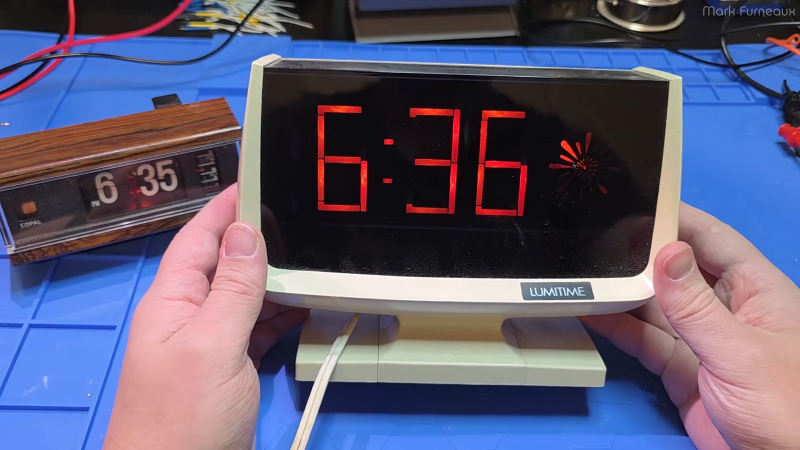
If you wanted to build a clock with a 7-segment display, there are a wide variety of ways you might go about it. You could grab some 74-series logic chips and create a whole bunch of counters and decoders to drive the display, or you could wire up a microcontroller with an RTC and have it do the hard work. Or, as a Japanese company once did… you could create a “digital” looking clock with no digital electronics whatsoever.
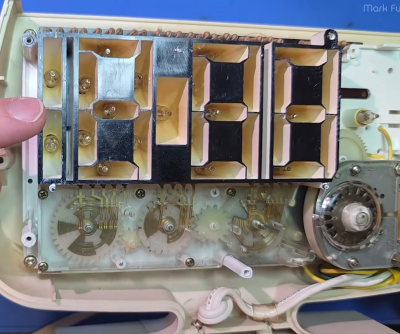
[Mark Furneaux] set about tearing down a Lumitime clock, built by the Japanese company Tamura. From the outside, it appears to be a rather stylish digital clock, with a bold red 7-segment display lit with neons. And in some regards, it is. Only, the secret of this clock is that it doesn’t use digital electronics to do the job. There are no counters inside, no real-time clock module, no transistor-based logic chips doing the counting with the output of a 32.768 KHz crystal. Instead, a motor drives a series of gears that turn metal plates that move under sliding finger contacts. The gear train and the metal plates are designed such that the contacts turn the various segment neons on in the correct sequence to display the current time. It’s like a player piano, only instead of playing a tune, it’s switching the segments of a display on and off to display the right numerals at the right time.
It’s a neat way to do a “digital” clock from an era when proper digital electronics were still very expensive. We’ve seen all kinds of whacky 7-segment clocks before, too, like this amusing water-based build. Video after the break.












I was disappointed that it was electromechanical, I was hoping for some crazy analogue contraption. Still cool though.
Have a look at the Franlab channel on YouTube. She covered this one a few years back, and plenty of other. She did a repair on a talking clock recently.
Does weird and wonderful displays as well, check out the Bina-View videos (also on HaD).
Thank you Zoe for not using the same clickbait title as the video, namely “This 1970s “Digital” Clock Has No Electronics Inside”, then opens it up to reveal a row of resistors.
That aside, that is a very cool clock. He warns that they cost a fortune, and indeed the cheapest one I can find on eBay in the UK is £250, yikes!
The word “active”, as in active electronics, is presumed by the non-pedantic.
Yeah, they’re pricey. Gotta love electromechanical gizmos though.
Resistors aren’t “electronics,” they’re passive. Heck, everything is technically a resistor. The title isn’t clickbait.
There used to be an distinction between “electric” and “electronic”, too.
And electronic usually involves active components, such an amplifier (transistor) or an IC.
While an electric guitar without the guitar amp would be passive.
A simple circuit using electro motors, magnets, resistors and incandescent lamps would be an electric one.
More difficult to define would be logic circuit operating on electro-mechanical relays and condensers/resistors, maybe.
Yeah, that’s pretty much how I was taught to think of it. I haven’t found many satisfying edge definitions, but usually people say that clockwork moving electrons around is still merely electrical, but if you have a vacuum triode or semiconductor somewhere it’s electronic. Still seems incomplete, since you have electric current controlling and modulating other electric currents in both.
In something like the Lumitime or a Telechron time switch, the Electricity is being used only to drive the motor and light the lamps. If I were to design and make a fully mechanical device of this sort using mirrors and a gas lamp to illuminate the segments, it would still be “pretty much the same thing.” Only it wouldn’t use electric power.
I have a 70’s alarm clock with a 7-seg display – that is totally mechanical. It uses moving shutters and some weird mech covers/uncovers the segments as needed. It’s so cool, I kept it but the motor wore out and got noisy. It used two #194 lamps for the backlight. On my list of cool things to teardown for fame and glory.
I had one of those back in the 80’s. When it died I tried to take it apart, only to find everything was heat-welded together. Inside was a complex assembly of levers, cams, and strange multi-lobed gears that I soon realized I had no hope of reassembling correctly.
If the video and the above comments are to be believed. These kinds of old exotic mechanical clocks can be a bit of a collector’s item. So do be sure to check lest you accidentally irreversibly tear down a potential piece of history.
In my teenage i disassembled tens of tube radios, tvs etc. Today some of those would be collecors pieces. But i have no regret, part of my technical knowledge is based on such irreversible autopsies:)
Btw both clocks are nice electromechanical gadgets.
Great project. Btw, such types of rotary contact wheels were used in the old washing mashines from the 70s, where the “washing program” was coded on the wheel, which was slowly rotated by a mains-powered synchronous ac motor with a reductor.
That makes me want to design and 3d print more electromechanical stuff
Yes! Logic can be made in many ways. Great article :-)
Mechanical timers on washing machines and clothes dryers were still common practice well into the 90s, and perhaps even later on basic models. Same with automatic ice makers and defrost timers in your refrigerator/freezer too. On some models the defrost timer was part of the ice maker, so if you turned off the ice maker (or it quit working) it wouldn’t defrost the evap coils anymore.
RE: “…even later on basic models…” still is. Bought washer fairly recently, 2021 or so, mechanical timer it is. The only “electronics” is the feeble “beeper” that announces the commencement, looks straight from the 1970s, except SMD.
I’ve long commented that average ubbity uppity mega expensive machines use the equivalent of Arduino Mega plus bluetooth or whatever it is that’s The Major Fad. Some may even have rp2350 level of sophistication – the ones that render pretty screens.
Average washing machine or drier really have not changed that much since 1970s, maybe new kinds of washer agitators that seem to finally resolve the perpetual problem of large item occasionally winding up themselves on the agitator (and, of course, trying to tear them apart during the spin cycle). Besides that, not much changed that would merit average washer/drier costing two or three prices comparably speaking. I stand corrected if one of the upscale expensive driers starts folding the cloths, and one of the upscale expensive washers start transferring washed cloth into the drier automagically, and loading the next batch after that.
Replying to my own reply.
Make me think all those electromechanical kinds should be relatively easily “upgraded” to the reed switch kind. Average reed switch can easily outlast the machine it is in – and when bought in bulk merits including alongside the ware. Why? In the offline dark ages average car driver would have a spare headlight or two somewhere inside the car hood, because whilst driving on a dark stormy weekend night with no store open anywhere near, and having a headlight (or two) go out, you’d WANT to have a spare at hand.
But still, reed switches or bystable relays with a bit of diode logic has got to do, methinks.
It’s been a long time since I’ve looked at clothes washers, I suspected that mechanical timers were still a thing but I wasn’t sure.
I’ve also had generally good results with older ECU-driven models that predate the IoT craze. My parents are running the same clothes washer from 2002 (a front-loading HE model) and it gets really, really heavy use. I’ve had to replace a lot of parts and assemblies in it (on its third drain pump!), and a couple years ago the ECU finally started acting up. Turns out that, after running 10,000+ loads, the solder joints on some PCB-mounted relays had cracked. The relays were really long and skinny, and the thermal expansion/contraction of the long body took its toll. I touched them up with some 60/40 and it’s been reliable ever since.
The 1980s washing machine before that had similarly been used heavily. The water level switch would stop filling too soon, requiring manual intervention. The transmission was failing, and would try to spin the drum while full of water at the beginning of the drain cycle. But that mechanical timer still worked like a champ! And the clothes dryer….I think it is still in service somewhere!
Ours still is and still runs. I have to hose the timer mechanism box out with contact cleaner every couple of years to remove soap goo and lint from the contacts but it works :) We looked at some newer models and they were just ridiculous in their demands. Good ol offline clothes washing for me please :) The coolest thing I had not been aware of was the service mode on these where you twist the knob back and forth to test the components. It is cool and helpful :)
The best part was when water inevitably got inside and corroded the tracks. An early childhood memory of mine is of the washing machine disassembled and someone fixing the program wheel.
Hi! Weather stations used such contact wheels, too.
Or rather, more precisely, the sensors for the wind direction (n,w,e,s and in-between).
Fran Blanche covered this a few years ago. It’s amazing what was done with wheels, gears and cams.
I’m not an ME, but those are a special kind of smart.
https://youtu.be/SVG9veCKogU
Yep, the Fran video was the first thing I thought of when I saw this. Cool to see it again in a different setting and knowing that more people appreciate the technology of this era. I find it fascinating that one technology (mechanical clockwork) was used to simulate another (digital circuitry).
Re: wheels, gears, and cams
Ken Shirriff did a reverse-engineering series on a Bendix Air Data Computer.
https://www.righto.com/2023/02/bendix-central-air-data-computer-cadc.html
http://www.righto.com/2023/10/bendix-cadc-reverse-engineering.html
http://www.righto.com/2024/01/bendix-cadc-pressure-transducers.html
http://www.righto.com/2024/02/reverse-engineering-analog-bendix-air.html
http://www.righto.com/2024/02/bendix-cadc-servomotor-tachometer.html
We seem to have forgotten why a digital clock is called a digital clock. It displays the time using *digits” rather than dials; it has nothing to do with it’s electronics. As such there is no need for scare quotes, it is an “electro-mechanical digital clock”.
I’m quite surprised they managed to make these as reliable as they are, with moving parts, gears, and worst of all, electrical contacts that slide over each other. I would have expected these to not last too long. A decade max. But then again I don’t design mechanical devices.
Might I dare to know to timing accuracy? 1000PPM? 10K PPM?
Since the motor is probably synchronized to mains frequency, long term accuracy might be 10-50 ppm.
Yes, all the electromechanical clocks’ motors run off the mains, hence, synchronized by the power companies, ie, reasonably well regulated.