
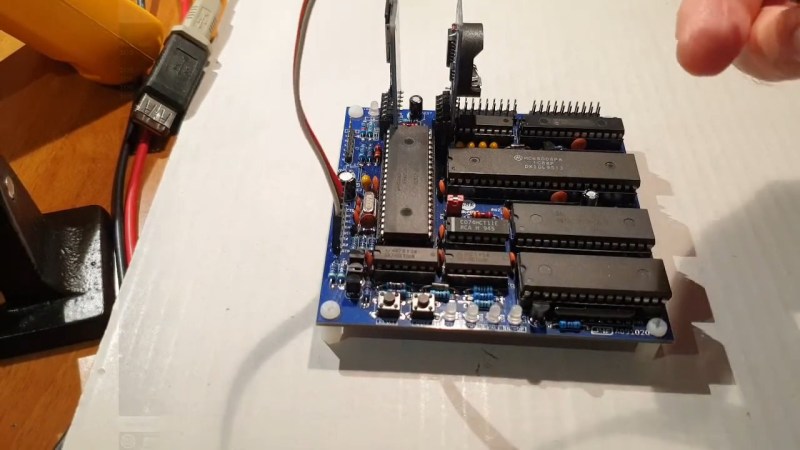
Homebrew computers don’t have to be retrocomputers, but [Just4Fun]’s all-through-hole, 68008-based “68k-MBC” certainly qualifies, so it is a worthy entry in our ongoing contest. While there are both “full” and “lite” hardware configurations, the three-IC “lite” configuration is what first caught our eye. Yes, three: the 68008, an SRAM chip, and a PIC microcontroller that acts as the ROM.
Software is provided by the suitably-retro CP/M68K, or standalone executables, which run on both hardware configurations.
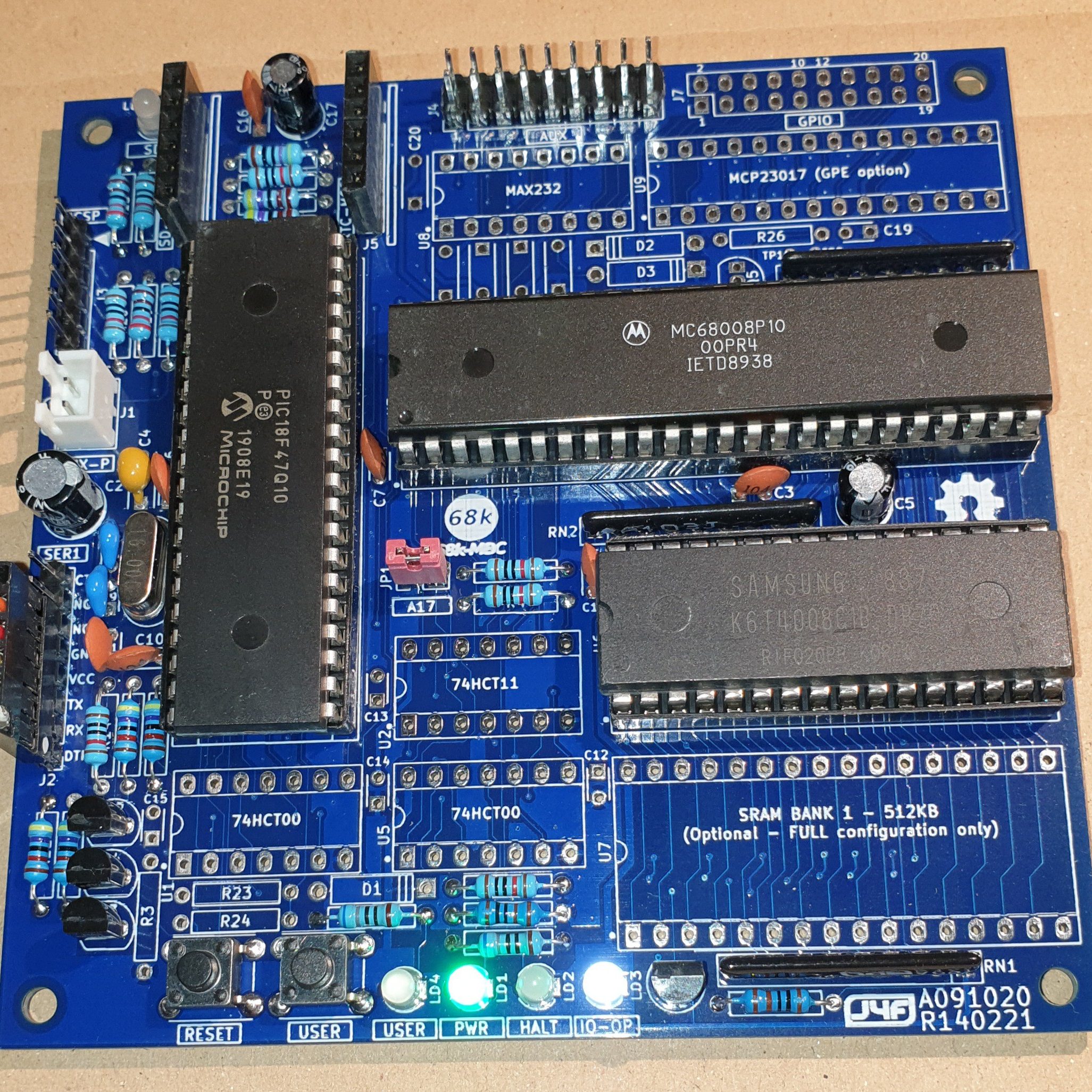
The “lite” option restricts you to a maximum of 512 KB of RAM and a single serial port, but it looks like you still get I2C and the option to plug in an SD “hard drive” or RTC module however you configure the machine. Through the serial port, you can of course connect a terminal of you choice, or even use a thermal printer. The “full” version has two serial ports, if you want to do both. [Just4Fun] also has a parallel adapter lets you plug in printers with that interface as well. The demo video is below, but be warned that the text-to-speech narration won’t be to everyone’s liking.
We’ve featured other single-board-computers using the 68k before, but this one is a worthy contender in our contest, not least for the impressively low chip count. This contest has gotten oodles of entries, but there’s still time for yours: entries close October 27th.













I count 7 ICs…
And me 9 on the mainboard.
haha yeah i thought they should have put the lite version in the header pic too. because 3 ICs sounds impressive to me. makes sense though that a PIC could mop up a little glue logic (i assume) while also providing a virtual rom
You don’t see nine?
Death cures all wounds, that’s my motto.
https://www.redfactionwiki.com/w/images/b/b6/Medic.jpg
There are 4 lights
I SEE FIVE LIGHTS!
Oui mon capitaine! We can light 4 baguettes/cigarrets at once!
I2C controlled agonizer sold separately.
They always get you on the accessories.
this has been around for years!…
there is also the z80 version by the same guy…
…ya can do it all with a single ESP32 and emulate just about any retro system…
Hi! The eZ80 is still on sale and has an Z80 mode.
Indeed, a four-chip version has been done for the HaD 1″ square project.
https://hackaday.io/project/161496/
Do an ESP32 Cray
Ya can do it with a pC and emulate about any system…
Picard: I see three chips!
That is clearly is at least 7 ICs, does HAD think we are blind?
They will just never admit, and Tyler the slop text proxy in particular, that they heavily rely on LLM to feed their blog. If they would admit it, I would be fine with it, but the deliberately not ANSWER that question.
That question has been answered in the negative repeatedly, and quite explicitly to you and others. I’ll do it again just in case you’re willing to listen this time : Hackaday uses human authors to write human text. No LLMs are involved in the generation of our articles. When there are mistakes, they are human mistakes. When there are typos, they are human typos. If something is worded oddly or is unclear, a human wrote it oddly or without clarity. If there is annoyance at commentators who refuse to believe that, well, can you blame a human for getting annoyed?
There is a “full” version, and a “lite” version. The maker had better images of the “full” version– which is the same board with all the ICs populated– so we ran with that as the header. The image we used for the thumbnail on the front page had the “lite” version; I’ll embed it into the article for the easily-confused.
Bzzt. A whole microcontroller to replace one or more I/O chips and the ROM. EEPROM programmers are cheap. Fails the retro sniff test.
ZX81 did it with 5 less than that board
I might be old fashioned, but I tend to feel that a three chip computer needs, well, just three chips.
Something like the RC2014 Orton 3C uses just a Z80, 32k RAM and one logic chip, but still has a front panel for programming and can do 9600 baud serial
I need to build this!
I really hate these “retro pc builds” that use an MCU more powerful than the processor itself as “glue logic” If you’re going to go to this point, just emulate the damn thing.