
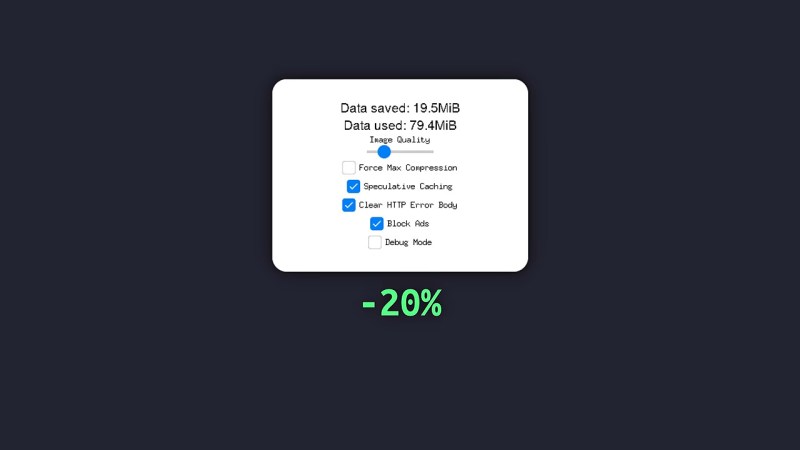
It’s no secret that the size of webpages has been slowly — or not so slowly — creeping up over the years. Does a simple website need to span multiple floppy disks? [PortalRunner’s] doesn’t — or rather, he doesn’t want to burn that much of his limited mobile data. So he built a self-hosted HTTPS proxy to compress images and websites, block ads, and save his bandwidth.
The proxy itself is based on mitmproxy rather than reinventing the wheel. The biggest gains are, of course, from knocking images down to size — since he’s only going to be looking at them on a tiny screen, he can not only apply the better compression of .webp rather than the more common .PNG and .JPEG, but also toss unneeded information by reducing the resolution. Exactly how much quality to toss is left up to the individual user in a handy config.
Likewise, if you’re willing to wait a little longer for pages to load, you can force every webpage to get the highest possible level of compression — otherwise the server is only going to do that with ridiculous Java-heavy pages that absolutely need it. As a bonus, going through your home server means this acts like a private VPN to help protect your data on the go. If you want the details, check out the GitHub link above or the video embedded below.
This project is explicitly about saving data; it won’t help older hardware get online the way the publicly hosted FrogFind search engine or private-hosted MacProxy servers do. If you really want to escape the bloat of the modern internet, a proxy can also help you go way back.












Assuming it’s not 1996 and this means JavaScript-heavy, all the “force max compression” option seems to do is uncompress, minify, and recompress assets. That’s going to make zero difference to SPAs which are invariably minified already. At least it slows down page loads though!
This makes no sense. Just use Tailscale and AdGuard Home.
Compressing slop makes it compressed slop. I’d rather save the power and avoid slop altogether.
This reminds me of the commercial compression proxy services we used to have back in the dialup days, like Onspeed, Propel Accelerator and Artera Turbo. Made a massive difference when I was still on dialup whilst the rest of the world moved onto cable and DSL. And then in the early smartphone days there used to be Google Web Accelerator, which made a huge difference if you were on GPRS/EDGE, although the more convenient and better option was browsing via Opera Mini, which was a huge lifesaver on slow and capped connections… which I relied on well into the 3G era too, because data used to be so expensive back then.
Speaking of mobile browsers, anyone remember Skyfire on WinMo/Symbian? It took a radically different approach and remotely rendered the webpage in a desktop browser, allowing you to view embedded Flash and Java content on pre-smartphone era devices, and in the early-smartphone era, Puffin browser did the same thing.
Man, those were the days… we came up with so many weird and cool ways to speed up with web. Maybe I should write an article about this or something.
Yep, and 99% of the “internet boosters” you could download were malware.
I’d happily go back if I could get a SIM for my SE P910
a proxy that would make an old Chromebook usable would be nice. i have several that have a couple gigabytes or RAM and refuse to load most pages. for my remote control system, a website i built and maintain myself, i can make it work fine. but it would be nice to be able to watch youtube videos and load Github again on those machines.
2GB RAM are more than enough for a Linux desktop on a lighter OS/DM such as for example Alpine Linux + XFCE. New Chromebooks/boxes can be unlocked so that they can host a real Linux distro.
Take a look here: https://docs.mrchromebox.tech/
My uBlock Origin stats are currently at 4.131 million blocked to date, or 42% of everything on the pages I have viewed. I have an extremely low tolerance for annoying bullshit – avatars, smilies, emojis, nearly anything that animates in an endless loop. I do not need your scroll-to-top buttons or your fixed headers that eat 30% of my screen or your newsletter signup offers.
I also do not need any of your fonts, thanks. I already have fonts. They’re built-in. They display text just fine.
Mine’s saying there’s 44 blocked fonts on this page alone.
Perhaps 80-90% of a modern webpage is junk. Lazily thrown together pages that rely on infinite bandwidth and (preferably) multiple cores to render in a timely fashion. (Then there’s also the spyware libraries — you incorporate this stuff into your webpage for a kickback from the spyware companies.)
There are relatively few websites that deliver an adequate amount of information for a page’s worth of display. Most clag the screen up with irrelevant advertisements, constant attempts to display video and audio…..the modern web is mostly junk. It only exists because the practitioners are good at one thing — selling the belief that they have a viable business model to each other. The moment that belief is challenged the entire Web platform will collapse like the house of cards that it is.
Right now, more than 90% of a site’s visitors aren’t humans looking for information; they’re bots.
And I’m only talking about the “friendly” bots that make standard requests—not the ones constantly hunting for WordPress vulnerabilities, for instance. Even if your site doesn’t use WordPress, they show up every single day, just in case…
So, if you build a site and want your work to actually pay off, you have two choices: either you add external content—like ad images or stupid videos that start playing automatically, because hardly anyone sticks around a site that’s just text (reading is too exhausting)—or you put up a paywall, count the cheapskates, and then realize some moron on Facebook has ripped off your pages just to get likes!
So yes, to survive on the web these days, you have to do things that will annoy some people—specifically the very people you would have loved to build a site for, while holding down a different job, a real job that actually puts food on the table.
Text only and HTML 1.1 for me. Good luck hacking that! It’s just read only files with no execution anywhere to be seen. Popularity has ruined the web.
Don’t forget ublock origin and pihole