
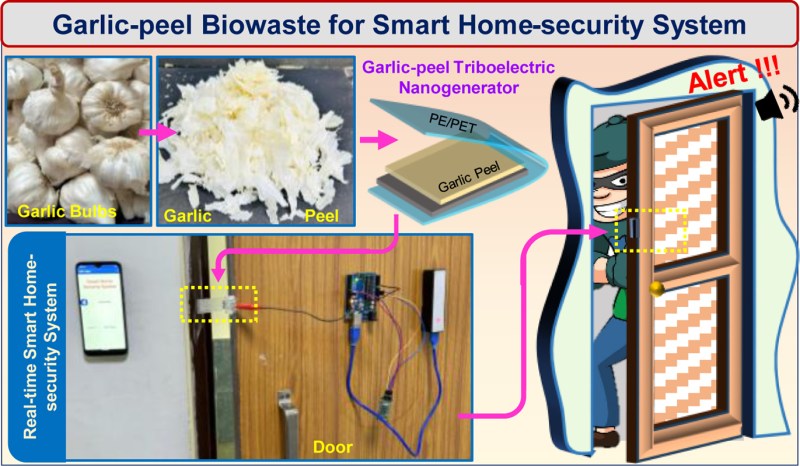
Most home security sensors require a chemical battery or external power source to operate, which can be a point of weakness. If the battery in a window or door sensor dies overnight and nobody is there to swap it, it might miss that one intruder or mess up your carefully curated home automation system. In that sense self-powered sensors are rather interesting, such as this one by [Manas Tiwari] and [Deepak Bharti] that is based around the triboelectric effect.
The research article is sadly paywalled, but the IEEE Spectrum article covers all the salient details. The sensor uses ground up garlic peel for the positive side of this triboelectric nanogenerator (TENG) as they call it, with a sheet of polyethylene (PE) forming the negative side. Once installed on a door frame, opening said door generates about 210 VAC with a 45 µA short circuit current. A dual-side layer of garlic peel bumps this up to 400 VAC and 65 µA.
As installed, the researchers used this generated current to detect changes using a separate MCU running off a powerbank, which obviously does not really solve the ‘running out of charge’ issue. The generated power could conceivably be used to send a brief wireless packet to a receiver elsewhere in the room, somewhat like the Bluetooth link in the example, but more low-power.
The researchers also reported that this sensor was still functional after half a year in storage, and survived 200 stress cycles, which seems like a good start for what appears to be a very cheap sensor to construct.










First thought when I saw the headline: Is this to keep vampires out?
Haha yeah, thought it would be a halloween story :)
Ain’t Halloween coming soon? And as all the shops are allready full of specific marchandise, why not scientific research? The are low on funds.
Showing my age that I think of Usenet, and the KIBO electric effect…
Is it April already? Bananas make great ice skates too, but some things are just not really worth doing for various reasons.
Okay, absolutely not how I was expecting garlic stuff to be used!
FYI: Despite having “IEEE” in its name, the IEEE Spectrum is more like those Taboola feeds for chumboxes than serious technical journalism and this is a prime example. They turned some junk publish-or-perish “research” from a minor (local) technical university somewhere in India and made it into “revolutionary technology” 🤦♂️.
Thankfully the article was published in IEEE Sensors
Wario would be impressed.
My very first thought: “Time to send this to my online friend who goes by the pseudonym ‘Wario’.”
Can we use them for power bank which used for phones and electronic vehicals .is it possible
No, but every street in India has plenty of human feces laying around. People can go outside, collect them and burn them to heat water, turning it to steam which is going to power turbines in recogeneration plants across the country.
The article was actually published in IEEE Sensors
https://ieeexplore.ieee.org/document/11661585
M. Tiwari and D. Bharti, “Smart Home-Security System Based on High-Performance Garlic-Peel Biowaste-Derived Triboelectric Nanogenerator,” in IEEE Sensors Letters, vol. 10, no. 10, pp. 2505604-2505604, Oct. 2026, Art no. 2505604, doi: 10.1109/LSENS.2026.3726055. keywords: {Materials;Weighted sum model;Security;Smart homes;Energy harvesting;Permission;Electrodes;Internet of Things;Technology;Timing;Mechanical sensors;biowaste for energy;energy harvesting;smart home-security systems, and;triboelectric nanogenerator (TENG)},