
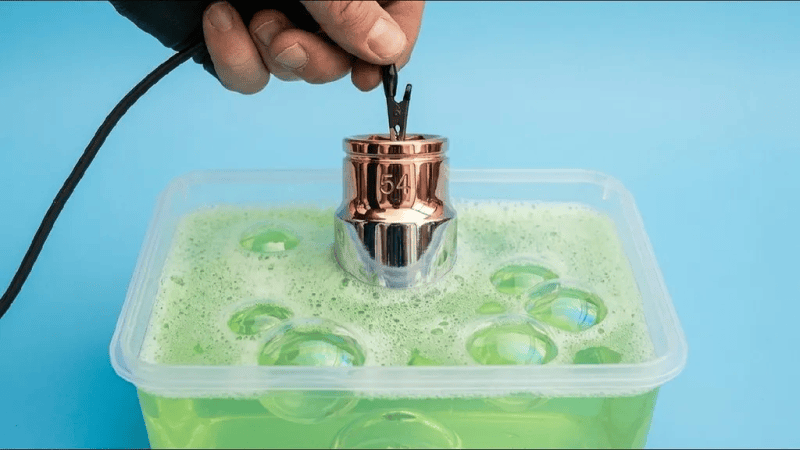
We imagine that electroplating is like making PC boards or soldering surface-mount chips. Before you’ve done it, it seems like a lot. Afterward, you can’t remember why it was such a big deal. [Kovancapol] wants to show you how to plate a mirror-finish nickel over your tools, and while it looks like a lot to set up, we are guessing that it gets easy once you have everything together.
There is a bit of chemical setup, as you might expect with reagents like nickel sulfate and nickel chloride. Then there’s the glassware, nickel anodes, and a power supply. As you can see in the video, the results look very nice. We can’t help but wonder what other uses you might have for this process.
A conductive coating on a 3D print might be feasible. We aren’t sure soldering PCB traces would be worth it since nickel gets hard to solder as it oxidizes. You can mix and match plating for some pretty impressive results.











I’m not sure the long term issue with the electrical nickel plating of components mixed with circuitry would be the soldering. Whiskering might become an issue. But it’s late and I’m probably orders of magnitude off.
Tin, zinc and (to some extent) silver are the problem metals with whiskering. Nickel is more like iron or copper (which, I mean, is no accident), not (commonly?) known to whisker. (I guess most of the periodic table can whisker under just the right conditions, but no one’s having practical issues with the rest.)
Shockingly(?), not all nickel is practically unsolderable. I picked up some edge-mount BNCs recently that say they’re nickel plated, but they soldered almost like they were tin plated! I wonder if they applied an OSP or something; or if the plating I’d soldered previously was just old?
Nice experiment, but I would refrain from trying it and ask everyone to do the same. Don’t play with chrome if you don’t know how to deal with it (and especially how to properly dispose of it!); it is highly dangerous for both your health and the environment.
I mean, nickel. Nasty stuff anyway.
Nickel isn’t that bad, and even if it was, it would still be fun to play with. Never become overwhelmed by your fear of death, it will stop you from having any fun at all.
Do I have to watch the video to find out what voltage PSU is being used?
No, because it isn’t about the voltage.
It is all about the current. 300mA.
You use a power supply with a current limiter set to 300mA and the voltage allowed up to 7V. The voltage changes to accomodate the 300mA. You don’t control the voltage at all.
Yeah lemme plate my car’s bumper at 300mA, should work just fine. You’re talking very confidently about things you know nothing about.
The image shown in the article is apparently AI generated.
The video in the article talks about nickel plating. If you want to see actual shiny copper plating you need to watch the next video in the sequence:
https://www.youtube.com/watch?v=ccVAe34dTuI
Also, these are videos that you can watch at 2x speed with the sound off. Save yourself some time.
Nickel has that one problem of contact sensitization which eventually turns into a permanent allergy. The salts and dusts should likely do it faster and with far greater reliability.
There is a reason that surgical steel has chromium and not nickel. Whereas hexavalent chromium is a process hazard for electroplating, but is safe to the end user after washing, nickel is uniformly a hazard in skin and flesh contact. For those sensitized to nickel, even stainless steel can become a hazard.
Do not do this where you live. Fume hood or outside only. Full body splash protection and a dust and mist respirator for nickel salt dust are advised. Clean the whole area and all glassware thoroughly thereafter. Do not scale beyond your ability to clean after. Remember that if you contact sensitize yourself enough you will not be able to use what you plate.
That’s a good general advice. Always ask “If this thing spills here, what must I do to clean it up?”.
It’s not about scale either. What would happen if, for example, you spilled a bottle of car brake fluid on your coffee table and everything that’s on it? Hint: there’s a reason you never set the bottle down anywhere on your car while working on the brakes.
Not an issue with DOT5.1 which is used in pretty much any car manufactured after 2006.
DOT 5.1 is glycol based. It is still hazardous to paint. You may be confusing it with DOT 5 which is silicone based.
You mean I should wear impermeable gloves when I wash my hands at my expensive brushed nickel finish faucets?
Like your expensive brass finish faucets, they’re probably lacquered
This goofy idiot probably wears a respirator to put salt on his food. To any readers: do not listen to him, and do not allow health paranoia to ruin your curiosity about chemistry.
“The Secret Of Mirrored Tool Nickel Plating” – This video shows exactly how not to do it. The most important thing is surface preparation and absolute cleanliness which the video failed in every way.
We used to have a guy that did electroplating from a motel room. He mostly did gold and silver, but claimed to be able to do other metals as well. He did bronzing, too… like baby shoes and stuff.
I highly suspect that that’s exactly what “affordable” jewelry makers do all the time.