
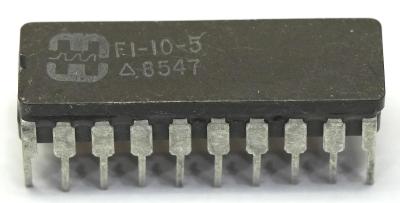
Recently [Ken Shirriff] got handed a mystery IC by [CuriousMarc] who had found said IC in a box of various old chips. Labelled only with a date code of the 47th week of 1985 and a mysterious F1-10-5 alongside a logo that didn’t lead to any hits in the typical IC databases, it was up to [Ken] to figure out what lurks inside this CDIP chip.
As it turns out, it’s actually a pretty interesting IC with an easy to identify die once the ceramic package had been cracked open with a surgical hammer-and-chisel strike.
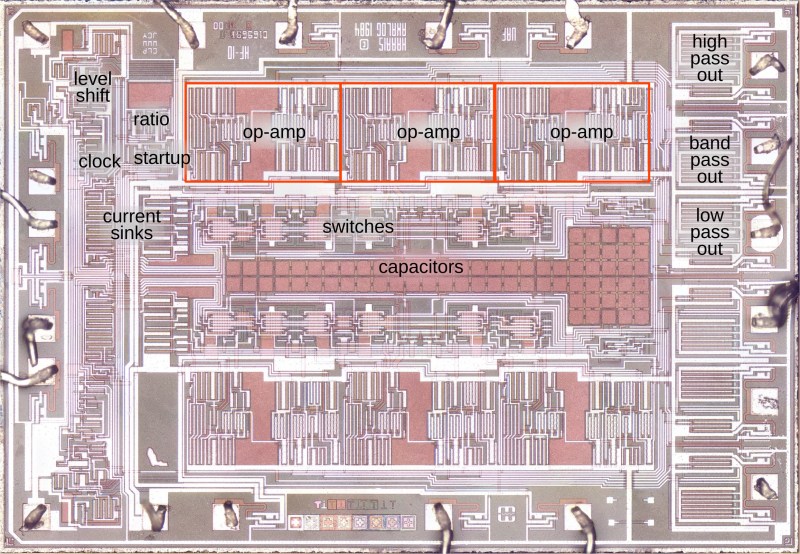
With the die under a microscope it was identified as a Harris HF10, itself a variant of the National Semiconductor MF10. This is a dual switched capacitor filter, with the modern version being e.g. the TI MF10-N in both PDIP and SOIC, but sadly no CDIP any more. Availability seems scarce, so the MF10 may not be long for this world.
These filter ICs can tune their capacitors to act as a low-, band- or high-pass filter. How this works is explained by [Ken], with switched capacitors replacing the resistors of a typical filter circuit. The main reasons for doing this over just using a resistor include how large resistors can get compared to the relatively small capacitor, not to mention their fixed value versus the adjustable resistance from the switchable capacitor.
The remainder of the circuit is mostly there to enable the switching and overall operation, providing a fascinating glimpse at a chip that would have been incredibly useful in the 1980s, including in synthesizers where this adjustable filter feature was most convenient.












lcamtuf has a nice article on how switched capacitor filters work: https://blog.coredump.cx/p/cursed-circuits-2-switched-capacitor
Okika (formerly Anadigm) manufactures switched capacitor based FPAAs, it’s a fascinating technology. Thanks for sharing this, Maya!
Neat stuff.
I remember buying a MF10 at Radio Shack some time around 1982-3. Innovative place it was, back then. Interesting chip to play with, but I never found a use for it beyond a not-very-useful synth plug-in.
I remember getting it at the same time as a SAD-1024 bucket-brigade chip, also fun to play with, and found a bit more use in the mixing console.
The “begats” of these things and the companies that produced them is interesting. Ken gives a glimpse of it near then end of the article. Unclear how Harris came to make a version of a National Semiconductor ship though: Licensed? Second-sourced? I wonder how cosy they were.
NS always had an interesting catalog.
The Harris logo wasn’t in any databases?
Forgive my extremely limited understanding, but capacitors are great for building filters, much like tubes. Delaylines can be used as well. Most filters are nonlinear, some component needs to accumulate and discharge the signal with specific coefficients, this heldback signal can be used on the original signal to perform differentials necessary for filter construction
Thanks, but I’m gonna stay with AS2164 :)