
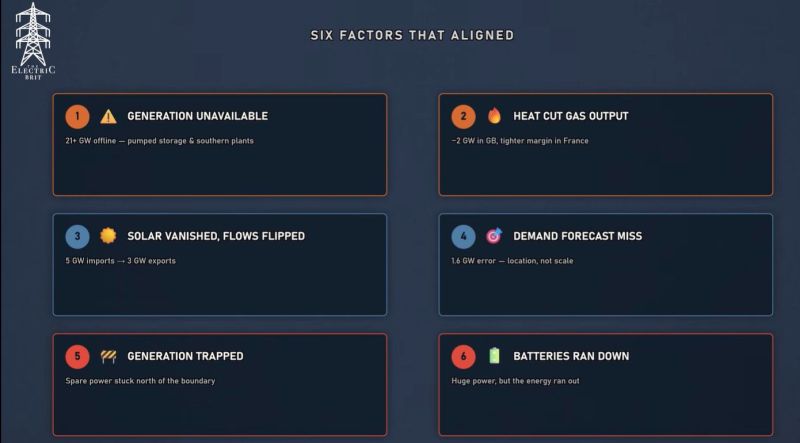
Amidst one of the worst heatwaves in European history, Britain’s national grid saw itself faced with a quiet crisis this summer. On June 23rd, the grid frequency dropped to 49.657 Hz, down from the nominal 50 Hz — getting very close to the lower bound before safeties would start disconnecting parts of the grid. In a video by [The Electric Brit] this event is investigated, including its causes and how France’s spare capacity managed to save the day.
 Under normal operating conditions the UK grid is kept above 49.8 Hz, with the statutory lower limit being 49.5. Meaning that another drop of 0.157 Hz would have set in motion a series of quite extreme grid protection mechanisms including the possibility of local blackouts.
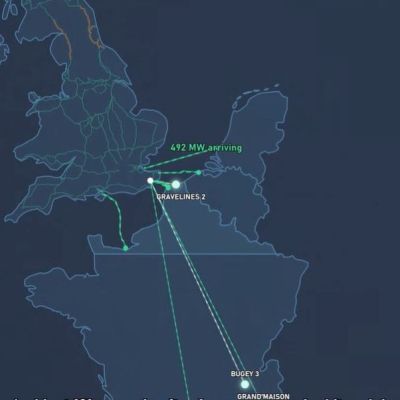
Fortunately the cessation of energy exports and the importing of French power from hydro and nuclear power stations managed to nip this issue in the bud before it could get any worse. Although an example of correct grid management, it also shows how poorly planned maintenance and events like a heatwave can line up quite a few holes in the cheese slices that invite disaster.
The problems here began weeks prior to the event, with 21.2 GW of generating capacity offline. Of this, 12.6 GW was planned maintenance, another 8.6 GW was unexpectedly offline, while another 2.6 GW of gas generation was mostly unavailable due to the heatwave curtailing production. A couple of interconnections with Ireland and other nations were also down for maintenance, leaving the grid control room with precious few options.
Although the UK’s transmission system operator (TSO) NESO had its predicted capacities for variable renewable sources (VRE) like solar, it could not see local demand and production from e.g. rooftop solar in the control room. This became rather exciting when the evening neared and rooftop solar output dropped. Here NESO turned out to be lucky, but such hidden factors form a major risk factor when such consumers return to grid power.
As VRE sources fell quiet across Europe that evening, this put the onus on remaining generating sources and brought the slowly developing crisis to its apex. Fortunately importing energy from France saved the day here, but there are many lessons to be learned here, many grounded in how complex AC grid management is once you consider all aspects that affect not just generators but also transmission lines.
This event is different from the frequency oscillations that triggered the blackout on the Iberian peninsula in 2025. In that case a problem existed with reactive power management, with oscillations amplified by grid-following converters from solar farms and insufficient capacity on the grid to absorb this surge in reactive power, ultimately leading to the cascading blackout.
Amidst these lessons on grid-management the discussions on whether baseload power generating is truly dead among other tropes, as well as the calls by European TSOs to make grid-forming converters mandatory on VRE generators will no doubt intensify.










One does wonder if more storage would have mitigated some of the effects?
“…with oscillations amplified by grid-following converters from solar farms …” An interesting failure mode most likely not in the brochures.