
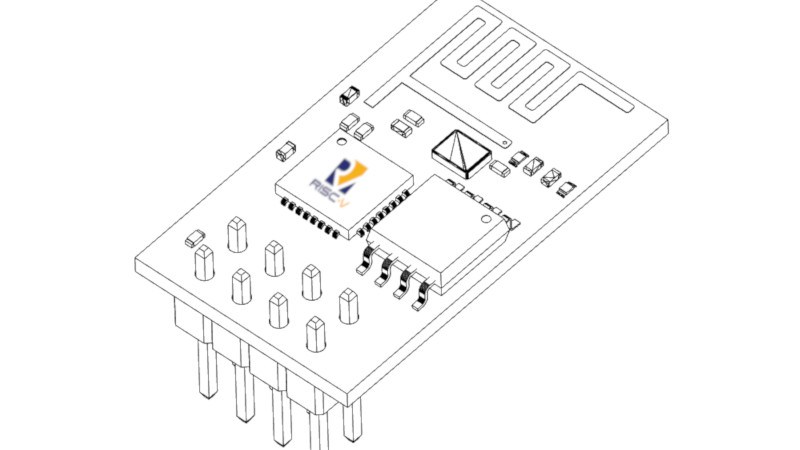
Generally the DVB-S and -S2 standards require a satellite somewhere in Earth orbit to provide a signal to receive, but you can also transmit your own DVB-S2 stream with any RF transmitter if you’re so inclined. Courtesy of recent breakthroughs in using the RF hardware of the ESP32 on a raw level, [SP8ESA] has created the ESP32-DATV project using which you can broadcast a DVB-S2 signal using an ESP32-C3.
While a host PC side application handles the heavy lifting of turning the input video signal into a DVB-S(2) compliant signal, it is the ESP32-C3 that prepares the samples for transmission before sending them off to its RF block, with no external hardware needed.
If this brings to mind the idea of using an off-the-shelf DVB-S2 receiver to play back the signal, the frequency range for DVB-S2 is 10.7 – 12.7 GHz, while the ESP32-C3 is limited to roughly 2.4 GHz courtesy of it targeting only 2.4 GHz Wi-Fi and Bluetooth signals.
Targeting frequencies as low as 100 MHz might be possible with some hardware tweaks, but for higher frequencies the ESP32’s RF block might need a complete overhaul.
Thanks to [ftg] for the tip.












The hackrf outputs power at 10-12 GHz frequencies unintentionally. If you transmit at 5.5 GHz it puts out enough power at 11 GHz to be received by a standard satellite LNB. It’s possible this could do the same thing.