
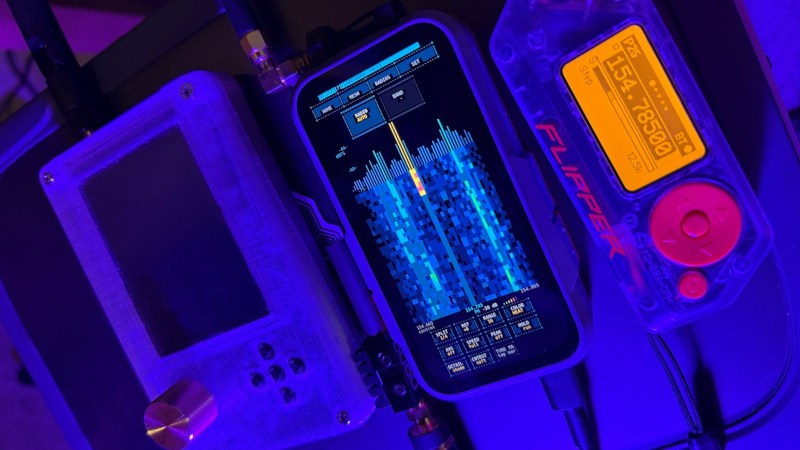
The news of the past couple of weeks has seen the ESP32 turned into an software-defined radio (SDR) thanks to a hidden baseband mode, an exciting development by anyone’s standards. It seems unexpected SDRs are like busses in that you wait for ages and two turn up at once, because hot on the heels of the ESP32 story is [Samson1te], revealing the SDR functionality hidden within the LR2021 LoRa chip. This one is especially interesting because as well as a 2.4 GHz radio, the chip sports a radio that works from 150 to 960 MHz.
We’re indebted to them for posting this in a comment on our receive converter post, as a complimentary project to the ESP32 one. It gives a 16-bit SDR with receive and transmit, however as with the ESP32 it’s early days and we hope great things lie ahead. There are comprehensive docs available, should you wish to enter the fray. Currently the main demo is P25 digital voice.
If you’re interested, you can follow our coverage of the ESP32 SDR.












That’s a fast turn-around time from comment to article! This is pretty exciting from a hardware hacking perspective. It’s like our little version of a Precambrian explosion or a tech revolution. Fun times.
Very much so.
Who would have thought that chips using software to define their radio would be capable of SDR!
Fair enough if people have found undocumented API calls, but SDR is the whole reason these chips exist in the first place.
Most modern radio chips use SDR functionality internally, they just don’t expose it to the world.
Someone in the know suggested to me that these hidden functionalities are there for testing purposes. As part of the QA tests in manufacture they run diagnostics on all the various parts of the device, including the SDR front end. For that it’s handy to have hidden access to its interface.
Flexibility in dealing with standards changes without creating a whole new chip. Same with fixing implementation bugs. And of course the usual, moar features.
Indeed they are there for internal testing purposes, and that’s why they need to be ‘found’. However my point still stands that it’s not amazing they are SDR as this is how (at least some) RF chips have been made for over 20 years.
Not all do not expose it, some of them have a documented IQ interface that is used to support new protocols…see for example STM32WL33 (there are others anyway)
The existence of the tech isn’t the cool part. We all know they run on SDRs. The cool part is the figuring out how to use it. They don’t advertise the use nor support it because it makes the devices work outside of their certified frequency ranges. That means the device loses its certification. But discovering the ability to use it is like jailbreaking an SDR that pretends to be just an R. I guess you realize that and just don’t find it interesting, but some of us do. This is hacking.
Like Jenny pointed out, on paper it sounds pretty tame.
However this is also quite different than the ESP32 projects recently because this is first and foremost a radio. Which ultimately make it more usable in the SDR sense, but less interesting in a “hardware hacking” way.
It’s also the fact that it’s a single tiny chip, that’s much lower power than an RTLSDR. Yes, not as capable, but it makes a wonderful complimentary radio in combination. Which is my main use for it in the LakeShark project.
inb4 it gets removed in subsequent chip revisions
BS. chips revisions just do minor changes, it would cost too much to change a lot. And besides this, you need that feature for testing the chip. You cannot remove it an pray everything will be allright. You need access to fine tune parameters, and then with those parameters applied you can attempt to get the certification. It fails ? back to tuning. At worst, a revision (minor edits).
Couldn’t they disable it in a minor revision while still being able to test and update their inventory by adding one of those eFuses?
Maybe, but I doubt it. It’s more useful to them to keep it for development purposes and I’m sure companies use this internally. At least, in the older variants as you can do this with the SX1262 as well, it’s just not as wide. (But goes higher in my tests).
Correction: SX1262 does NOT do raw IQ though, only demod and RSSI.
The conspiracy theorist in me would like to think it was a small release of information by a security agency to initiate innovation and make potential backdoors or spy tech public knowledge ahead of an impending escalation of the wars going on at the moment.
No doubt the reasoning is far more benign and it’s just a case of cumulative progress and inspiration.
Still, either way, these sort of discoveries have interesting possibilities, especially with a large portion of modern technology being so interconnected these days.
“Hidden SDR” makes me wonder if these “hidden” features were intended with a eye to future surveilance abilities…
Paranoia doesn’t suit you.