
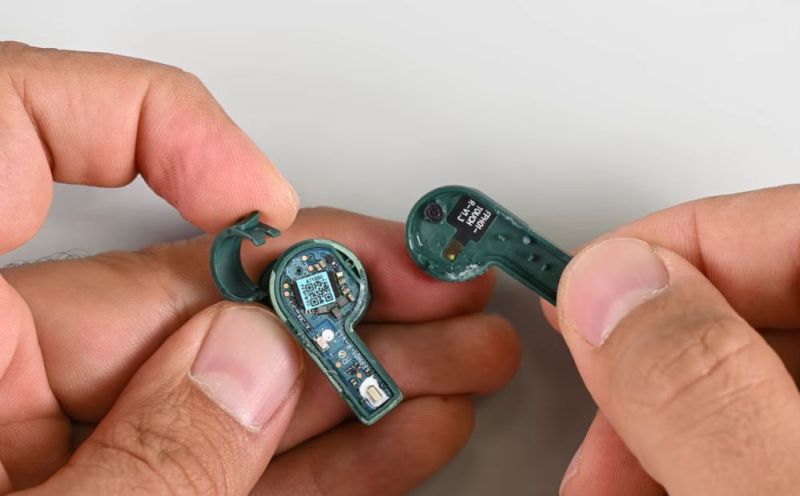
In a world where wireless earbuds are increasingly seen as devices that you toss into the e-waste bin as soon as they stop working, it’s heartening to see companies take the opposite approach with their designs. In a recent teardown of the new Fairbuds 2 by [iFixit] we get a blow-by-blow report of disassembling one of these devices, getting to its rechargeable LIR1054 coin cell, as well as the very accessible PCB should you have to replace a shorted capacitor or similar issue.
Much like with the first version, the 3.6 V lithium-ion coin cell can be extracted simply by pulling on the battery door, which leverages it out of the enclosure. Despite this easy access method and no glue these earbuds are still IP54 rated, so they’re safe to wear when you’re dashing for shelter in a sudden downpour.
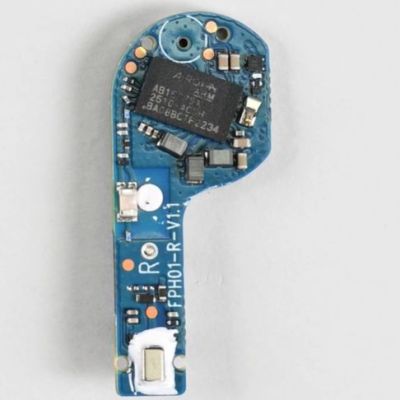
To get further into the device, you have to overcome the plastic clips that hold the enclosure together, along with what appears to be a few dabs of glue. Inside it you find the PCB containing the guts, including the Airoha AB1577S, Cortex-M4F-based IC that provides the Bluetooth Low Energy capabilities as well as enabling the touch control and other features.
Below the PCB is the coin cell holder, followed by the only part that saw real glue usage, namely the driver section. Presumably this is the compromise to keep things like sweat out of the device. Even so, after disassembly [iFixit] managed to reassemble the device and the earbud remained in working condition.
The case for the earbuds is even easier to disassemble, using just some bolts to unfasten. The USB-C port is soldered to the PCB which [iFixit] dinged them on, but still gave it a 10/10 on their repairability score.
Compared to Apple’s AirPods this is obviously a whole different world, although recently [iFixit] was somewhat pleased with the most recent AirPods generation being slightly more repairable, with non-destructive entry for a battery swap at least somewhat feasible.












Why would soldering the power connector to the PC board earn demerits? What’s the preferred alternative?
A daughter board with pins or a cable to allow easily replacing the port.
Maybe if the daughter board was somehow standardized so it can be used in multiple products and is therefore easier to source.
As the component cost of everything on the case’s mainboard is likely negligible compared to the cost of managing and distributing the replacement part, I think it’s sensible to save one replacement part type, one assembly step and one potential failure point, even if it means that replacing the USB connector now means you need to order a replacement part that costs 0.5 € more in components. Plus all of the cases of e. g. water damage where you might have no idea if one of the two parts is still good and will just order both parts to avoid paying and waiting for shipping twice.
Technically possible and economically sensible repairability are – unfortunately !! – two VERY different things, at least for those (like 99.xx % of consumers) who cannot perform the repairs themselves. Who would actually pay a repair shop to fix a pair of $50 earbuds that are no longer under warranty (which means “old”)?
In my experience, many of today’s electronic gadgets end up languishing in drawers – not because they have stopped working, but simply because their owners have bought something new. That , unfortunately, is the real-world problem – much more so than a lack of repairability.
This is the problem – stuff is cheap and labour is not. That’s why repairing stuff – especially tech stuff which will be outdated soon anyway – makes little sense for most people.
Whew! Change is on the way and that’ll be flipped.
Meanwhile, disposable vapes.
I think we’ve seen enough at this point… Head shops and vape stores should just be banned, get rid of the whippets, get rid of the kratom, get rid of the weird foreign front operations… They aren’t good, prohibition was nice actually
One Apple earbud boycott would do the world good.
Good luck getting the massive engagement required for such a feat from an incredibly niche community. You’ll never convince their luxury demographic, they don’t care about this stuff and in fact see it as a positive trait (keeping out the poors, etc).
My question is why do I never hear of these cool interesting low power BLE SoC chips? It’s all Nordic, Silicon labs, TI, ST etc. Meanwhile all the really inexpensive parts are Chinese or Taiwanese and completely unknown to me
The ones you mentioned are well documented, the inexpensive ones are not, well maby in chineese, so you May have some luck pointing your favorite llm at it?