
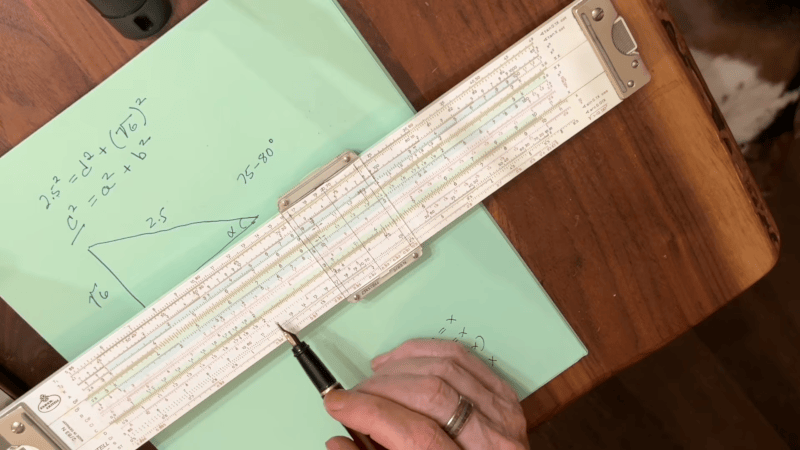
[Bob the Science Guy] remembers how to use a slide rule. Even after all these years, it is pretty easy to remember how to multiply and divide. If you can’t remember, you can usually work it out, as long as you understand how slide rules work. But what about sine, cosine, and quadratics? [Bob’s] been making videos about topics like this, and if you’ve wanted to put your slide rule collection to practical use, you’ll enjoy these videos. You can see one below.
The trick to the slide rule is that it is deceptively simple. You are in effect adding logarithms and then taking an antilog. The issue is that you still have to have some intuition about the scale of the answer since 2×3 works out the same as 2×3000 or 200×300.
But it is even trickier than that. Adding and subtracting is not easy on the slide rule. [Bob] shows how to use your math skills to convert problems that might have been addition problems into trig problems. So while it might seem more complicated to use trig, it may help work the problem on the slide rule.
We like slide rules. If you don’t have one, try this one in your browser (hint: go full screen and show both sides).












These days I think the only thing I’d like to do with a voice assistant is use it as an interface-free calculator. Just yell out some figures and have it tell me what the result is. That way I can do it while my hands are full or I’m measuring something. Have it take notes as well.
I bet there’s a good way to do a local-only open-source version of this, like on an ESP32-S3 SENSE with a tiny ML model. Have it connect to the network and drop the calculator tape in an app or a web page, maybe along with some verbal notes. I should make that.
You’ve reminded me of a 70s TV show, about a country doctor. He would drive around with radio contact to a base station – and his callsign had a 9.
Base would say “Niner” to avoid confusion with “five”.
You would need something similar, in a voice activated calculator.
Hmmm maybe, I think modern microphones and voice models can tell the difference. There’s not as much static on the airwaves these days. And I believe the use of “niner” was to avoid confusion with German for “no” in the old-time NATO phonetic alphabet (or whatever came before that)… could be wrong.
Well modern microphones and voice models yes, but poor voice handling somewhere in the path means I still need to use the full NATO mode. Speakerphone users, please pickup handset when clear sound is needed. VOIP=string & tin can sound! When ordering part numbers on the phone to who knows where it beats saying over and over “as in blah”.
Exactly. And much more.
I have a Hemmi 259D slide rule that I found in an antique store and I’ve been trying to learn the old tricks that were used for it. Nice that there’s a channel with a lot more of them!
Things like slide rules and classical mechanical calipers looks so beautiful to me. And there’s this sense of unquestioned reliability, even after so many things. A reliability that not even Microsoft, Google or Apple can f..k up…
Whoops, edit: “even after so many things = even after so many years”. Sorry!
The second original computer. The first was the human mind.
The slide rule I used in college is in the closet. It will stay there until I am dead and gone. Even the cheapest calculator works better and is easier to use. The same argument is why I drive a Tesla instead of Model T.
The slide rules I’ve owned each had an L scale. Addition and subtraction are straightforward.
This is the first I’ve heard of a “midpoint method” of solving quadratics. And I have an engineering degree. Something new. Every day.