
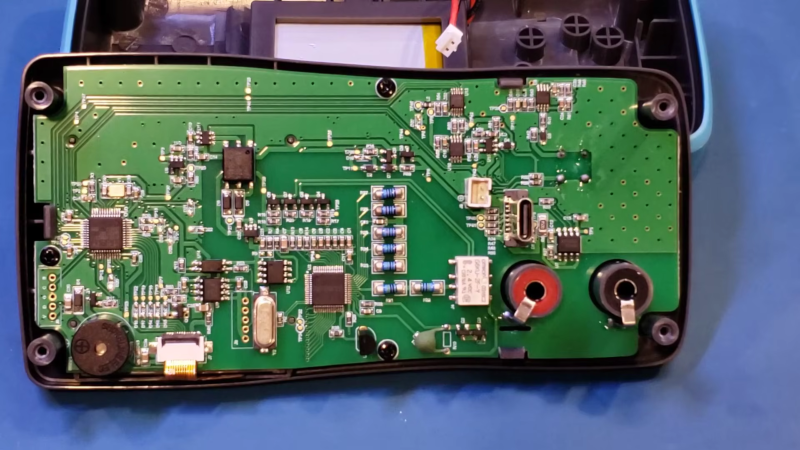
YouTube, like the Internet, has its plusses and minuses. On the plus side, you can find information on just about anything. On the minus side, you don’t always know if that information is of any value. On the plus side, you can connect to experts who have an uncanny knack for explaining things. On the negative side, you can find people who — let’s just say aren’t. Lucky for us, [Kerry Wong] is very knowledgeable about test instruments, so when we see a review from him, like the one for the ZOYI ZT-XC1 LCR meter and multimeter, we know we will get good information. Check out that review in the video below.
It used to be unusual to have an LCR meter that could measure inductance or capacitance in a home lab. But now it isn’t a big deal, and many multimeters and testers can at least attempt to read these quantities.
[Kerry] noted that the charging port is on the back, which is not very handy, but he also points out it isn’t a showstopper. Oddly, in multimeter mode, the device won’t read capacitance or current, so that makes it less handy as a multimeter.
One of the limitations of many capacitance measurement meters is that they can’t easily account for the capacitance of the test leads. This meter has two adapters that plug into the front of the meter for LCR measurements. That’s great, as long as what you want to measure fits into one of those adapters. If not, then you are out of luck. One adapter fits through-hole components, and the other one is a clever jig for holding surface-mount parts.
We always enjoy listening to [Kerry] talk about oscilloscopes. He even dabbles in reviewing test clips.












Is there a useful/easy to use (so not like the one from the video) jig that plugs into banana sockets on a multimeter and would facilitate the reading of CMS components? Bonus point if it’s compact
The hell is CMS? Google didn’t help
French abbreviation for SMD
Not that I know, but maybe Composants Montés en Surface, i.e. SMD (Surface Mount Devices)?
Yeah sorry, SMD
Can these LCR meters give a frequency vs impedance graph for caps? I would like to buy random caps from China and characterise them myself.
I could save a lot of money that way
And inductors too would be nice. Add in a curve tracer to sweeten the tool to the max!
Do you mean something like this?
https://josepheoff.github.io/posts/gnuradio-impedancetester
Nope.
Most LC meters measure at a fixed frequency of either 10 KHz or 100 KHz.
A NanoVNA will do what you want. You can have it sweep frequency and plot results, and send the results to a computer (USB) for display and processing.
I’ve had a “Peak Atlas LCR” bridge for years, its one of those “I don’t know how I ever managed without it” sort of tools. The unit is small and relatively inexpensive (still advertised for about $130 on DigiKey). I’d guess that by now any patents protecting it would have expired so its only a matter of time before the functionality finds its way into just about every multimeter. (So far outside the Peak I’ve not seen LCR functionality in anything short of a rather nice HP instrument — $$$$$$ nice.)
https://www.ai6xg.com/post/reactive-component-measurement-with-the-nanovna