
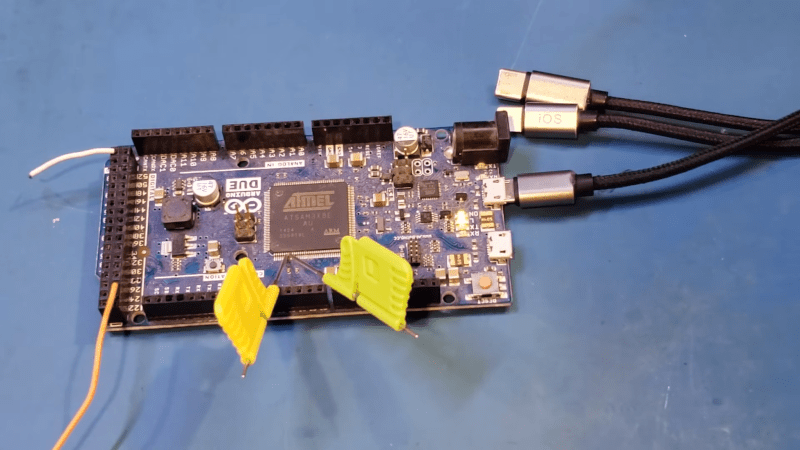
One of the many problems you run into when you work with SMD parts is trying to probe the little tiny pins. While we usually watch [Kerry Wong’s] videos for the oscilloscopes, it makes sense that he’d also be looking for probes. The video below shows some cheap probes from China that can clamp onto tiny QFP pins.
The probes look a little like tiny needles, but the needle part isn’t conductive. When you push them, very tiny and rigid clamps come out. On the other end is a pin that will take a female header or, of course, you could connect another test lead to that pin.
As an example, he shows a decidedly dirty Arduino Due and probes the CPU with the tiny probes. Off camera, he put two probes on adjacent pins on the QFP, and it worked just fine. Definitely something we will add to our toolbox.
The probes appear to work with pitches as small as 0.5mm, which covers many common situations. We’ve looked at oddball probes before. Or try making your own solutions.












I’m not sure what those adapters contain, but remember that you need more than just wires from dupont to coaxial to make an oscilloscope probe.
A direct connection puts a lot (100 pF per 1m of cable) load on the circuit being measured and can suffer from reflections too. For reasonably probing 1 MHz or higher frequencies, you need something similar to 10x probe, with the series resistor and capacitor compensation.
Watch for really cheap ones.
I bought a box of them and the pinchers would not clamp on properly and more times than not, the weight of the handles pulled them off the pins and pincers deformed. I tried to reshape the pinchers and the ends frequently broke.
When they did work for me, they were great!
Those clips beg for an insulating heatshrink sleeve along the cylinder !
Why, if they’re non-conductive?
They already have this, although it’s a bit hard to see in the video. Look @ 02:23 and 04:20. there is a transparent plastic tube around the metal. I also have the same model of grabbers and they really do have this tube.
Seems like a bad design, HUGE lever on a tiny IC asking for trouble.
I’m sure you have to be careful. Using them “upside-down”, with the trigger mechanism above the probe pin (like in the photo), definitely seems like the safest option. Then the pin can be rested against a surface like that plastic header, to relieve some of the strain.
I don’t know if I’d call it a “bad design”, though, unless there’s a better one that also performs the same difficult function. I haven’t seen any. Are there?
One unfortunate thing is that it looks like you can’t connect anything to the clip until after it’s attached, since its own pin is hidden by the trigger mechanism until it’s deployed. To put less strain on the IC pin, I’d prefer to be able to first connect a lead to the clip, THEN clip it to the pin.
Actually, maybe I’m wrong about that last part. The glare in the video thumbnail made it look like the pin doesn’t stick out the back of the red clip. But I think it does.
One problem that they have is that the pin (where the lead connects) is not a standard size and it’s difficult to attach to a dupont type socket. To make things worse, the pin tends to recede into the body when attaching, so you can’t use any force to attach the lead.