
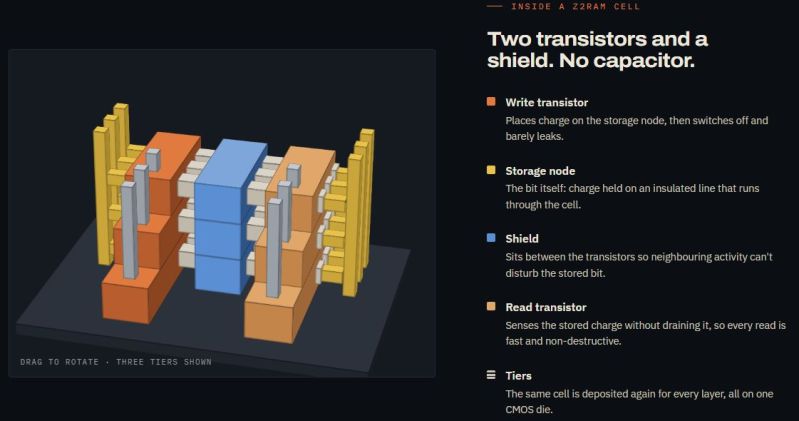
One of the annoyances in dynamic random access memory (DRAM) is the need to manufacture ever smaller capacitors for the typical one-transistor, one-capacitor (1T-1C) DRAM configuration. Over the past decades, researchers have studied the possibility of dropping the capacitor and using the floating body effect of current silicon-on-insulator transistors instead. One proposed form here by [Nagare Labs] seeks to even stack a design based on this 1T-DRAM in many layers for potentially very high-density RAM, called Z2RAM.
The concept of 1T-DRAM was first pitched by [S. Okhonin] in 2002, with research continuing since then to make it into a functional design suitable for mass production. As this 2022 paper by [Dongxue Zhao] (and others) shows, there’s still a lot of work to make this type of 1T-DRAM work.
What the design by [Nagare Labs] proposes is a — thus far experimental — hybrid SRAM/DRAM cell in which two transistors are used to either write or non-destructively read a stored charge. This might in some ways be easier, as it theoretically eliminates the need to refresh a cell. Of course, in SRAM a state is stored using a rather definitive latch-based circuit, whereas both traditional DRAM and these new types have to store a certain number of electrons.
So far, the Z2RAM design is struggling with stability issues, keeping it firmly stuck in the R&D labs for now. As the company behind it has attached itself firmly to the AI ecosystem, it probably at least stands to attract a lot of funding. If they do manage to bring it to the market, it could mean SRAM-like latencies at DRAM-like densities, which would be rather nifty.
Want to really learn about DRAM? Try building your own.











Exciting tech, hope it makes its way to my computer soon.
And hope modern software doesn’t bloat even more, lest 1TB RAM may end up being too little anyway
Why not create computers with unified memory where there’s no hard drives, CPU cache, GPU RAMDAC or NAS arrays. Just simply “memory” which you buy and install as needed. Modern programming and it’s bloat is a cancer precisely because we deal with so many different types of memory which use different access APIs and latencies that it makes computer design unfeasible.