
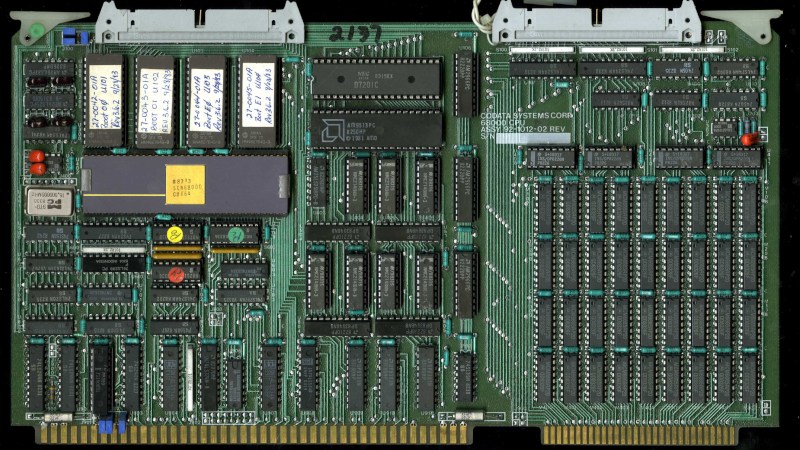
If we care to cast an eye over the history of ubiquitous personal computing as we know it today, we might immediately point at the original IBM PC. After all, for most of us our machines share backward compatibility in some form through multiple generations back to that original box from 1981.
But if we look at the things we use today and take for granted, from laser printers to graphics cards to the routers which power most of the Internet, they’re not from IBM at all. At the recent Vintage Computing Festival Berlin, [Michael Engel] delivered a talk naming a surprising progenitor for much of that technology, none other than Sun Microsystems.
It all starts with [Andy Bechtolsheim], famously Sun’s co-founder, when at the end of the 1970s he was a postgraduate at Stanford University. Working on the Stanford University Network — SUN — project he designed a computer to be used as a workstation on the network. The processor of choice then was Motorola’s 68000, but it lacked the MMU that would be required to run UNIX. His design had an MMU implemented externally to the 68000, with a bank of SRAM serving as the page table. This design would form the CPU board of the first Sun workstation.
The story might end there, were it not that many other companies had the same requirement, and Sun could supply them a CPU board. Silicon Graphics, the distant ancestral progenitor of your GPU, was one of them, so the first SGI workstation also had the same CPU as the first Sun. It appeared in the early Imagen laser printers too, as well as commercial AppleTalk to Ethernet bridges. Perhaps the biggest surprise is that because the original Stanford board had also been used as a router, the software for that became part of Cisco’s first product.
The video is below the break, and it’s a fascinating watch.











Thanks a lot for featuring my talk! Please let me know of any questions or comments you have.
A couple of pieces missing:
The original Stanford CPU boards, in bare PCB form, were floating around the area for essentially “any interested party” to purchase. I was at SRI at the time (1982), and had the opportunity to buy a bare SUN PCB for $50, IIRC. (“Build your own 68k system!”)
IIRC, the “pager” was particularly clever in that the propagation of the upper bits through the SRAM tables occured concurrently with the first half of the DRAM cycle (RAS, CAS, don’t remember which comes first.) So the paging essentially added zero to the total memory access time.
Internally at Stanford, many of the early Sun workstations ran an experimental Network OS – the “Stanford V Kernel” It booted from the network, supported B&W graphics with multiple windows, and ran adequately in the 256k of memory. (could you really run Unix in 256k, or did that require a memory upgrade of some kind?)
There were several other (short-lived?) companies that marketed (or tried) workstations based on the SUN-1 (The one I remember was “Forward Technology”, which had a workstation called the “Gateway.” Google says also Cadlinc, Pacific Microcomputer, and Bridge Communications (another router/teminal server company.)
The Stanford SUN project (and later cisco) also included “terminal servers”, capable of connecting a bunch of async crt terminals (many Heath-19 and similar) to the network (and thus to assorted mainframes and minicomputers.) The 16-port UART card was also designed at Stanford.
Bosack was director of the CS computer facility, Lerner of the Business school facility, and Lougheed of the EE facility.
Yeager (and others) at Stanford are bitter and vocal about the “theft” of their code, but the specifics are “more complicated.” How much of his code was in cisco’s initial release, in particular, and the “ownership” of projects implemented by “employees” vs professors and students. Lougheed and assorted folks had done perhaps a year of development after Yeager’s code, before SU fired Len and Kirk. For example, the original code (as I understand it – I haven’t seen it either) routed IP packets based on a (Xerox) PUP routing protocol; Stanford ran PUP in parallel with IP on their internal network, so that worked fine there, but it wasn’t much use to “other customers.” I believe the “settlement” reached was more about the code developed by Lougheed, et al, while they were still at Stanford, rather than Yeager’s code. I dunno; the cisco-side people have been pretty quiet about their side of the story.
cisco’s version of the SUN-1 processor also increased the EPROM size to a max of 256kbytes (4 x 27c512 chips.) (I may have a spare cisco CSC/1 board around, if you’d like to add it to you collection.)
Whow, thanks for all these interesting details!
I mentioned some of the companies building Unix machines from the SUN board in the talk, but I’m sure there were more. The board I have (shown in the picture in the header of this article) comes from a Codata machine.
I didn’t have time to dig deeper into the MMU details, but this is on my todo list – an overview of the different approaches (e.g. comparing the Sun 1 MMU to the one in the Lisa) would be nice to have.
There are so many details and sources related to this I collected and still I guess a lot is lost to history, so it’s great to hear from people who were around Silicon Valley at the time. It would be great to find a still unpopulated Sun 1 board – this would make it easier to build a replica… there’s not much use for it, but it might be a fun project for my students.
Sources and binaries for two versions of the V kernel are available on bitsavers (https://bitsavers.org/bits/Stanford/) along with the source code for Bill Croft’s SEAGATE Localtalk to Ethernet gateway. The V kernel sources seem to contain Sun 1 code, so I’ll definitely take a closer look. Thanks for mentioning V, I didn’t draw this connection…
The whole story around Stanford, Bill Yeager and Cisco is documented in a number of places (I linked some documents in another comment) and is definitely an interesting topic. I’ll probably dig a bit deeper into this, too, when there’s a bit more time.
I’m glad more people are interested in SUN, I was starting to believe there is no community left here. I’ve done extensive analysis over sun3, including a replica:
https://github.com/54weasels/sun3_60
https://docs.google.com/presentation/d/1wasxteEeNi30Fkk7yb3as92Rl7gMSfDpvPvVRrPJfao/edit?usp=drivesdk presented in https://youtu.be/Wpl1q2uuks4
Most interesting is the Stanford archive for early SUN. It has most of the design files for up to around Sun3, and I was able to extract board layouts and complete schematics:
https://htmlpreview.github.io/?https://raw.githubusercontent.com/54weasels/suds-tools/main/data/pc_boards/y_board.html
I would love to borrow a proper SUN1 card or one of the early 3mbit Ethernet cards. I’d scan it, trace it, correlate to the schematics so we can reproduce it. That for me is the pinnacle of conservation.
…PDF slides can now be downloaded from https://multicores.org/vcfb/Sunrise.pdf
Thanks. Also loved the final photo!
I worked in SV porting Unix, mostly to 68ks, there was a guy going around designing Sun style MMUs for companies, no 2 of them were the same (and some were broken, couldn’t protect the kernel from user space), we did over 100 ports, maybe a 3rd of them to these MMUs
That sounds very interesting!
Could you always convince the hardware designers to fix a broken MMU design you found or were there instances where systems were shipped even though it was known that the MMU was flawed?
I would be interested in learning more about this. Were there already methods used to validate/verify a MMU implementation and the related code in the OS? I would expect even with these rather simple MMUs, there can be quite nasty corner cases that have to be handled.
Btw., Forest Baskett’s original paper “Pascal and Virtual Memory in a Z8000 or MC68000 based Design Station” on the MMU design for the Z8000 and 68000 systems was hard to find.
A friendly person on Mastodon scanned a copy for me some time ago.
https://multicores.org/vcfb/forest-baskett-spring-compcon-80.pdf
Interesting. The dual processor approach was used by Sun, though I had been misled to believe that the second CPU was ‘behind’ the first one. In fact the Kernel processor’s Fault interrupt must also assert HALT or WAIT to the client processor while the kernel performs the MMU fixup.
The second thing is that I didn’t realise the Z8000’s segment scheme could simply be treated as a paged scheme, perhaps if the segments are generated at 4kB or 8kB offsets. I’ll have to check the Z8000 manual on bitsavers.
This is really interesting.
Note to Hackaday: the embedded video was hard to watch. Tiny, no way to maximize. I eventually had to open the browser’s inspector to get the embedded video link. Here it is, if you want to see it a little bigger.
https://us.mirror.ionos.com/projects/media.ccc.de//events/vcfb/2026/h264-hd/vcfb26-110788-eng-Sunrise_-_How_a_Single_University_Project_Kickstarted_New_Technologies_hd.mp4
A better way is to click the link in the text.
Here is the link again: https://media.ccc.de/v/vcfb26-110788-sunrise-how-a-single-unive
Cisco hadn’t properly licensed the networking code from Stanford, but a settlement was arrived at.
Yes, this is a complex story – you can read more about this in Bill Yeager’s Oral History (https://www.computerhistory.org/collections/catalog/300000010/) and also Tom Rindfleisch’s “The Origins of Cisco Systems – The Real Story” (https://web.stanford.edu/~tcr/tcr-cisco.html).
Even more technical details can be found in Bill’s paper “The Origins of the Stanford University SUMEX-AIM Router Technology – An Historical and Technical Overview by William James Yeager” (https://www.computerhistory.org/collections/catalog/300000119/). This is an in-depth description of many details, including the previous PDP-11 implementation.
We are currently in contact with the responsible persons at Stanford to get Bill Yeager’s original router source code published. This would preserve an interesting piece of Internet history.
This board should be near Colossus in the not yet and never will be built museum of the “really first computers”.
There was quite a number of proto-computers that didn’t quite become computers in the modern sense.
I recall how in the kindergarten I’ve noticed that average abacus – not the advanced one with the extra row of beads, but the cheap version with long rods – can double as simple gauge with some beads moved half-way instead of all the way to the end. In a way one can mimic tertiary computing, which I’ve tried inventing (but run out of patience, AHDH was faster).
Counting knots, though, did progress to rope memory ROM, but stopped short of adding ALU in the process, which to me sounds odd. Or, rather, I haven’t found any examples of such. Yet.
Something like that. Proto-computing would sure include slide rules and all kinds of mechanical devices invented since.
ADHD. Been chasing me ever since.
I did my PhD on a Silicon Graphics machine. Almost exactly like using a Linux machine today, except then I actually had to use my brain to write anything. Nurse fetch me a bedpan….
You know you’re getting old when all the machines you worked with are now in a museum or an exhibit at a retro computing event… :)
I’ll just toss the Sun 386i into the chat. (I still have one!)
That’s a fascinating machine, an x86 32-bit system without all the legacy and with a nice BSD (SunOS 4.0.2/4.0.3) on top. I analyzed the 386i firmware a bit, it switches to protected more pretty early on and the whole system feels very similar to other (68020-based or early SPARC) systems of that time. Unfortunately, I gave my 386i away many years ago, would be great to have one again…
Small world! I studied in Bamberg (Treffpunkt language school). I know a guy with at least one 386i, if you’d like to have one again.
Definitely small world, I hope you liked it here! :).If you could get me in touch with the person owning the 386i, that would be great!
What an amazing insight into how clever software and hardware could lure out a computational power at a much lower cost than existing products from a new VLSI-component. I guess this must have accelerated that complex software could be used by a lot more in applications that also created even more complex hardware and software . Did I understand it correct that the design of the MMU also was possible only because of the linear 32-bit address space and that no segmented addressing was required?