
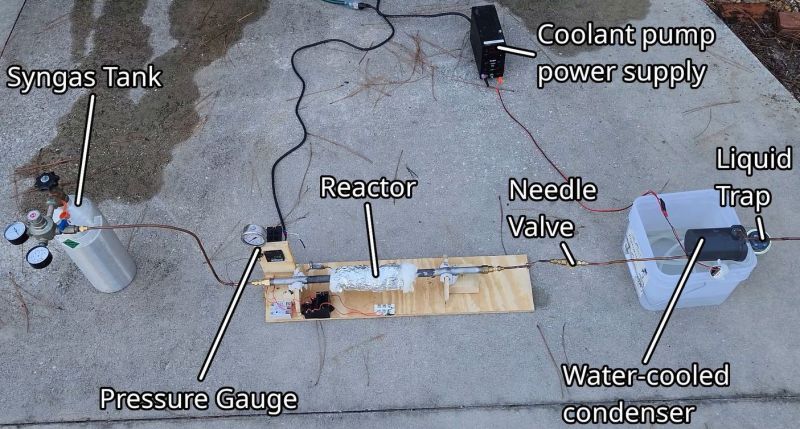
Although the Fischer-Tropsch synthesis (F-T synthesis) process is well-known and on face value quite straightforward, using it for DIY production of a somewhat defined length hydrocarbons is fairly tricky. This is the topic of a recent video by [Hyperspace Pirate], in which he goes over getting the right alpha value for his FT reactor in order to not just create the equivalent of crude oil.
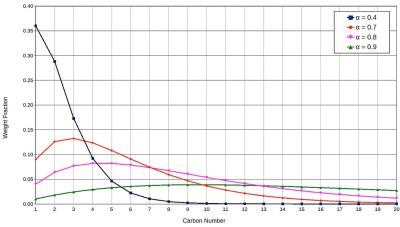
This alpha value is determined by the temperature and pressure inside the reactor as the syngas – consisting of carbon monoxide and hydrogen – is encouraged by the catalyst material to turn into proper carbohydrates. At very low alpha values this process will finish very quickly, creating mostly methane (CH4), while a higher number creates increasingly longer carbohydrate chains before they terminate with their final hydrogen molecules.
Since this process is exothermic, this creates many exciting opportunities for a production batch to be ruined unless you can somewhat control the temperature and pressure inside the reactor vessel. In the video a heater is used to kickstart the reaction, before it is turned off. As a catalyst an iron-based material is created that is packed inside the steel tube which forms the reactor vessel.
Through this the syngas is led, with the initial experiments producing a few mL of what appears to be pentane and hexane, with the rest apparently being gaseous methane, ethane and similar. This points to a fairly low alpha value, which is not ideal if your goal is to synthesize a specific hydrocarbon. With how complex this process is, there’s a good argument to be made that using F-T synthesis at a high alpha to churn out crude for standard distillation might be the easier method.










Fun fact, in alpha Hal Life 2 builds The Combine used synthgas for turning people into synths like stalkers, combine overwatch soldiers etc.
It’s a shame Valve never oficially released all their alpha and beta builds because gamers are missing out on a lot of gaming history.
never officially indeed.
i might have missed a earlier post or a non existing introduction to the subject at hand.
Boronated fuels were all the rage….I wonder if this might allow boron fuels with boron captured afterwards?
https://x.com/physorg_com/status/2115927561691705550
Carbohydrates?
Carboyhydrates and hydrocarbons are, technically, not the same thing.
Yes, they both have carbon and hydrogen in them. Carbohydrates are actually made of a lot of Cn(H2O)n units, so like hydrated carbon…. carbohydrate. Hydrocarbons are just hydrogen and carbon, nothing else, no oxygen.
There may be a way to turn carbon into fuel using acetone:
https://phys.org/news/2026-11-arctic-ocean-bacteria-acetone-carbon.html
Burning iron?
https://techxplore.com/news/2026-11-iron-powder-solar-power-winter.html
Implications for space use?
My first thought on reading the subject line: What’s a synga?
Nothin’
What’s a synga with you?
It’s a relative of the ahoga.
I’ve been waiting for this video for a while; gonna have to watch it tonight when I get a sec.
“With how complex this process is, there’s a good argument to be made that using F-T synthesis at a high alpha to churn out crude for standard distillation might be the easier method.”
Yeah, I think that a study of American history (specifically Edison and Tesla) shows us that bringing a known, functional solution all the way to production is often better than canceling a project to focus on perfecting the ideal solution. Which is especially true if it can be used to buy time and resources to finish that ideal solution without any employees or investors getting upset about things like money (or any foreign patent shenanigans stealing your easy royalty money out from under you, but I’m getting off topic).