
Turning Syngas Into Hydrocarbons With The Right Alpha

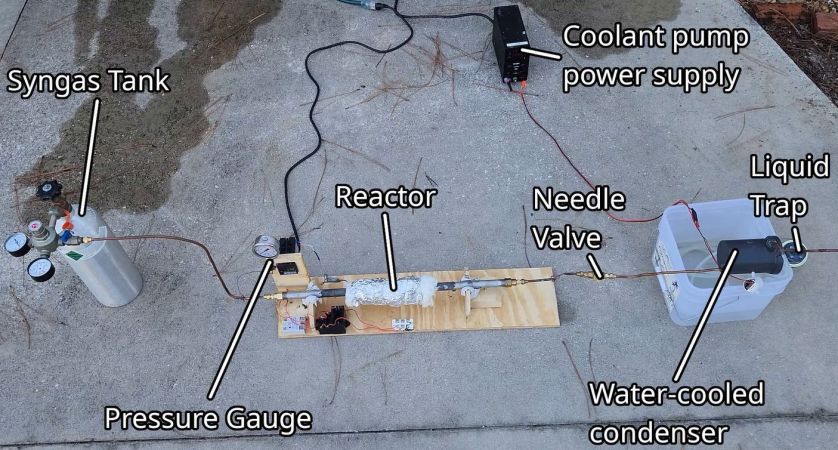
Although the Fischer-Tropsch synthesis (F-T synthesis) process is well-known and on face value quite straightforward, using it for DIY production of a somewhat defined length hydrocarbons is fairly tricky. This is the topic of a recent video by [Hyperspace Pirate], in which he goes over getting the right alpha value for his FT reactor in order to not just create the equivalent of crude oil.
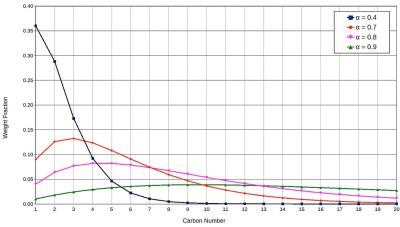
This alpha value is determined by the temperature and pressure inside the reactor as the syngas – consisting of carbon monoxide and hydrogen – is encouraged by the catalyst material to turn into proper carbohydrates. At very low alpha values this process will finish very quickly, creating mostly methane (CH4), while a higher number creates increasingly longer carbohydrate chains before they terminate with their final hydrogen molecules.

Since this process is exothermic, this creates many exciting opportunities for a production batch to be ruined unless you can somewhat control the temperature and pressure inside the reactor vessel. In the video a heater is used to kickstart the reaction, before it is turned off. As a catalyst an iron-based material is created that is packed inside the steel tube which forms the reactor vessel.

Through this the syngas is led, with the initial experiments producing a few mL of what appears to be pentane and hexane, with the rest apparently being gaseous methane, ethane and similar. This points to a fairly low alpha value, which is not ideal if your goal is to synthesize a specific hydrocarbon. With how complex this process is, there’s a good argument to be made that using F-T synthesis at a high alpha to churn out crude for standard distillation might be the easier method.

Continue reading “Turning Syngas Into Hydrocarbons With The Right Alpha” →
Be Your Own Oil Company With Desktop Fischer-Tropsch Process

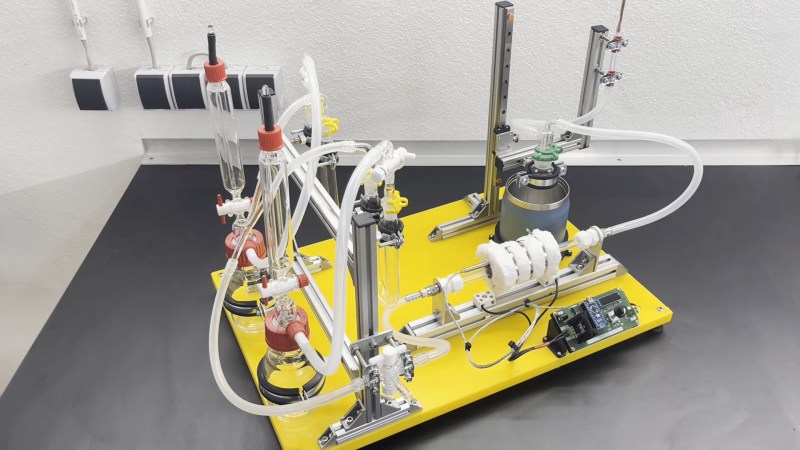
Plastics, oil, petrol– the modern world is entirely dependent on hydrocarbons. The good sources are slowly running low and supply is increasingly complicated by geopolitical factors we really don’t want to get into, but hey! It’s just hydrogen and carbon, right like it says in the name. How hard could it be to roll your own at home. Well, if you’ve got a lab like [Marb]’s Lab on YouTube, it might just be doable, as he demonstrates in his latest video.

The Fischer-Tropsch reaction was discovered back in 1925 in Germany by a couple of gents named Fischer and Tropsch. In the unpleasantness that followed later, Germany made good use of their process on an industrial scale, since they had ample coal and no oil on hand. Coal-rich South Africa has also made us of it, particularly during the Apartheid-era trade restrictions. Every so often the idea of industrializing the process comes up in the USA, but there’s still enough oil there it doesn’t make sense economically.

Those nations all have something in common: they’re all coal-rich countries, and that makes sense because coal is easily converted to carbon monoxide and hydrogen– a combo known as syngas– and it just so happens that those are the feedstock for this reaction. The actual chemistry going on inside is quite complex, but conceptually it is pretty simple: hydrogen and carbon monoxide mix over a hot metal catalyst, and combine to form various hydrocarbons.

In [Marb]’s glassware-based demonstration, the catalyst is Cobalt (III) Oxide on silica gel– a lovely, cancer-causing substance that must be prepared for each use, as it lasts but 24 hours before further oxidization ruins it. That’s in spite of purging the system with argon– a necessary step if one does not wish to explode. The yield isn’t amazing, and [Marb] isn’t sure exactly what mix of hydrocarbons he has created– although they smell like gasoline and burn like the dickens, so mission accomplished.

This might seem like the furthest thing from green, but if you use solar power to run the process and something like woodgas– which is syngas by any other name– as a feed-stock, then you’ve got a carbon neutral energy storage medium.

Thanks to [Markus Bindhammer] for the tip!

Continue reading “Be Your Own Oil Company With Desktop Fischer-Tropsch Process” →









