Be Your Own Oil Company With Desktop Fischer-Tropsch Process

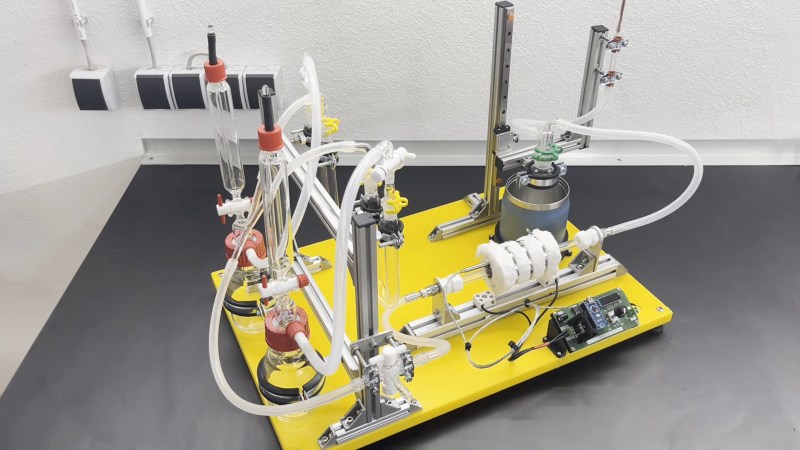
Plastics, oil, petrol– the modern world is entirely dependent on hydrocarbons. The good sources are slowly running low and supply is increasingly complicated by geopolitical factors we really don’t want to get into, but hey! It’s just hydrogen and carbon, right like it says in the name. How hard could it be to roll your own at home. Well, if you’ve got a lab like [Marb]’s Lab on YouTube, it might just be doable, as he demonstrates in his latest video.

The Fischer-Tropsch reaction was discovered back in 1925 in Germany by a couple of gents named Fischer and Tropsch. In the unpleasantness that followed later, Germany made good use of their process on an industrial scale, since they had ample coal and no oil on hand. Coal-rich South Africa has also made us of it, particularly during the Apartheid-era trade restrictions. Every so often the idea of industrializing the process comes up in the USA, but there’s still enough oil there it doesn’t make sense economically.

Those nations all have something in common: they’re all coal-rich countries, and that makes sense because coal is easily converted to carbon monoxide and hydrogen– a combo known as syngas– and it just so happens that those are the feedstock for this reaction. The actual chemistry going on inside is quite complex, but conceptually it is pretty simple: hydrogen and carbon monoxide mix over a hot metal catalyst, and combine to form various hydrocarbons.

In [Marb]’s glassware-based demonstration, the catalyst is Cobalt (III) Oxide on silica gel– a lovely, cancer-causing substance that must be prepared for each use, as it lasts but 24 hours before further oxidization ruins it. That’s in spite of purging the system with argon– a necessary step if one does not wish to explode. The yield isn’t amazing, and [Marb] isn’t sure exactly what mix of hydrocarbons he has created– although they smell like gasoline and burn like the dickens, so mission accomplished.

This might seem like the furthest thing from green, but if you use solar power to run the process and something like woodgas– which is syngas by any other name– as a feed-stock, then you’ve got a carbon neutral energy storage medium.

Thanks to [Markus Bindhammer] for the tip!

Continue reading “Be Your Own Oil Company With Desktop Fischer-Tropsch Process”

Hackaday Links Column Banner

Hackaday Links: July 13, 2025

There’s interesting news out of Wyoming, where a coal mine was opened this week. But the fact that it’s the first new coal mine in 50 years isn’t the big news — it’s the mine’s abundance of rare earth elements that’s grabbing the headlines. As we’ve pointed out before, rare earth elements aren’t actually all that rare, they’re just widely distributed through the Earth’s crust, making them difficult to recover. But there are places where the concentration of rare earth metals like neodymium, dysprosium, scandium, and terbium is slightly higher than normal, making recovery a little less of a challenge. The Brook Mine outside of Sheridan, Wyoming is one such place, at least according to a Preliminary Economic Assessment performed by Ramaco Resources, the mining company that’s developing the deposit.

The PEA states that up to 1,200 tons of rare earth oxides will be produced a year, mainly from the “carbonaceous claystones and shales located above and below the coal seams.” That sounds like good news to us for a couple of reasons. First, clays and shales are relatively soft rocks, making it less energy- and time-intensive to recover massive amounts of raw material than it would be for harder rock types. But the fact that the rare earth elements aren’t locked inside the coal is what’s really exciting. If the REEs were in the coal itself, that would present something similar to the “gasoline problem” we’ve discussed before. Crude oil is a mixture of different hydrocarbons, so if you need one fraction, like diesel, but not another, like gasoline, perhaps because you’ve switched to electric vehicles, tough luck — the refining process still produces as much gasoline as the crude contains. In this case, it seems like the coal trapped between the REE-bearing layers is the primary economic driver for the mine, but if in the future the coal isn’t needed, the REEs could perhaps be harvested and the coal simply left behind to be buried in the ground whence it came.

Continue reading “Hackaday Links: July 13, 2025”

Electric Vehicles, The Gasoline Problem, And Synthetic Fuels

When you’re standing at the gas station filling up your car, watching those digits on the pump flip by can be a sobering experience. Fuel prices, especially the price of gasoline, have always been keenly watched, so it’s hard to imagine a time when gasoline was a low-value waste product. But kerosene, sold mainly for lighting, was once king of the petroleum industry, at least before the automobile came along, to the extent that the gasoline produced while refining kerosene was simply dumped into streams to get rid of it.

The modern mind perhaps shudders at the thought of an environmental crime of that magnitude, and we can’t imagine how anyone would think that was a good solution to the problem. And yet we now face much the same problem, as the increasing electrification of the world’s fleet of motor vehicles pushes down gasoline demand. To understand why this is a problem, we’ll start off by taking a look at how crude oil is formed, and how decreasing demand for gasoline may actually cause problems that we should think about before we get too far down the road.

Continue reading “Electric Vehicles, The Gasoline Problem, And Synthetic Fuels”

See-Through Catalytic Converter

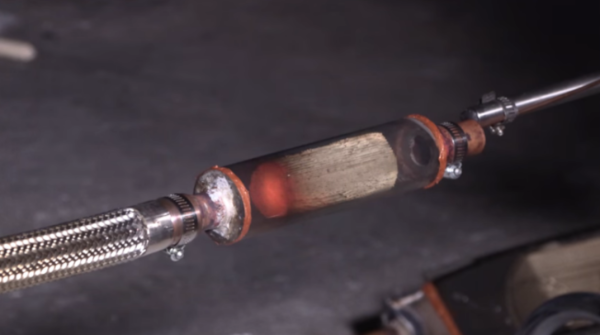
There’s always something to be learned from taking things apart. Sometimes the parts can be used for other things, sometimes they can be repaired or improved upon, but sometimes it’s all in good fun. Especially in this case where extremely high temperatures and combustible gasses are involved. This is from the latest video from [Warped Perception] that lets us see inside of a catalytic converter as its operating.

Catalytic converters are installed on most vehicles (and other internal combustion engines) in order to process unburned hydrocarbons from exhaust gasses with a catalyst. These can get extremely hot, and this high temperature complicated the build somewhat. There were two prototypes constructed for this build and the first was a cross-section of a catalytic converter with a glass window sealed on in order to allow the viewing of the catalyst during the operation of a small engine. It was easy to see the dirty exhaust gasses entering and cleaner gasses leaving, but the window eventually blew off. The second was a complete glass tube which worked much better until the fitting on the back finally failed.

A catalytic converter isn’t something we’d normally get to see the inside of, and this video was worth watching just to see one in operation in real life. You could also learn a thing or two about high-temperature fittings as well if you’re so inclined. It might be a nice pairing with another build we’ve seen which gave us a window into a different type of combustion chamber than ones normally found on combustion engines.

Thanks to [Ryoku] for the tip!

Continue reading “See-Through Catalytic Converter”