
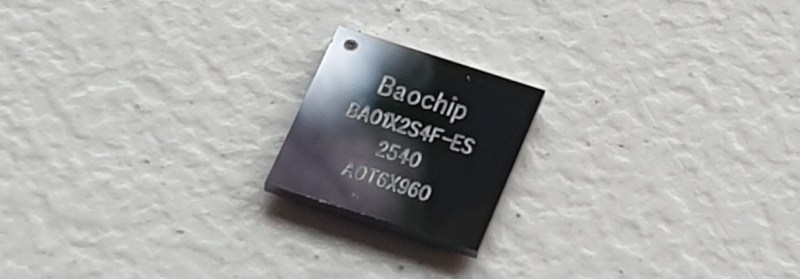
For most people, just getting any old microcontroller or system on chip (SoC) from our favorite – or cheapest – vendor is more than good enough. But if you’re really into high assurance computing where every transistor has to be accounted for, you got a bit of a problem. This is basically why [Andrew “Bunnie” Huang] pitched in and had the Baochip-1x produced.

This SoC’s design is based heavily on the FPGA-based CPU in the Precursor device, which itself is claimed to be a fully verifiable communicator design. Since it does have an MMU, you can run any software on it that supports the RV32IMAC RISC-V instruction set, with a Coder’s Guide available for those who might feel interested in this SoC, along with the SystemVerilog and Verilog-based sources.
In addition to the DIY assembly process, you can even get a physical hardware version, including the ‘Dabao’ evaluation board with a very Raspberry Pi Pico-shaped form factor. Inside this SoC is a single-core, 350 MHz VexRISC-V core, 4 MB resistive RAM (RRAM) and 2 MB of SRAM, along with a whole heap of security-related features.












The same Bunnie Huang who developed and then abandoned Chumby? No thanks.
I’ll be damned, that *is* the guy who made the Chumby!
i feel like the Huang family has a lot to be proud of in the news of late
He designed it, but abandoning it was a commercial decision and not his. So what is your problem? Is suddenly every engineer responsible for the commercial decision of a company?
Oh, and there is also sources in HDL, so you can always make your own.
Is this the same Baochip that got blown wide open after being the DEF CON badge this year?
Yes it was
?
The tone in this comment section is ghastly. Bunnie has helped many people get into hardware hacking the past 25 years or so. A lot of good came from his work. You should aspire to do the same instead of posting dismissive one-liners.
Amen. Ya gotta have a set in the first place to put them on the line, even if they do occasionally get stomped on. How many projects have the others put out into the world?
At least, it would be a better target for custom operating systems, than the many ESP32-ones.
Hacking on it at defcon was great. Made a 1 bit platformer on it XD
it looks like an interesting board! i’m not sure i’d have a use for it but i like the direction things are heading. i appreciate that hackaday brought it to my attention.
this write up kind of bummed me out though…verification is an interesting field but i don’t understand how it relates to this product. every vlsi design goes through verification before being fabricated, even / especially cheap products. plenty of products with MMUs are nonetheless parts of fragile systems.
this phrase “where every transistor has to be accounted for” upset me. it means less than nothing. a hand was waved in the direction of meaning. i guess i just get angry when i read anti-meaning. that’s probably a ‘me’ problem but i just figured i’d speak up in favor of meaning :)