
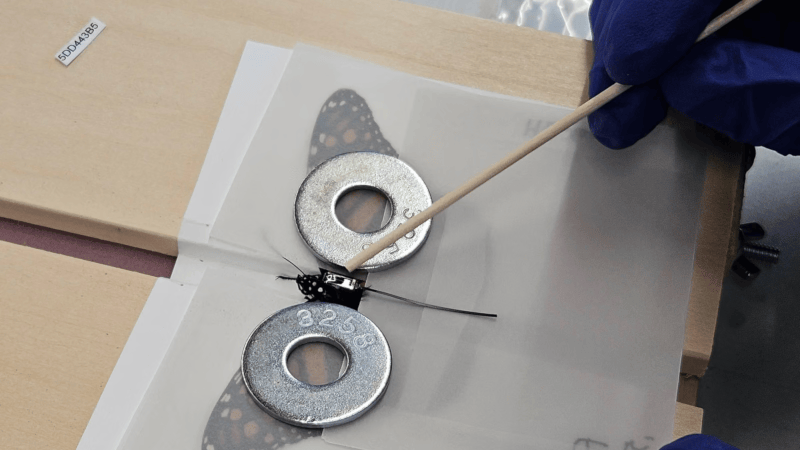
Miniaturization is one thing, but how would you like to design a transmitter that attaches to a butterfly? That’s what the BlūMorpho transmitter is made to do, according to [Tom Jokinen] writing for Be Giant. Apparently, most of these butterflies have a two- to six-week life, but periodically a “super generation” spawns and lives up to nine months. This is enough time to migrate from Canada and the United States to Mexico. In Mexico, they spend the winter, and then return when the weather is more hospitable. Scientists wanted to study this migration pattern, and the tiny transmitter is exactly what they needed.
You can even download an app to track the butterflies yourself. The transmitter looks like a tadpole and weighs 60 milligrams. There’s no battery, but there is a tiny solar cell. The transmitter emits a Bluetooth signal that your phone’s location services can relay.
To affix the transmitter, researchers put a glassine envelope over the butterfly, weigh its wings down with something slightly heavy, and then apply eyelash glue to the transmitter. You can see the process in the video below.
What else could you do with a virtually weightless Bluetooth tracker? It is possible that dedicated tracking stations could have a longer range.












Impressed it’s Bluetooth, I looked into some local research on dragonflies, the transmitters they were using do very short burst transmissions that basically transmit an id, nothing else. A very tiny, very short, signal spread over a frequency such that the average receiver wouldn’t even notice the signal in the noise. With transmitters that last up to 1yr and the size of a large grain of rice, a tiny wire antenna hanging from it.