
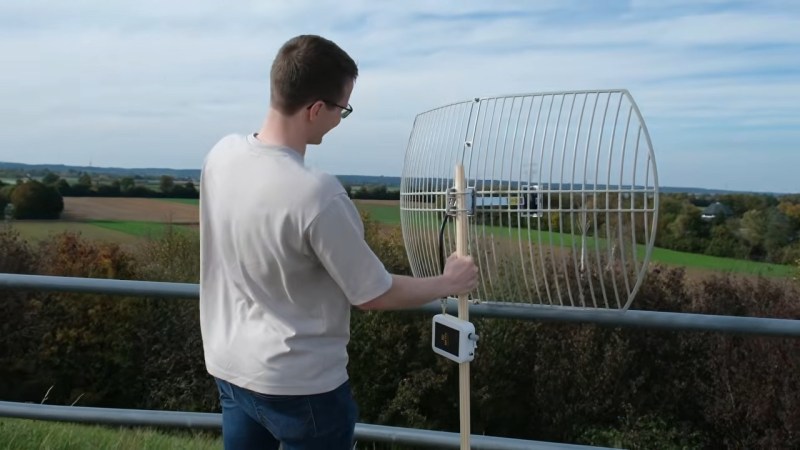
Bluetooth is a short-range protocol that’s great for peripherals and finding your keys, but it’s limited range is mainly a product of how it’s usually implemented. A recent video from [nktbuilds] demonstrates this by extending its range out to 12 kilometers, or around 7.5 miles.
The secret is twofold: one is the antenna, a parabolic unit that captures far more than the dinky dipole in your phone. The other is a very sensitive receiver with a much lower noise floor. What you won’t see here is any extra power than you get stock out of one of those generic coin-sized Bluetooth tracker tags. It’s kind of obvious, in retrospect: grab more signal, lower your noise floor, and get a better result. Still, it certainly wasn’t obvious it would work out to 1200 m, and it’s an impressive feat by [nktbuilds]. We’re going to have to keep it in mind next time we lose our keys.
Of course this doesn’t mean you should jump to Bluetooth for distance communications. You’re still better off sticking with something like LoRA for that, especially since it’s good to hundreds of miles if you can get line-of-sight — or even tens of thousands with the right setup.












Is it 12km or 1200m?
Ca. 12 km (12000 m)
To be fair, “1200” appears in the video blurb and in the video itself (as a multiple of the 10 m usual range). The author seems to have skimmed the article with the same diligence that he uses apostrophes in the very first sentence, and his editor let it go.
I have to say we get excellent value for what we pay for all this content, so let these little things slide.
Sure. Let’s leave easily correctable mistakes on the Internet.
Don’t bother changing something that might confuse someone reading this in the years or even decades from now…
/s
This isn’t a print article that would require page space to print a retraction and a follow up.
Just fix the error.
If it prevents even one person getting confused by this, the 10 seconds of work will be worth it.
One needs a solid means to carry the signal to the antenna, and not by using RG58 junk. Thd loss is extreme. Heliax is the best choice, or direct connection to the antenna, using uhf as a link to the Bluetooth system.
This way, you get freedom of movement from the BT antenna, without sacrificing range.
Metric keeps confusing Americans.
No, it’s very easy to understand and we’ve used it for select purposes for generations. It’s just the fact that the figure sounds a bit optimistic, making people suspect that the decimal might have gotten shifted to the wrong place.
That said, hey I recognize that cheap parabolic! I have one rusting in a garden shed somewhere, I should figure out something to do with it again.
Is that suspicion why the article says both 12 km and 1200 m but not 12000 m?
More confusing that it says both 12k and 1.2k — being American doesn’t affect the article’s content 🤷♂️
Note that there’s a second reason why this is receive only: Bluetooth is one of the protocols whose effective range is limited by the speed of light, to about 1.5 kilometers.
In a Bluetooth Classic piconet all the devices are synchronized to the central device’s clock, and the Central expects packets to arrive on exact slot boundaries plus/minus 10µs. That also means that the maximum round-trip time (in terms of speed of light) is 10µs -> ~3km round-trip, or 1.5km maximum separation.
In wifi, there is a parameter ACK timeout:
https://www.tp-link.com/th/support/faq/907/
I can’t get Bluetooth to establish a reliable connection between my living room and the kitchen. Only two walls and 10m. I’ve got to read the article to learn something new…
People forget that you need a line-of-sight between the transmitter and the receiver.
It’s radio, not light. What you need to avoid are things that absorb 2.4GHz radiation. Something that unfortunately humans are quite good at…
And trees. Bushes. Walls. Bodies of water…
And aluminium-dust filled breeze blocks common in UK 70s construction.
Went from having one WiFi point in a ~2000 house which gave me coverage throughout the house and halfway down the road, to needing 3 access points to get passable coverage just in a 70s house.
Hi there! The “line-of-sight” statement is not wrong, however. It’s a traditional analogy in radio.
And often applied to describing microwaves (GHz and up).
Longer radio waves (=lower frequencies; medium wave, shortwave bands etc) do follow curvature the of earth, do bounce off the sky and also travel in a straight libe if the antenna allows for it.
Shorter radio waves (higher frequiencies; super shortwave babd, VHF/UHF etc) are more similar to light in their behavior/properties.
They mainly travel in a straight line, do get reflected less and penetrate buildings and walls less.
Like a torch light vs a light bulb, if you will. They have a higher distance damping, also.
That’s why the frequencies between 400 and 900 MHz are so sought after. They’re balanced in terms of features.
They permit small antennas, work far with low transmit power and still have the characteristics of shortwave on a smaller scale.
They still work through cellar walls and “in the woods”.
Aren’t there metric names for living room and kitchen? If not why not?
No doubt the directional transmitter antenna violates local laws about the maximum EIRP tx power. (If you have a +10dB antenna, you need to reduce the tx power by 10dB)
If you interfere with a random stranger’s Bluetooth, expect a visit from men in grey suits.
After DOGE (Department of Government Efficiency), are there any men in grey suits left.
They will be back.
Good thing it was receive only then isn’t it?
Plainly stated in the video. I suggest watching before commenting.
The Hubble Network does one better and does Bluetooth to orbiting satellites.
And probably illegal in a lot of places on the globe. Dont be surprised if the boys in blue come a´knocking on your door.