
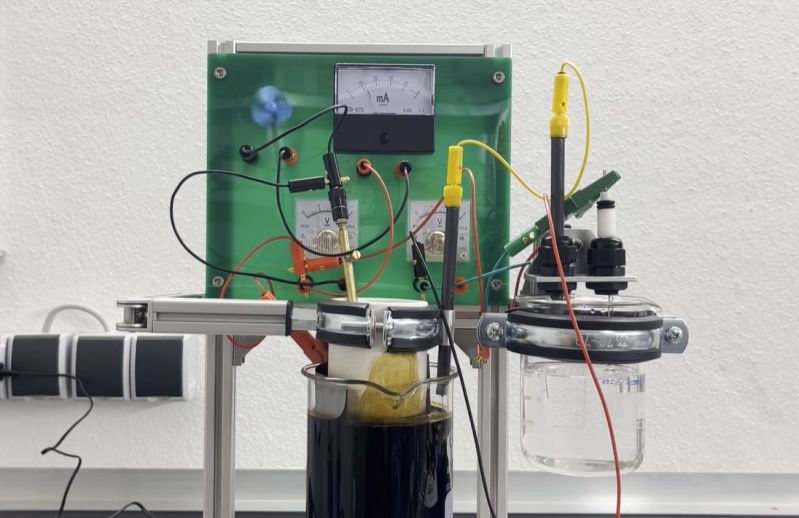
As simple of a concept flow batteries are, the used chemicals can still be somewhat problematic in the context of a school experiment. To this end [Markus Bindhammer] decided to implement a flow battery version that uses compounds from green tea for its electrolyte, based on a German research paper from 2016.
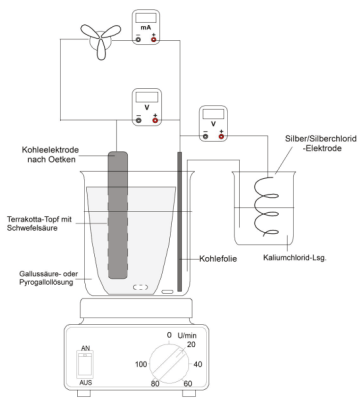
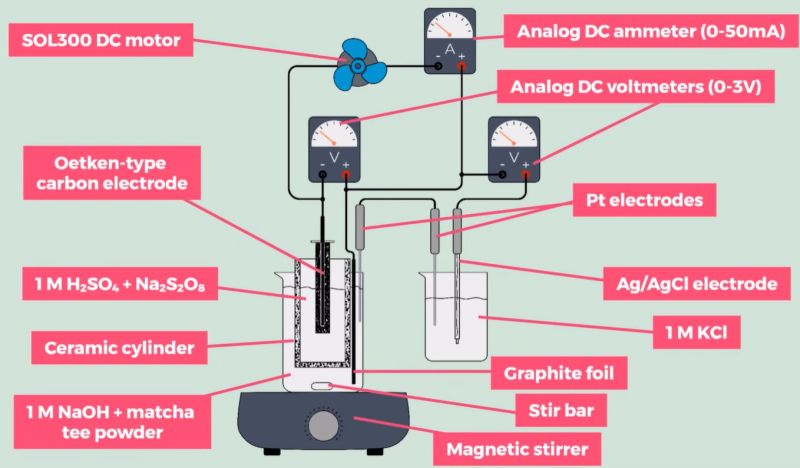
These organic flow batteries can use gallic acid, pyrogallol as well as the polyphenols in green tea, making them rather safe even in the hands of more careless students. The demonstrated flow battery uses a carbon electrode with activated carbon around it to increase surface area, a platinum wire electrode, and a graphite foil as third electrode.
In the paper a silver electrode is also used, along with the additional electrodes, and a terracotta flower pot as the barrier between the carbon and graphite electrodes, with [Markus] further explaining that there are fortunately cheaper options than what he is using, especially with the flower pot instead of a special ceramic vessel.
The electrolyte solution has epigallocatechin gallate (EGCG) dissolved in it, which here comes in the form of finely ground green tea powder (commonly known as matcha), which so happens to be pretty rich in this substance. In the below graphic by [Markus] you can see the complete set of solutions and other relevant details.
Of course, the performance of this type of flow cell isn’t amazing, with a cell voltage of less than a volt and a few mA of current, but it’s enough to spin a small fan, and to light up a few LEDs. This would be more than enough to demonstrate the reaction and flow cells in general, as long as you don’t mind donating some tasty matcha to science.












Who knows the history of flow batteries in China could have started with green tea?
I do miss being able to just walk into a shop and buy certain things.
Americium fire alarms, Borax, Potassium Chlorate pond oxygenator, Potassium nitrate stump remover [the irony], Barium Sulphate soil testers, etc. Some things like bulk copper sulphate and sulphur powder and iodine are surprisingly still available, if you know where to look, usually farming shops.
Danke, Maya:)
Light up a few LEDs? Either a jewel thief circuit maybe. You do need to boost the voltage.
Jewel thief? The battery has enough “juice” to add a joule thief.
He should use it to calculate the finite probablilty of creating a functioning organic flow battery, and then feed that back I …
The odds are 10 to the 1.74 trilllion power and falling……..
When I can pull into [insert fave coffee shop here] and top up my battery, I’m sold. Won’t be cheap though lol.
If you want to experiment with polyphenols and related compounds in plants then this is a good resource as you can sort by the amount found in the plant part. “Dr. Duke’s Phytochemical and Ethnobotanical Databases.”