
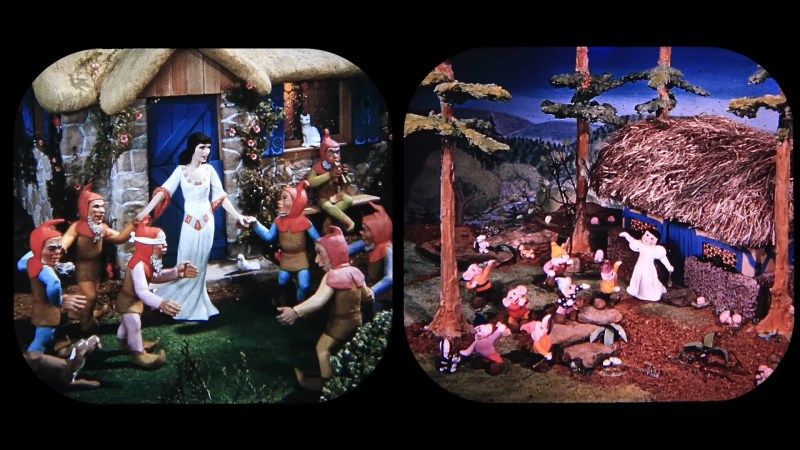
The basics of producing a stereophotograph of real life places were well-established by the time the View-Master arrived, but producing images of imaginary scenes was a bit more involved. [View Master Travels and Peter Dibble] took a look at how the fairy tale and media tie-in reels may have been made.
Starting with simple dioramas, View-Master eventually developed an entire team to work on fairy tales. One of the most influential members was sculptor [Florence Thomas]. She was instrumental in updating many of the original fairy tale reels from small scale miniatures to 1/6 scale dioramas for the scenes. Unfortunately, the department was eventually cut and all the original miniatures thrown away.
Before VCRs, View-Master was the primary way people could interact with their favorite TV shows and movies when they weren’t being broadcast. TV shows could be photographed while in production in Hollywood with a stereo camera giving great visual detail. Some cartoon and movie reels were less engaging, having been made from promotional images, giving more of a paper cutout appearance rather than “real” 3D. In either case, many of these visual techniques have been lost with little documentation on how they were achieved.
We previously covered [View Master Travels and Peter Dibble]’s History of the View-Master and how you can digitize the disks for posterity.












As the proud(?) owner of an inherited setup for producing these (camera’s, film cutter, a ton of tin reels, and a setter for making the reels permanent, as well as an x-shoe adapter for a xenon flash, projector, and all of the other toys of a low-end pro kit) I love seeing how the top quality things were done.
My kit came from my grandfather, who had a consumer camera for vacation, and the low end pro for work. He wasn’t a photog, but an engineer. His last job before retirement in 1977 were the valves on the Alaska pipeline. There are some wonderful reels from his jobs in the 1950’s through the mid 1970’s from his collection. Some are digitized and out there. Any stamped “proprietary” have not been. Ya, its been 50 to 70 years, but some of it may still be considered an issue, unfortunately.
“Staring with simple dioramas”. Typo, but really not far out of line. :-)
I inherited a viewer and stack of reels. Still kind of fun to look at. If you want to know what some tourist attractions looked like (e.g. Marineland of the Pacific) in the 50’s-60’s, I may have you covered.
Thanks for catching that!
I remember looking at some of the old attractions with one at my grandma’s house when I was a kid.
“Before VCRs, View-Master was the primary way people could interact with their favorite TV shows and movies when they weren’t being broadcast.”
Umm no. View Master was NEVER the primary way anyone but kids interacted with anything. In the 60s and 70s we bought movies, cartoons, etc on Super8, You could purchase everything from classic Universal monster movies and silent-era comedies to massive blockbuster hits like Star Wars Walt Disney also famously sold condensed versions of its animated and live-action features.
US Military sent ~100K units with ~6M reels for aircraft identification to the GI’s in the 1940’s (source: QI and Wikipedia, take your pick, https://en.wikipedia.org/wiki/View-Master)
Great way to tell a Texan from a Zero.
and aircraft identification has WHAT to do with ” interact with their favorite TV shows and movies when they weren’t being broadcast.”.
Oh thats right….NOTHING.
You said “anyone but kids”.
Breathe a bit.
And you think that busting out the viewmaster was the primary way aircraft were identified? really?
Hey WHA?, who peed in your cornflakes this morning?
I don’t know about viewmasters, I made a lot of them myself, but in the 1900s Keystone views were huge, and a lot of them were of news events, natural disasters, etc.
prior to that, other companies were publishing newsworthy stereo views, like this
https://bid.fleischersauctions.com/online-auctions/fleischers-auctions/lincoln-excecution-of-conspirators-before-the-fall-8705484
“Interact with their favorite TV shows and movies when they weren’t being broadcast.”
News, events and natural disasters are NEITHER TV shows nor Movies.
Er, no. According to wikipedia, the Keystone Views company started producing stereograms in the 1890s and continued to the 1960s. The 1900s was a very small proportion of that.
Besides, they are johnny-come-latelys. I have many card stereograms from the 1870s onward, but the Richard Verascope glass stereograms are much more interesting, see https://vintagestereoscopicglassslides.wordpress.com/ for a few
Before VCRs was an error on my part. You’re totally correct that wasn’t the first home movie format. Given the age of the View-Master, I’d argue the video was correct that there’s at least a decade or so before Super-8 would’ve been ubiquitous.
When it came to interacting with TV Shows and movies, I usually went with – toys.
Examples I remember include: toy gun of Napoleon Solo (Man From U.N.C.L.E.), and a model gyrocopter (James Bond, You Only Live Twice).
today you could make reels, using an image editor and a color printer.
I wonder if it would look good at the resolution of a typical color printer. My Epson 835 maxes out at 5760×1440 DPI. Resolution for 35mm film is probably more like 3000×3000 DPI. I also wonder about the saturation when printing on transparencies. Might be worth trying.
A how to make your own on Instructables.
https://www.instructables.com/DIY-Viewmaster-Reels/
I think we as humans don’t think about lot of cool technology that already been researched and forgetting about stuff of the past in searching for something “new”…
This is why it’s called “RE-search” =))