
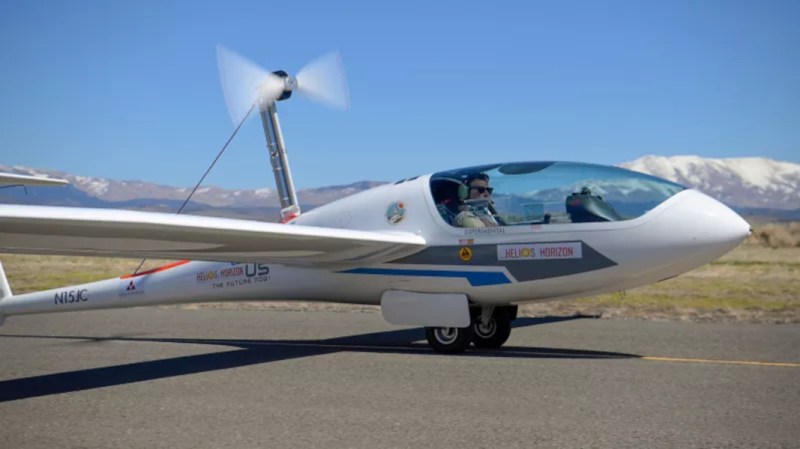
There always seem to be a handful of revolutionary technologies perpetually out of reach: fusion energy, quantum computers, and full self-driving cars are always in this list, and it seems like there’s also some battery technology which will finally let us fully decouple from fossil fuels in there as well. Although lithium batteries have allowed some ground-based electric transportation, the energy density is still not enough to enable full electrification, especially for things like aircraft. Solid state batteries may be on the verge of changing some of this, though, and a team has recently put them to work in a test aircraft to help make some headway with this novel battery chemistry.
The main contributing factor of these batteries’ improved energy densities is the ability to use a solid lithium anode, which has much higher energy density than the graphite-based anodes in modern liquid electrolyte batteries. Solid state batteries also have improved safety, since the solid electrolyte is generally not flammable and the battery itself is less prone to thermal runaway. The tests in this aircraft, a modified motorized glider, bear this out as well. With a standard lithium ion pack the team was able to harness 250 Wh/kg and with their new solid state battery they managed 410 Wh/kg, which let them fly the craft up to 24,000 feet (7,315 m) with the help of some wing-mounted solar panels.
Of course, a motorized glider is a long way away from battery-powered commercial flights, but tests like this are an important step on the way to de-carbonizing one of the more impactful industries on the planet, as well as hopefully making it less expensive to operate aircraft in the way EVs are generally much cheaper to operate than their internal combustion equivalents. But the limiting factor to adopting solid state batteries isn’t going to be implementation but rather the discovery of a cost effective way to manufacture them at scale. It’s the same reason we haven’t seen mass adoption of things like algae-based biodiesel or economic carbon capture yet.












these gliders have such good glide slope characteristics that you really dont need much to get them off the ground. then the motor and battery is not so heavy that you cant still catch thermals for free altitude. some thin film solar cells on the wings and you can recharge when gliding or climbing thermals. you can keep it up for days (the world record is 70 hours without a motor). though i hear a glider rating is really hard to get.
getting a glider pilot license is faster and cheaper than getting a single engine land (SEL, aka regular pilot license) for most people. Easier? Two totally different skill sets flying power vs flying sailplanes. I solo’d after maybe a year of every weekend or two lessons. There really is no rush after solo, either, since all your “full ticket” allows you to do is take passengers and most gliders are single-seat. Obv there are two seat ones, and trainers with two seats, but the higher performance ships are all mostly single seat.
When I did it instructor was a hilariously underpaid $35/hr and renting the trainer glider was like $40/hr. $50 for a tow. So a 2-hour lesson was something like $200. Even my broke-ass self could afford that by not eating out and riding my bike instead of taking a car. And obv no fuel to purchase. The fancy glider was like $110/hr to rent. I’d rent that one if I was flying someone else just cuz it was a a bit more fun to fly and looked sexy.
Other weird things- you can fly a motoglider, and also if you fly motogliders you can technically (legally… covered by an insurer is a whole other thing) “exercise sport pilot privileges” which has some benefits.
My friend had an airplane and it super fun to fly, but nothing compared to gliders. Most, if not all, the glider pilots I met that started with power then got glider tickets never went back to flying power. It is that much more fun (and way, way cheaper). Owning a glider is within the realm of a very modest income. Even a bargain basement power plane is like an order of magnitude more expensive to fly an moreover, maintain.
The local club here have been operating an electric plane (a Pipistrel Velis Electro) now for a couple of years. It worked well for them and they were quite happy with it. About half the price per hour compared to their Piper PA28s and Cessna C172s, but only around 50 minutes airtime and 1:20 hours to recharge. The airtime isn’t a problem, the majority of the flights are shorter, but I guess the charge time is too much on a nice day when many people want to fly. They are now selling it and two other planes after buying two Bristell B23s.
Sounds like Pipistrel needs to redesign it with a quick-swap battery pack…
It is relatively common for gliders (flown by experienced pilots) to travel many hundreds of kilometres on a single cupful of propane fuel.
If the battery does catch fire, it is possible to abandon the aircraft without landing it :)
A European startup says the old li ion assembly lines do not need to be retooled for their 450 wt-hr/kg solid state battery.
Wh/kg you mean ?
Watt hours per kilogram.
But that’s energy per weight. They also need to consider energy per volume/space. Quantumscapes has that locked down at 844wh/L (844 watt hours per liter).
I think we’ll see future batteries break into two sections. Ones that have greater energy per weight where space doesn’t matter and then others where they have limited space to cram in high energy batteries. Quantumscapes should take over electric vehicles and Ai storage centers. Both should eliminate the risk of fire. IMO.
It doesn’t use a solid state battery, but Harbour Air, in Vancouver, has been testing an electric plane for commercial use, seeking certification for 2027. They have very short routes, on small float planes – it’s an interesting use case.
https://harbourair.com/going-electric/
https://skiesmag.com/news/battery-cooling-continues-to-vex-harbour-airs-ebeaver-program/
Great share. Ty
336 nautical miles tested, so not a “long flight” but definitely fully electric!
https://beta.team/
I’m not sure the soaring guys need disposable batteries. Stefan Langer seems to be using 60% of the battery for a self launch, the rest seems good enough to prevent an outlanding. Below video he added solar to his trailer to charge a spare while he is out flying, get away from outlets.
Stefan Langer / Solar Charging My Electric Glider — Off-Grid Self-Launch Test (AS 33 Me) / https://www.youtube.com/watch?v=vUkEEqP3sGs
PS: 360 cameras seems to have found a perfect usecase in gliders. Subject is tied down and not moving.
Although it is great to push this technology forward, there is nothing wrong with carbon based fuels. The problem is where it comes from, which is presently underground. The energy density of carbon based fuels is really high, and the safety problems have been largely sorted out (there are of course still accidents though).
With the uptick in excess solar, particularly in light of the still-not-quite-there storage solutions, effort should be put into storing that excess energy in hydrocarbon bonds… ie: petrochemicals. They can be later burnt as per normal fuel-burning processes with the net carbon cycle being closed.