
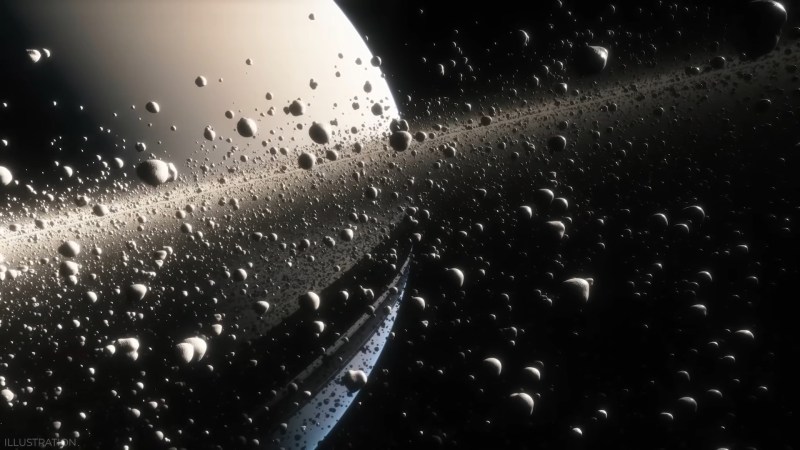
In ecology, there used to be a concept — now largely unfashionable — that species could be described as r- or K-selected, depending on how they treat their offspring. An elephant that has one calf every few years and devotes immense resources to them is adopting a K-selection strategy — much as NASA traditionally has to its flagship probes, like Cassini. A sea turtle who leaves hundreds of eggs in a clutch on the beach and leaves without saying “good luck”, content in the knowledge that one of them will probably make it to adulthood is engaging in an r-selected strategy, and it’s this strategy that [Dr. Michael Rubenstein] is proposing for a next-generation mission to Saturn as part of NASA’s Innovative Advanced Concepts Program for 2026. Entitled “Actively Steerable Femtosat Constellations for In-situ Exploration of Saturn’s Rings, Atmosphere, and Magnetosphere” 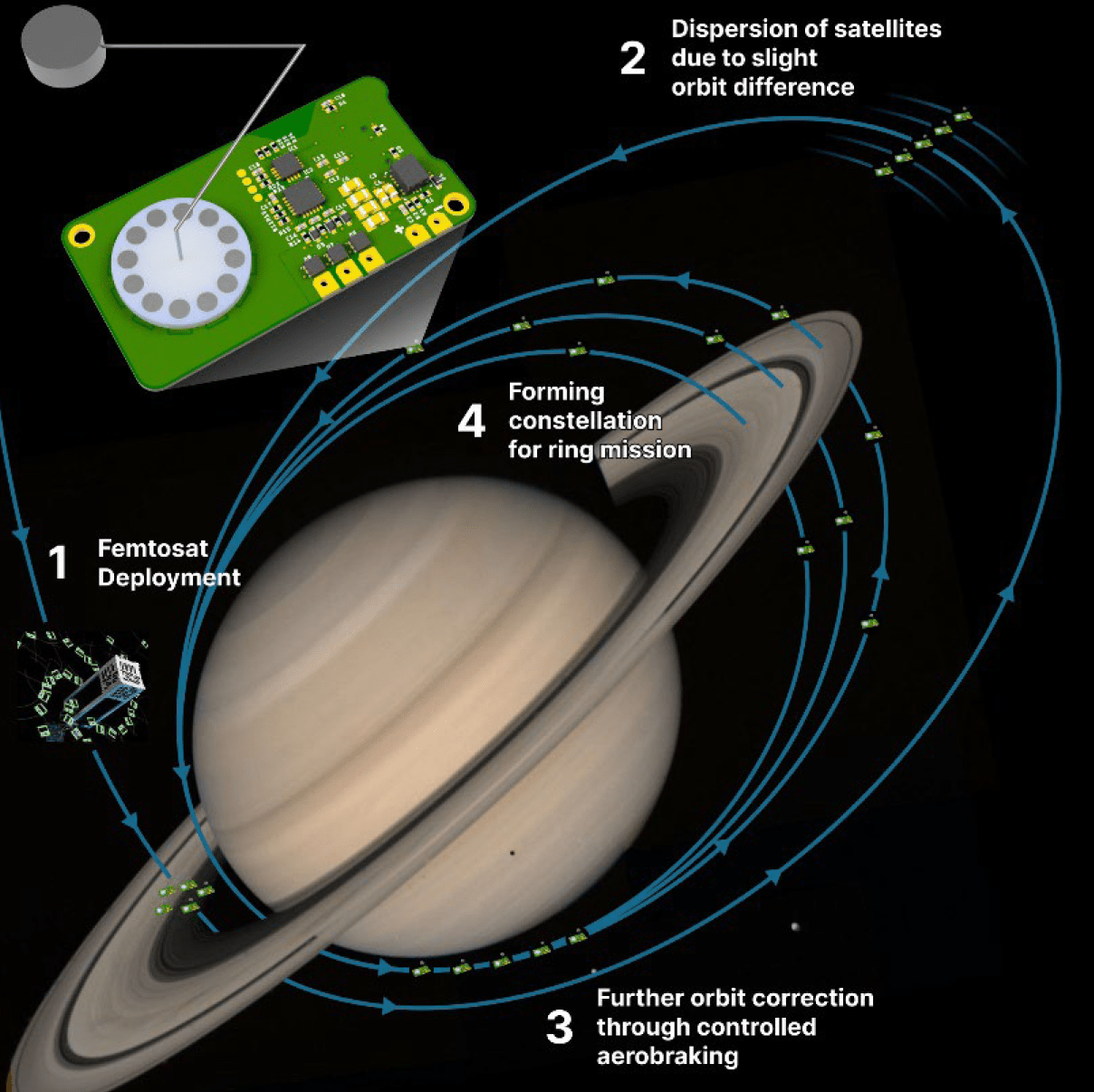
The concept is pretty simple: the rings are a horrifying mess of dust, debris, and ice bits of all sizes that represent almost certain death for a spacecraft. By launching 10,000 femtosatellites, those odds of almost certain death become an almost certainty that one or more will make it through with precious data. In the immortal words of Lord Farquhar, “Some of you may die, but that is a sacrifice I am willing to make.” With Cassini, NASA would never consider such a sacrifice. With itty-bity femtosatellites, it starts to make sense. We’ve been saying for years that the future of space is tiny, but these sacrificial probes would make even modern cubesats and picosatellites look big.
Thanks to [Richard HT] for the tip! His tip was to a podcast featuring [Dr. Rubenstein] with [Fraser Cain], which we’ve embedded below. It has a lot more details than NASA’s official blurb page.








Where, exactly, is the dividing line between exploration and littering?
Space is big. It’ll be okay. Be quiet.
The line is where we live. Ideally we don’t litter, not because of morality or ethics, but because of our livable environment. Dumping radioactive material all around your house is bad. Dumping it far away in space doesn’t really matter. If something unknown lives there, that would be bad. We can be reasonably confident nothing lives in the rings of Saturn but rocks. Everything came from stars in space. Sending it back into space is probably not an issue until we’ve done it so much that we’ve reduced the mass of Earth.
I mostly agree. I would just add that if you dump too much stuff in the space environment studying it today, asking the questions we have today.. then you lose that pristine environment for studying tomorrow with tomorrow’s technology and questions.
But… that would be a LOT of Femtosats!
One of it is useful.
And you’re not going to destroy much in a (temporary) ring of rock debris.
Legally speaking, it becomes littering when the aliens issue you a fine
There really isn’t one, exploration is a messy job.
NASA: Ok the results are in, seems that the rings and the asteroid belt both aren’t asteroids/debris but just litter from some alien race, a race that is years ahead of us.
Correct, the alien race has developed nuclear fusion, AI AGI and full self driving cars. They are precisely two years ahead of us
The Fact that someone like Elon would genuinely say something like that…
That would be the most important discovery in human history
I once suggested this approach to Carolyn Porco in Twitter and she rudely seemed to make fun of the idea. I agree this idea is sound and its time has come. Building $1B probes one-off as treasures isn’t the answer just like servers are commodity and should be used in the 100s or millions to do big tasks reliably and easily (once the parallelization and scaling problems are solved).
NewSpace HLLV haters were rude to her first….the MSFC haters. SLS could put a REAL probe like JIMO out there…interstellar probe—but folks are so used to Delta II sounding rockets littering Mars with bomb-disposal robots that they and cubesat apologists think small and shout down folks like Carolyn.
She needs to be NASA Chief Administrator, not Elon’s fighter jock stooge.
“Lord Farquhar”
I think that should be Lord Farquaad?
Maybe they were speaking historically, rather than in memes? Probably not, but…
Lord Marquardt of the House Hypergolic
Not that guy i think?
Farquhar is a fair-haired boy!
Quantity Over Quality? 🤨
Yeah, sounds totally like current zeitgeist.
Any thoughts about the overhead/burden/resources needed to receive data of the many low-power signals?
“Sometimes quantity has a quality of its own.”
-The Zerg
„Kräht der Hahn früh auf dem Mist, ändert sich das Wetter oder es bleibt wie es ist.“ 🙂
https://en.wikipedia.org/wiki/Farmers%27_lore_jokes
Heheh good old German humor, there’s no substitute for it
Like it says in the Book. There’s plenty of fruit at the vineyard.
Wenn der Knecht vom Stalldach pieselt, mein der Bauer “oh, es nieselt!”.
Wenn der Knecht zum Waldrand hetzt, war das Plumpsklo schon besetzt.
Sind die Hühner platt wie Teller, war der Trecker wieder schneller.
But those cheap, low-end CubeSats in Earth’s LEO aren’t required to be shielded.
They’re stacked Arduino Uno/sensor boards, basically, with some accu pack and some cheap, polycrystaline solar cells glued to the chassis.
I wonder how such naked little PCBs with consumer grade ICs will survive in the strong electromagnetic fields of the gas giants.
I presume they’re meant to be kept in a shielded enclosure until they’re released under the Van Allen belt, which are far above the rings.
Ah, good idea! 🙂👍
“now largely unfashionable”
As opposed to proven wrong. It’s unfashionable because it makes the current batch of biologists uncomfortable.
Also convolutes this story requiring an explanation for a description that’s irrelevant. I’m pretty sure we could have come up with something better than a barely applicable out of date biological comparison for something having nothing to do with biology.
“spray and pray” comes to mind
More like .. Can’tssini amirite
I don’t understand why that environment would be so “dangerous” to satellites. Those rings have been pretty stable for a long time, and that can only be if all the rocks have very similar orbits, and thus relative speeds are very low. Anything that significantly deviates from that will be filtered out pretty quickly. So yes, it’s not the “empty space environment”, but my guess is that hopping from one rock to another would be pretty easy. I do have no idea at all what the “average” rock size in those rings are. Probably a lot of dust, sand and pebble sized stuff so a robust shield to go through that at (guess) 100km/h relative speed will be necessary, as such small things are too hard to avoid. How much time would it take to hop between “interesting objects” at such a low speed. Is that realistic?
Cool! Based on this? https://vanhunteradams.com/Papers/R-selected.pdf