
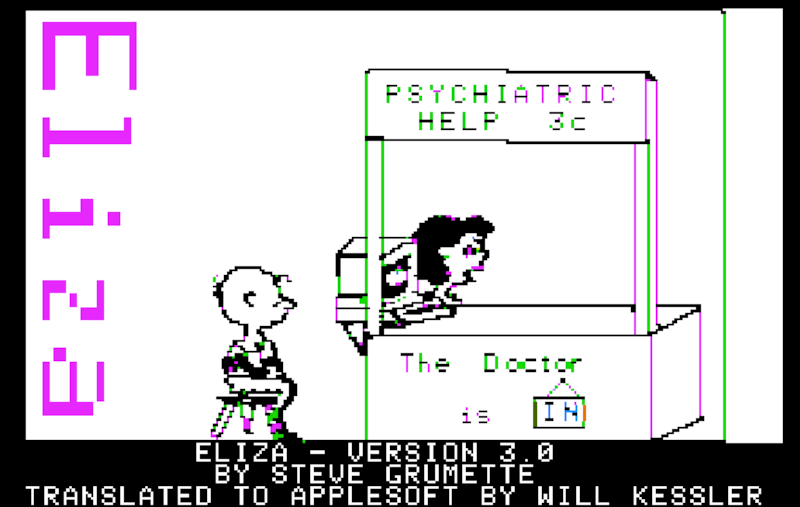
One day, people will look back at what we call Artificial Intelligence and laugh. We do the same thing today, as chat bots totally outstrip what the computer industry called AI up until pretty recently. This didn’t escape curators at the Internet Archive, apparently, and [Jason Scott] tells us about a recent collection, “Vintage Artificial Intelligence.”
These are old software titles that will run for you in emulated machines right in your browser, ranging from somewhere in the 1970s to the 1990s. There’s Eliza, of course. Actually, there are several copies of Eliza. Given how simple it was to write Eliza, it did a pretty good job. Then there are adventure games that are pretty conversational, Lisp, Prolog, which was going to spawn expert systems to replace us all, and Racter, which tried to write fiction.
There was even Alter Ego that was supposed to help you explore life decisions, maybe? There are a couple different versions of even a few versions of Conway’s Game of Life. We aren’t sure that’s ever really been AI, but perhaps it depends on your definition. We’re happy to see Sargon, the chess program, represented.
We didn’t see Hexapawn, which is a shame. We also didn’t see Parry (the paranoid counterpart to Eliza) or that elusive software we remember but can never find that built word chains from text called George.
We’ve written about Eliza before. If you want to experiment with Prolog and you like Pokémon, you’ll appreciate this tutorial.











I still credit Eliza with my (valid) distrust of AI as a useful general purpose response tool.
George is tickling a memory, maybe I used it once upon a time.
It also holds that humans need to provide ‘AI’ with the information it is dispensing. Until the generative intelligence can learn something in the same way as humans it will have a difficult time understanding what humans want. Humans have a model of the world in their head, one where people for example have 5 fingers usually, and base their responses off a (mostly) accurate worldview. Since the AI has no worldview or imagination in the classical sense I remain distrustful of the answers.
Another thing is humans have a motivation to provide correct information to preserve their reputation at the very least, if not a desire to be helpful (not just fed a script of helpful sounding words.)
Eliza was a toy, and I think everyone knew it.
In the 80s on home computers, sure. But decades earlier in the early days, too? 😕
I vaguely remember that Weizenbaum was very crushed by the response of the participants.
He was sure they would see through the masquerade.
Thus, he had lost faith in human judgement and became a critic of artificial intelligence.
Or so I remember, I would have to double check.
Weizenbaum was surprised not by its capabilities, but by people’s reactions to what he knew was a toy.
The era or the type of computer on which software is run does not change its capabilities, or whether it should be regarded as a trivial demonstration.
I also refuse to use modern software because ancient software sucked. I only use hardware now. I built a hardware web browser so I could type this comment on my typewriter. I keep ending up with reams of hardcopy. Kinda sucks, but thems the breaks when you refuse to change your mind after 40 years of progress. The winter months stay pretty warm. I guess that’s an upside.
RE: typewriter v computer. Still waiting (~20 year later) for the AI to deliver me that proverbial $15K average Sam’s car I’ve been asking since late 1990s. Not cheap Tata Nano resold for ten prices, a modern 100% locally made car with all the amenities included, but for the sane price.
Meaning, I don’t see a lot of progress out of THAT AI movement that seem to be permanently mistaken for progress. I am not interested in AI hallucinations, average recreational drug taker can deliver those on the cheap for the price of asking at Kensington st in Philly. I am interested in REAL results, say, permanently stopping the wars of no clear merit, or insourcing all critical factories back to the US of A (ie, reversing decades of NAFTA), or, at least, dethroning (and ideally destroying) all the maaaffiaas in the banking industry.
Orange to apples, typewriters to computers, obviously, computers win. What I don’t see are the tangible results at my bottom of the food chain where they suppose to precipitate by now. Affordable housing maybe? Deflated doctor’s fees that are also advertised up front? Plenty of moving targets to chase.
they’ll laugh because all we have now is a bigger hardware bill and energy expenditure. what we’re doing now is largely the same algorithms as were in use 15 years ago and more, but we’ve thrown billions of dollars of hardware at the problem and given them near infinite resources at the cost of the rest of the economy. Hardware and software are a balanced set and very little of this technology has been done on the software side. When the boomtime spending gets cut back as it always is with boom bust cycles a lot of the ‘amazing’ performance will disappear as well.
the fundamental associational techniques are old, but the way they are chained together is new. and actually using them is super new.
27 years ago a cognitive science researcher contacted me (an undergrad hoping for a summer job) to see if i had any ideas on how to convert a semantic distance dataset — thousands of (word1,word2,distance) triples — into a vector space (like 7 dimensions), where each word would have a position within that space that roughly matched its distance from the other words. i didn’t have any great ideas…it seemed like an enormously expensive problem to approach naively, and resistant to any decomposition techniques i know. from skimming a few recent papers about LLMs, i think this is now considered a solved problem and fundamental to many LLMs. and many of the techniques are much older than that.
but decades ago, the techniques had been invented, and no one was using them, because they were simply too expensive. the research was split between people waiting for computation power to catch up, and people trying to cut the computational complexity by dozens of orders of magnitude. the people waiting for compute seem to have mostly won :) and now that huge compute is plausible, making the algorithm 2x or 100x more efficient is immediately profitable too.
“making the algorithm 2x or 100x more efficient is immediately profitable too.”
For a very narrow meaning of “profitable” that doesn’t include financial profit. As far as I can tell, it’s all a big Ponzi scheme.
Reducing costs while keeping prices the same is absolutely a way to increase financial profit. Either you’re very confused, or you lost me. Cause your logic doesn’t seem to be logicing.
i think your description of the overall business situation is accurate but i have seen some of the published papers from these companies and (some of) the engineers / scientists within them are definitely collecting a paycheck while spending their days thinking up performance improvements.
I feel you on some of your points, but I dunno if you can dismiss it all. I can tell Claude to simply re-create a Gaussian splatting photogrammetry suite that I saw in action and wanted for myself, and it writes it in a few hours, including debugging. That legitimately was not possible very recently. Whether this is good or bad is a different story, but this is a new capability that must be reckoned with.
AI williams ai it again; oh joy.
not like every other website is doing it. no escape for you!
ugh.
I see KGBook (aka facebook) overwhelmed by AI bots. Human moderators now having really tough time countering the AI generated content (which at times is rather good – I’ll give AI hallucinating engines a credit) with any kind of moderation.
I watched them (KGBook moderators) flailing in the mid-to-late 2010s already, and they were steamrolled by rather well-made red propaganda (chinese and russian). Decade later they seem to get both under more-or-less-good control, but not dethroned, both are still widespread on KGBook under gazillion different disguises. If they use AI to counter other AI that’s terrible, at some point they’ll just cooperate an convince humans they don’t have to do anything, it is all taken care of. As if.
Can’t tell if this is meant to be funny or not, but we absolutley 100%ly do all of our writing the human way.
I’ll give you that AL and AI render the same in sans-serif fonts, but that’s honestly the closest we come.
Your pessimism is unfounded. Read more Hackaday.
What’s wrong with putting vias in pads? Done it deliberately a few times. Helps stop pads from lifting off during re-working for one.
That’s some expensive rework insurance! Last I checked via in pad caused a $5 board to cost $300. Has the cost gone down?
Ah, like the infamous the farmer’s daughter on C64 or softprn adventure, but with more -um- direct character interaction? ;)
Also, being living in 21st century, an “ai boyfriend” might also be appealing to some. :)
PS: Text-adventures are also know as interactive fiction (IF).
Such as A Mind Forever Voyaging, The Mist or Planetfall.
Infocom was a big publisher back in the 80s. Mindscape also was relevant.
These text-adventures basically were digital versions of “choose your own adventure” books.
Text-adventures also exist as “interactive fiction with graphics”.
They mainly had a text parser, but also optional graphical illustrations and an optional graphical interface (they could be disabled):
The Legend Entertainment games of the 90s come to my mind right now.
In esrly to mid-80s, there were classics such as Fahrenheit 451, Dragonworld or Rendezvous with Rama (Trillium games).
Or Mickey’s Space Adventure, which used a simpler text interface aimed at kids.
A sub genre were interactive comics, maybe, such as Spider-Man (1984).
Or Lane Mastodon vs. the Blubbermen (an so-called Infocomic).
More info:
https://www.mobygames.com/game/1870/spider-man/
https://retro365.blog/2021/05/13/bits-from-my-personal-collection-infocomics-different-times-calls-for-different-measures/
In Japan, there was a then-new genre derived from western graphics adventures: Visual novels.
They were controlled not in full sentences or by key words (N, GO NORTH, TAKE LAMP, TAKE THE LAMP),
but by using pre-defined commands to choose from.: Like 0=Take, 1=Exit, 2=Ask etc.
Examples are Snatchers on PC-88/MSX or Sega CD, “JESUS: Kyoufu no Bio Monster” on Famicom/MSX/PC-88/FM-7 etc.
An English analogous with a similar interface might been the DOS shareware game The Last Half of Darkness”
It used function keys (F1, F2, F3..) for the commands.
Later Japanese visual novels (VNs) then used a mouse-driven menu system.
Such as Season of the Sakura, which was made available in western hemisphere by JAST USA.
It was sort of popular in the 90s for being available in English and of decent quality.
It also had positive reviews on early homepages on the world wide web, I think.
The last stage of adventures were point&click adventures, maybe.
Such as Flight of the Amazon Queen, Loom, Sam&Max or Beneath A Steel Sky in early 90s.
Some visual novels and later graphics adventures were updated to use a GUI.
The later Sierra On-Line games used a combination of text input and graphics interfaces before switching focus on GUI input.
Such as Space Quest 3, which used the older SCI0 engine.
Myst and similar titles then abandoned text input altogether.
That’s just a short and simplified summary, of course. There’s much more.
And Eliza and text-adventures share an more or less intelligent text parser, maybe.
So it might be interesting to have a look at them and the engines they were built upon. :)
How long until there’s an LLM dungeon master?
A few years ago. All you have to do is input the prompt.
I guarantee you that somewhere somebody has a DnD campaign where not only the dungeon master but all the players are LLMs running on their own in a box, and the human is just mining it for storyline and worldbuilding, or whatever other perverse reason for doing such a thing.
Hi, it’s not directly related but there was a screen saver with a virtual world that users could interact with via text parser.
The user could watch the characters doing their business and talk to them.
It’s called “The Chronicles of Jaruu Tenk” (Win9x/2k/XP).
I remember a book titled something like “Natural Language Processing Using BASIC” back in the 80s or 90s at my library. I finally bought it when it was sold in their book sale but then lost track of it when I moved. I never got around to entering the listings included till it was to late. Its been awhile since i checked, but it wasn’t on Internet Archive and not listed on any used book sites either.
My future plans was to use it with the Commodore 64 and a speech synthesizer like Covox or one of the others, but, lost opportunity all around
On that 8-bit AI subject, I got OPEN PILANTRA made for the TRS-80 Color Computer.
Sort of a random movie generator, it is supposed to “look” like AI :)
Check it out, it is free, do your own “stories” with it ;)
https://fued.net/open-pilantra/
They will not laugh. They will look at you with pity.
Dr. Sbaitso 4lyfe